|
Getting your Trinity Audio player ready...
|
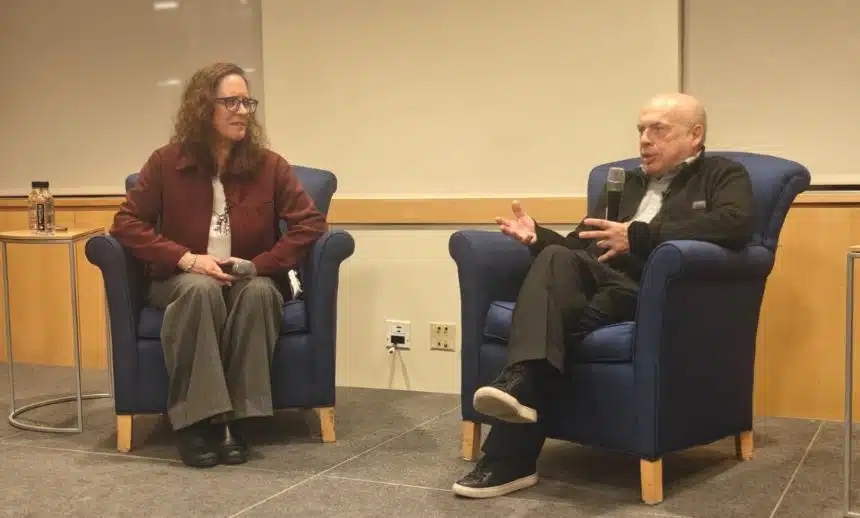
Combat Antisemitism Movement (CAM) Global Advisory Board Chair and former Soviet dissident Natan Sharansky participated in a special forum on Tuesday at Columbia University in New York City, where he shared his life story with students and offered insights into the antisemitism crisis plaguing American college campuses today.
The forum — held under the banner of “Denial of Individual Liberty: Personal Reflections and Lessons Learned Living Under Communist Rule” — took place at the Kraft Center for Jewish Life and was co-sponsored by Columbia/Barnard Hillel and the Columbia Institute of Global Politics.
Former U.S. Secretary of the Treasury and former U.S. Ambassador to Israel Jack Lew gave introductory remarks at the event, and the discussion with Sharansky was moderated by CAM President of U.S. Affairs Alyza Lewin.
Sharansky — who became a global human rights icon during his nine years of incarceration in Soviet prison for his Zionist activities as a young man (he immigrated to Israel immediately upon his release in 1986) — began by recounting his youth growing up in the USSR, focusing on the impact Marxist and socialist ideologies had on individual freedoms and antisemitism.
“According to the theory of [Karl] Marx, the world is divided into oppressors and oppressed,” he said. “In the past, it was serfs and masters, and now it was proletarians and capitalists. And to have a revolution and create a ‘society of equals,’ the ‘society of oppressors’ must be destroyed, not changed. The oppressors are always wrong and the oppressed are always right.”
“Soviet ideology was against religion and against nationalism, and they had special problems with Jews,” Sharansky recalled. “Jews had this feeling of solidarity between themselves and Jews tried to stick to their religion and tradition more than some others.”
Sharansky noted he was raised in an assimilated environment. “We didn’t have bar mitzvah, we didn’t have brit milah (circumcision), we didn’t have synagogue, and we didn’t have Hebrew books,” he said. “We had nothing. The only Jewish thing we had was antisemitism, which there was a lot of — on the streets and, mainly, this policy of de facto restrictions on Jews going into public life. You were born with this disease called ‘Jew,’ so you had to learn how to live with it.”
Later in the conversation, Sharansky turned to the rise of antisemitism on American college campuses in recent decades.
“We’ve had enemies and faced antisemitism from the Right and the Left, and Islamists, all of them, but I believe that’s what’s happened at American universities over the past 25 years, everything began with the fact that Jews started being afraid to be free and say what they really think. If I have hope now, it’s that after October 7th, the most awful pogrom in modern history, and all the shock over what’s happened at universities since, it’s that some Jews have stopped being afraid.”
A full video recording of the event will be uploaded here when it becomes available.
What an honor to attend an event hosted by @CombatASemitism in partnership with @cbhillel, welcoming Natan Sharansky to speak with Jewish students at Columbia. Natan shared his story growing up as a Jew in communist Russia and how it shaped his lifelong fight against oppression… pic.twitter.com/yV6OP3sPHX
— Natalie Sanandaji (@NatSanandaji) February 4, 2026