|
Getting your Trinity Audio player ready...
|
British groups Massive Attack and Primal Scream have joined “No Music for Genocide,” a campaign urging artists to block access to their music in Israel.
The initiative, modeled on earlier boycott movements, claims support from more than 400 artists and labels. It also explains how to geo-block songs so they cannot be played in Israel.
Massive Attack said they had asked their label to remove all their tracks from Spotify. The band pointed to CEO Daniel Ek’s investment in Helsing, a European defense company that develops AI and drone systems. “The hard-earned money of fans and the creative endeavors of musicians funds lethal, dystopian technologies,” the group said.
Spotify insisted it operates separately from Helsing and “has no involvement in Gaza.” In addition, Helsing stated that its systems serve only European countries to counter Russian aggression in Ukraine.
Other groups signing on include the Irish rap group Kneecap. The band is known for anti-Israel rhetoric. During a performance at Glastonbury Festival, they joined chants of “Death to the IDF.” Moreover, one member currently faces terror-related charges in the UK for alleged support of Hezbollah.
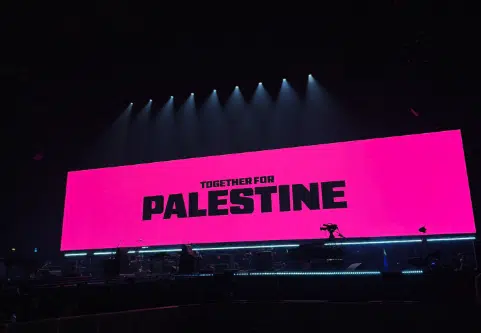
“Together for Palestine” Concert in London
The boycott campaign coincided with Together for Palestine, a sold-out London concert that drew 12,500 people to Wembley Arena. Organized by musician Brian Eno, the event featured musicians and celebrities. Tickets cost around £70 each, and proceeds went through the British charity Choose Love to Palestinian-led groups in Gaza.
Addressing the crowd, U.N. Special Rapporteur Francesca Albanese — notorious for her long record of antisemitic incitement — declared, “The genocide in Gaza is a defining moment.”
The accusation of genocide is especially grotesque. The term was coined after the Holocaust to describe the systematic annihilation of the Jewish people. To use it now against the world’s only Jewish state twists history and fuels modern blood libels. Furthermore, this is antisemitism, plain and simple, according to the IHRA Working Definition of Antisemitism, which includes “drawing comparisons of contemporary Israeli policy to that of the Nazis.”
Former French soccer player Eric Cantona demanded that Israel be barred from the next World Cup. “I played for France and Manchester United. I know that international football is more than just sport, it is culture, it is political, it is soft power,” he said, according to the Daily Mail. “In a way that a country represents itself on a global stage, the time has come to suspend Israel from that privilege.”
A Cultural Campaign with Global Reach
By presenting Israel’s defensive war as “genocide” while ignoring Hamas’ October 7th atrocities, the concert promoted a one-sided narrative. The Hamas-led terror attack murdered 1,200 Israelis and saw 251 hostages dragged into Gaza — yet that context went unmentioned. Instead, thousands in London heard blatantly false claims of “systematic starvation,” “genocide” and calls to strip Israel of its place in international sport and culture.
By using music and culture to push these narratives, celebrities and organizers single out the Jewish state, help normalize antisemitism, empower Hamas, and conceal the horrific terror that started this war.