
The Combat Antisemitism Movement (CAM) hosted an urgent online briefing on Tuesday examining the the rapidly evolving war with Iran, the Tehran regime’s internal dynamics following the killing of Supreme Leader Ayatollah Ali Khamenei, and the broader regional and global implications of the ongoing conflict.
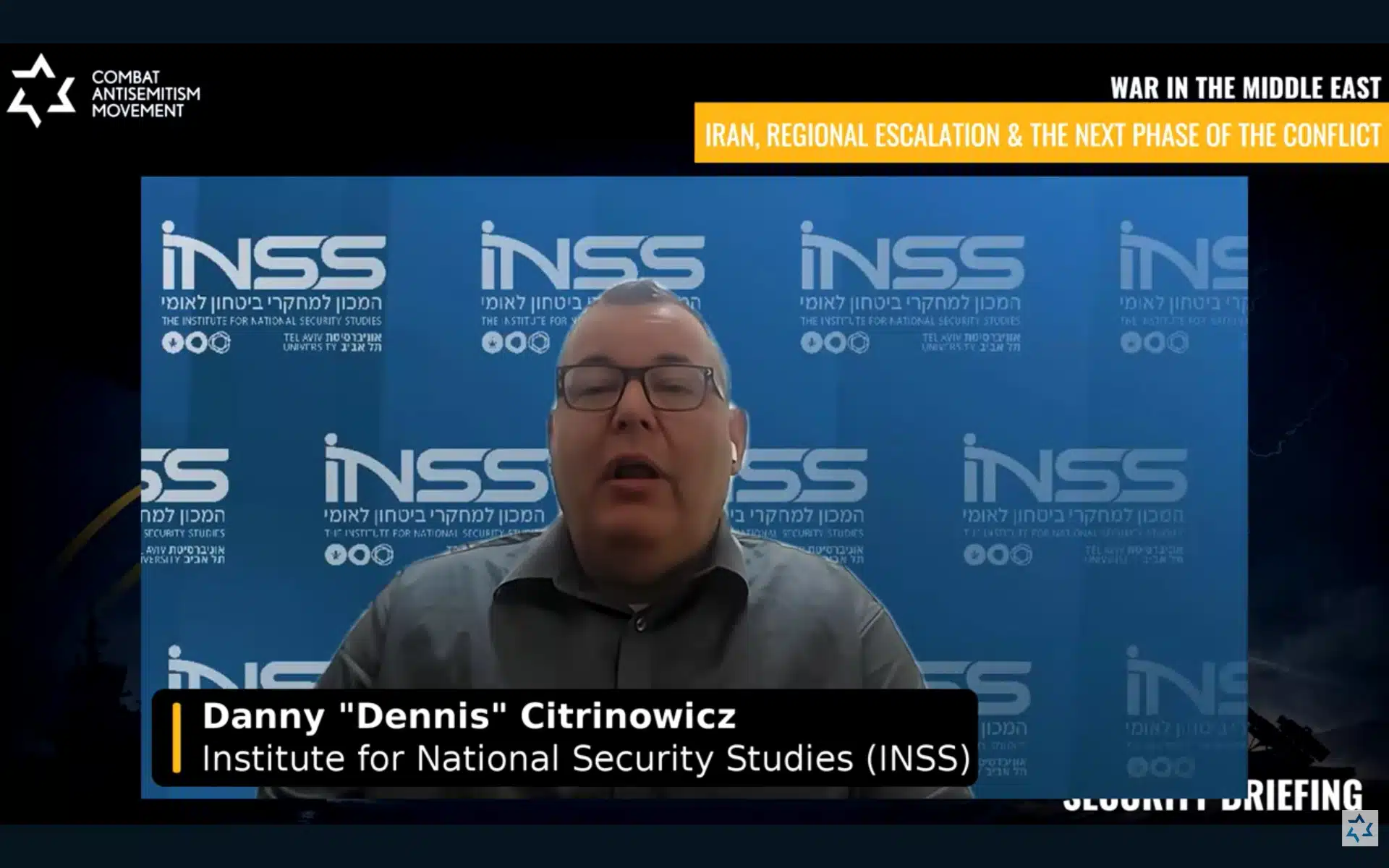
The briefing, titled “War in the Middle East: Iran, Regional Escalation & the Next Phase of the Conflict,” featured Ellie Cohanim, Senior Fellow at the Independent Women’s Forum and former U.S. Deputy Special Envoy to Monitor and Combat Antisemitism, and Danny (Dennis) Citrinowicz, Senior Researcher in the Iran and the Shi’ite Axis Program at the Institute for National Security Studies (INSS) and former head of the Iran branch in the Research and Analysis Division of Israeli Military Intelligence.
The discussion was moderated by CAM Director of European Affairs Shannon Seban.
Watch the full briefing HERE:
In the week following the launch of U.S.-Israeli strikes on Iran on Feb. 28, the Antisemitism Research Center (ARC) recorded a 34% increase in antisemitic incidents worldwide. Of the 154 total incidents monitored by the ARC, 73 — nearly 50% — were motivated by the Iran war, involving perpetrators driven to act by support of the regime or conspiratorial hatred of Jews and Israel.
During Tuesday’s briefing, Citrinowicz analyzed the impact on the Iranian regime of Khamenei’s death and the appointment of his son, Mojtaba Khamenei, as his successor.
“Assuming that he is able to function as supreme leader, at the beginning stages he will probably be more or less like a puppet run by the IRCG (Iran’s Islamic Revolutionary Guard Corps),” Citrinowicz said of Mojtaba Khamenei. “The IRGC pushed for his election. I think the system wanted to show continuity and obligation to the way of [Ali] Khamenei.”
Citrinowicz addressed Iran’s regional strategy and its network of proxy forces often referred to as the “Axis of Resistance,” including groups such as Hezbollah in Lebanon, Shi’ite militias in Iraq, and the Houthis in Yemen.
He also noted, “When we are talking about combating Iranian activity worldwide, we shouldn’t focus only on the Middle East,” highlighting Iran’s global reach as far as Europe, Africa, Latin America, and Australia.
Cohanim described the Islamic Republic as one of the world’s most severe human rights violators, pointing to repression, executions, and the suppression of domestic protest movements. “The greatest victims of the Islamic Republic of Iran are the Iranian people,” Cohanim said.
She further emphasized that dismantling Iran’s nuclear program, ballistic missile capabilities, and support for proxies would significantly reduce the regime’s ability to threaten Israel, the region, and world as a whole.
The security briefing was the second organized by CAM since the outbreak of the Iran war. The first — “War in the Middle East: Khamenei’s Death and the Future of Freedom in Iran” — can be viewed HERE.