|
Getting your Trinity Audio player ready...
|
In a special online briefing hosted by the Combat Antisemitism Movement (CAM) on Monday, experts offered insights on the ongoing war with Iran and the escalation of Hezbollah attacks on Israel’s north.
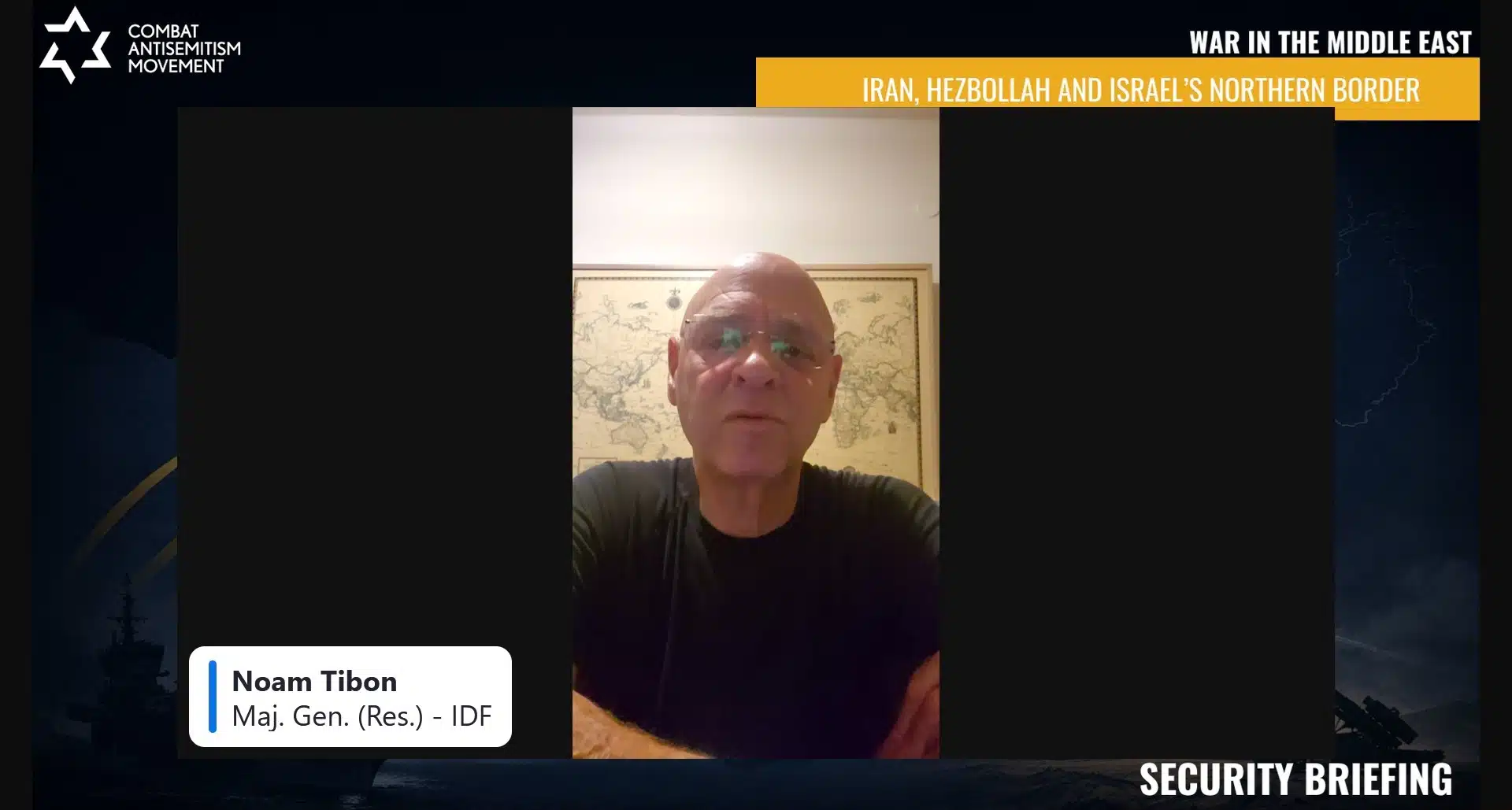
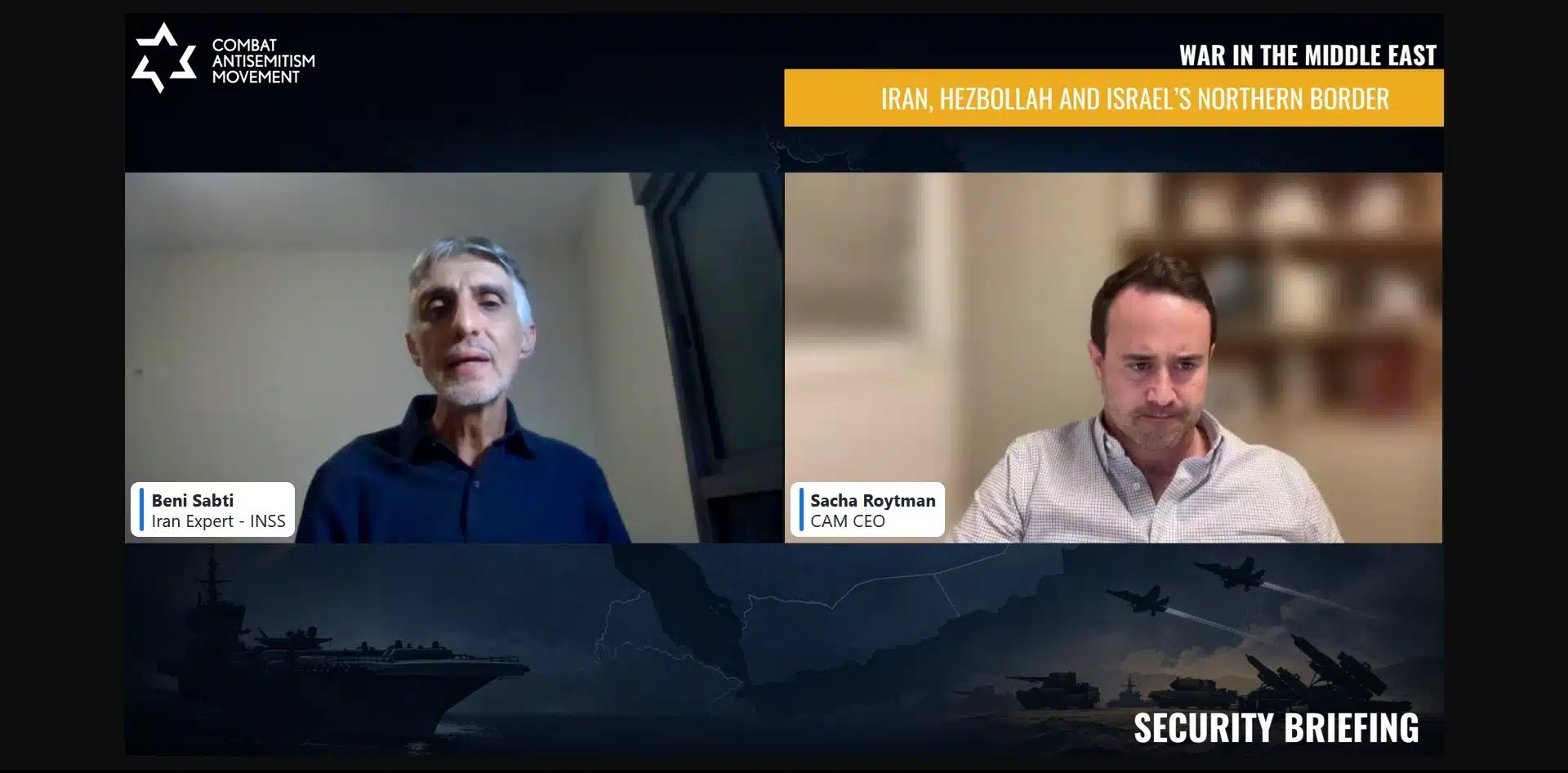
The briefing, titled “Iran, Hezbollah & Israel’s Northern Front,” featured Beni Sabti, an Iran expert at the Institute for National Security Studies (INSS), and Maj. Gen. (Res.) Noam Tibon, who served in the IDF for 35 years and commanded the Northern Formation (Northern Corps), among other senior military roles.
The discussion was moderated by CAM CEO Sacha Roytman.
Watch the full briefing HERE:
The Tehran regime, Sabti pointed out, was “not for its people and not for its country.”
“It’s about surviving — and helping terrorism,” he emphasized.
“According to their own polls, 90% of the Iranian people are against the regime,” Sabti said, but further noted the absence of a unified opposition leadership continued to prevent mass mobilization.
Iran’s Proxy Strategy on Israel’s Borders Faces New Strain as Hezbollah Weakens
Tibon described Hezbollah as Iran’s most significant regional ally. “Hezbollah is the strongest and biggest proxy that was built by Iran… in order to protect Iran,” he said, underscoring that the group had effectively become a “state within a state” in Lebanon with a military force stronger than country’s army.
At the same time, he assessed that Hezbollah was now in one of its most vulnerable positions in years, citing reduced Iranian funding, disrupted supply logistics through Syria after the fall of the Assad regime, and decimated leadership.
Tibon stressed that securing Israel’s borders was both a military necessity and a national principle. “This is the meaning of Zionism — that we are living along the borders,” he said.
He added that the Lebanese army was currently too weak to disarm Hezbollah on its own, and outlined a dual approach for Israel — intensifying military pressure to degrade Hezbollah’s capabilities while establishing a security buffer to protect northern Israeli communities, followed by coordination with the Lebanese government. At its core, he said, Israel’s objective was clear — restore sovereignty and stability along the northern border.
‘I’m Not Leaving Anyone Behind’: Maj. Gen. Tibon’s October 7 Testimony
At the close of the briefing, Tibon shared a firsthand account of October 7th, when he received a message from his son, who lives in Kibbutz Nahal Oz, that terrorists had infiltrated the Gaza border community. Within minutes, he and his wife were on the road from Tel Aviv. As they drove south, what struck him immediately was the absence of any organized response. “We were the only vehicle on the road,” he recalled. “I thought I would meet a lot of forces… and it was strange.”
Along the way, they encountered survivors fleeing the Nova music festival massacre. “They told us terrorists came… they slaughtered everyone,” he said. Tibon and his wife turned back to evacuate them and then continued toward the border. The deeper they drove, the scale of the attack became impossible to ignore. “I was a combat officer all my life,” he said. “I saw bodies. This was part of my profession. But I never saw something like this in my life.” The roads were filled with devastation — “cars upside down, burning… full of bodies.”
At one point, Tibon found himself in the middle of an ambush, taking a rifle from a fallen soldier and returning fire. “I was fighting for my life,” he said. Moments later, he encountered a wounded soldier. “I look at his eyes, and I cannot leave him there to die,” he said. “I’m not leaving anyone behind.”
Tibon’s wife transported wounded soldiers to a hospital as he continued forward.
By early afternoon, Tibon reached the entrance to Nahal Oz with Israeli special forces. Inside, terrorists had already moved house to house. His family remained locked inside their safe room as the attack unfolded just feet away.
“I’m knocking on the door and I say, ‘It’s abba, it’s dad,’” he recalled. From inside, his granddaughter answered: “Saba (grandpa) came.”