|
Getting your Trinity Audio player ready...
|
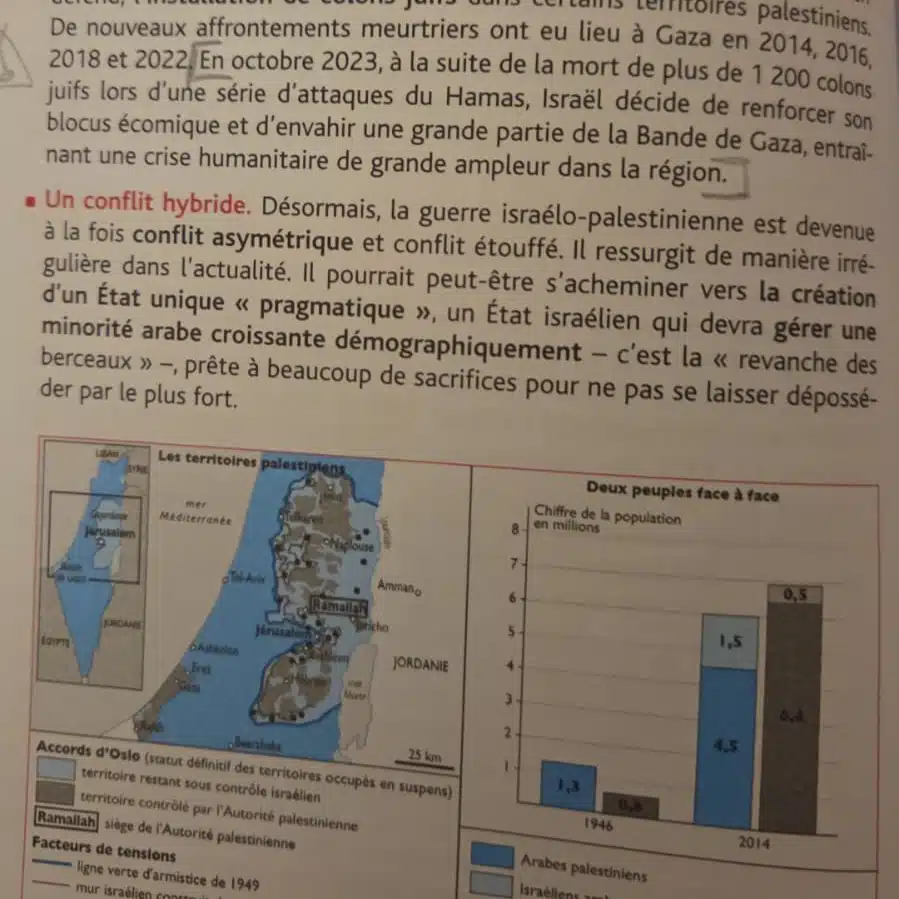
Three textbooks used to prepare high school students for national exams drew scrutiny in France this week over their distorted presentation of the October 7th massacre in Israel.
The study guides — published by Hachette Education — included the following passage: “In October 2023, in response to the deaths of more than 1,200 Jewish settlers in a series of Hamas attacks, Israel decided to strengthen its economic blockade of the Gaza Strip and invade large parts of it, resulting in a large-scale humanitarian crisis in the region.”
The wording in question reverses cause and effect, mislabeling victims as “settlers” and focusing on Israel’s reaction to Hamas’s aggression — while omitting the fact that Hamas, a genocidal antisemitic terrorist organization, deliberately and indiscriminately targeted Israeli civilians.
In a post on X, French President Emmanuel Macron called the textbooks “intolerable,” saying they represented a “falsification of the facts.”
Un manuel de révision du baccalauréat qui falsifie les faits : c’est intolérable. Comme tout relativisme sur les attentats terroristes et antisémites du Hamas du 7 octobre. Le révisionnisme n’a pas sa place en République. J’ai demandé au Gouvernement de prendre des mesures.
— Emmanuel Macron (@EmmanuelMacron) January 14, 2026
Yonathan Arfi — President of the Representative Council of French Jewish Institutions (CRIF) — said the wording amounted to “an unacceptable legitimization of terrorism by Hamas.”
Combat Antisemitism Movement (CAM) Director of European Affairs Shannon Seban called the textbooks a “scandalous rewriting of the largest pogrom against Jews since the Second World War.”
🚨Le Hamas a trouvé des relais jusque chez @HachetteLivre, notamment à travers des ouvrages de révision parascolaire destinés à des élèves de Terminale.
Cette formulation constitue une réécriture scandaleuse du plus grand pogrom de Juifs depuis la Seconde Guerre mondiale. Face à… pic.twitter.com/cV9NzuQBr2
— Shannon Seban (@ShannonSeban) January 14, 2026
Hachette Education Chairman Arnaud Lagardere issued an apology on Wednesday and said the textbooks were being recalled. The publishing company has also launched an internal investigation into the matter.
Education Shapes How History — and the Present — Are Understood
This episode is not only about October 7th. It is about how students are taught history, what facts are emphasized, and whether education fosters critical thinking or ideological distortion.
When educational materials erase context, blur responsibility, or reframe terrorism, they fail to equip students to understand the present or navigate the future. Weak education does not remain neutral — it leaves space for falsehoods and antisemitic narratives to take hold.
“Education must remain the central battleground in the fight against antisemitism,” Seban said.
Seban proposed a three-part plan to prevent similar occurrences in the future —
1. Establish an independent review committee within every publishing house: All publishers must create an independent committee to review school textbooks. Reviews must take place before publication, not after controversy erupts.
2. Create an official mechanism to report problematic content: A clear and accessible system should allow teachers, researchers, parents, and students to flag questionable content. This mechanism must require a mandatory, reasoned response from the publisher within defined time frames.
3. Adopt a national charter for educational publishers: A national charter should commit publishers to shared principles — historical rigor, factual accuracy, and clear terminology — so that everyone is held accountable.
As antisemitism continues to proliferate across the globe, what students learn — and how they are taught to think — will shape whether history is understood or repeated.