|
Getting your Trinity Audio player ready...
|
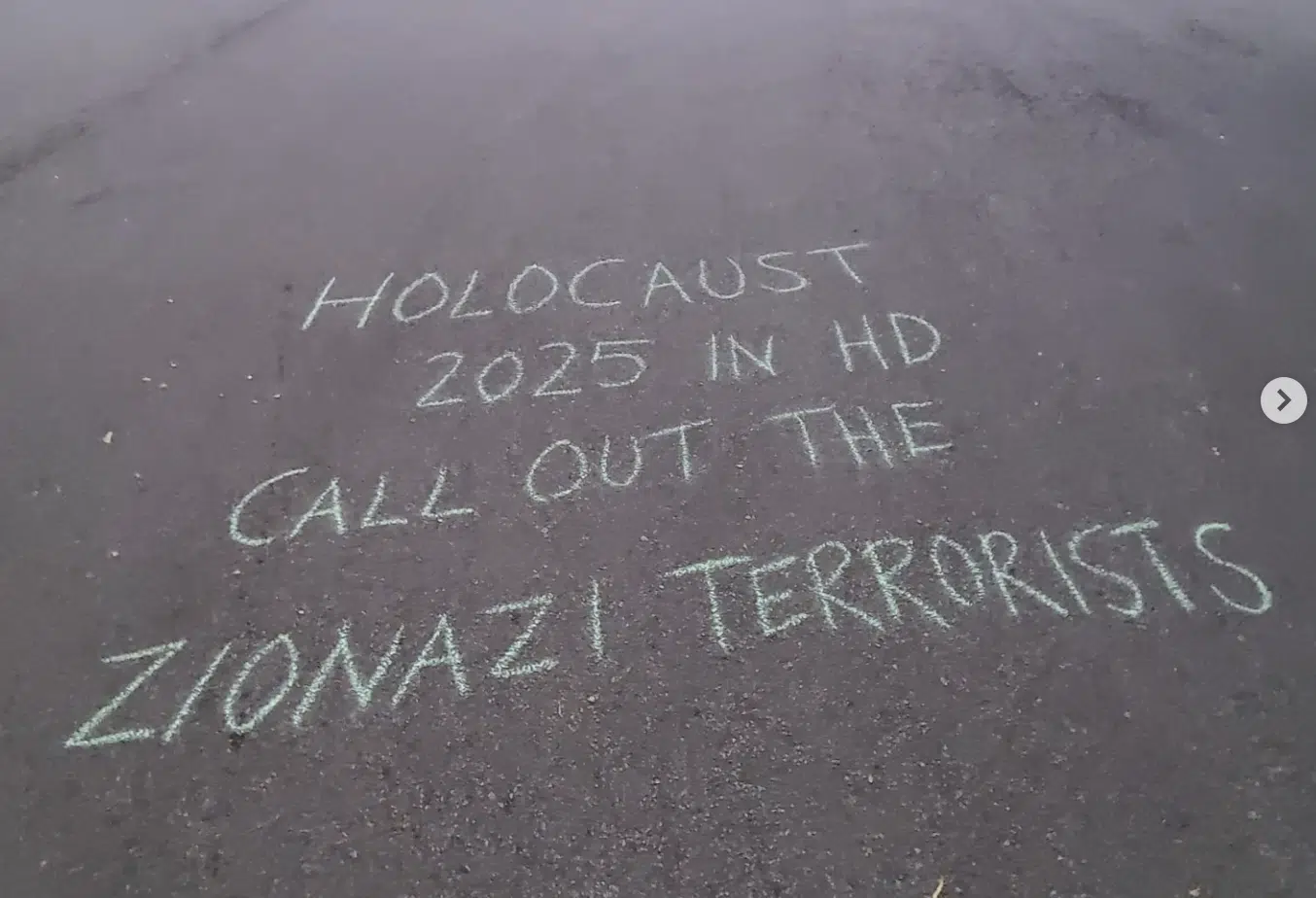
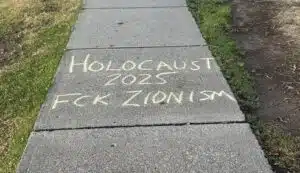
“Holocaust 2025 in HD. Call out the Zionazi terrorists.”
The message appeared on a sidewalk near Douglas Park in Vancouver, British Columbia, several months ago. It was scrubbed away, but within hours, new writing appeared nearby — different wording carrying the same intent. This pattern repeats across the neighborhood. Sidewalks, bus stops, and public fixtures are marked, cleaned, and marked again, often in the same locations. What looks temporary does not behave that way. Repetition keeps the messages in place, turning a removable medium into a constant presence in shared public space.
Terms like “Zionazi” recast Jews as Nazis, turning the Holocaust into a weapon against its victims. Nearby, messages such as “F* Zionism,” “End Israel,” “Stop Israel Cult Now,” and “Death to the IDF” appear in steady rotation, reinforcing the same message across the space.
Steven and Josh, who asked to be identified by their first names, have spent months documenting and removing the messages while organizing neighbors to push back.
“He writes in areas with heavy foot traffic, like bus stops, bike paths, and sidewalks,” Steven said. “Anywhere people will see it.”
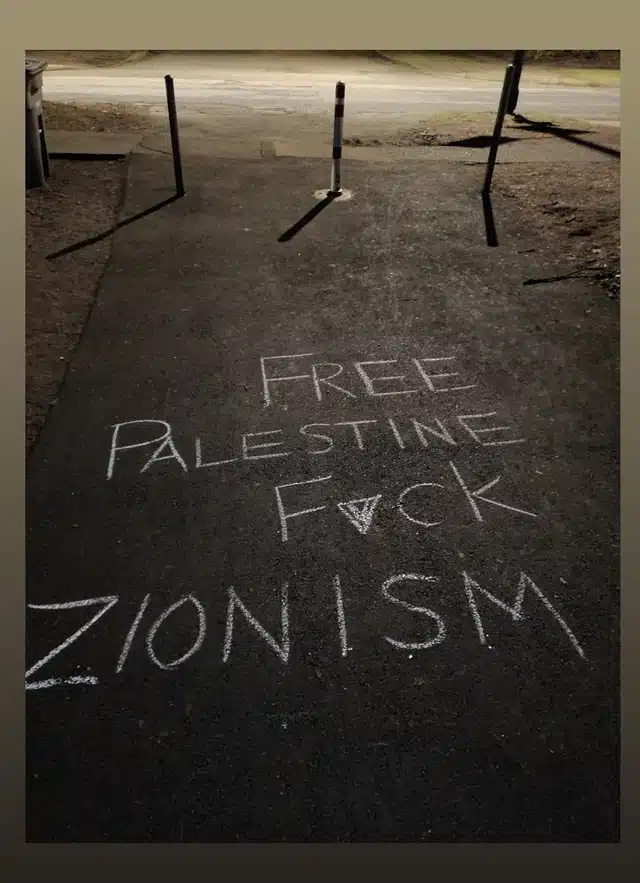
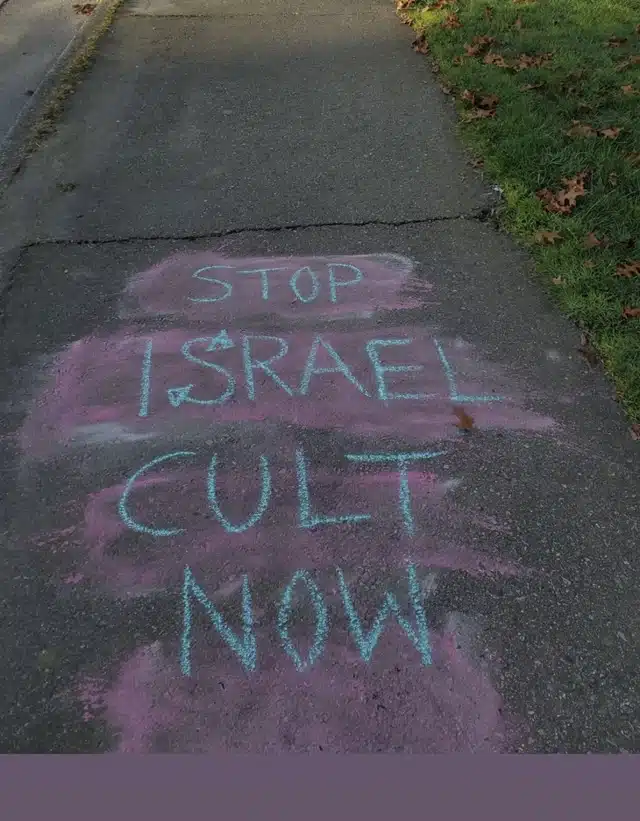
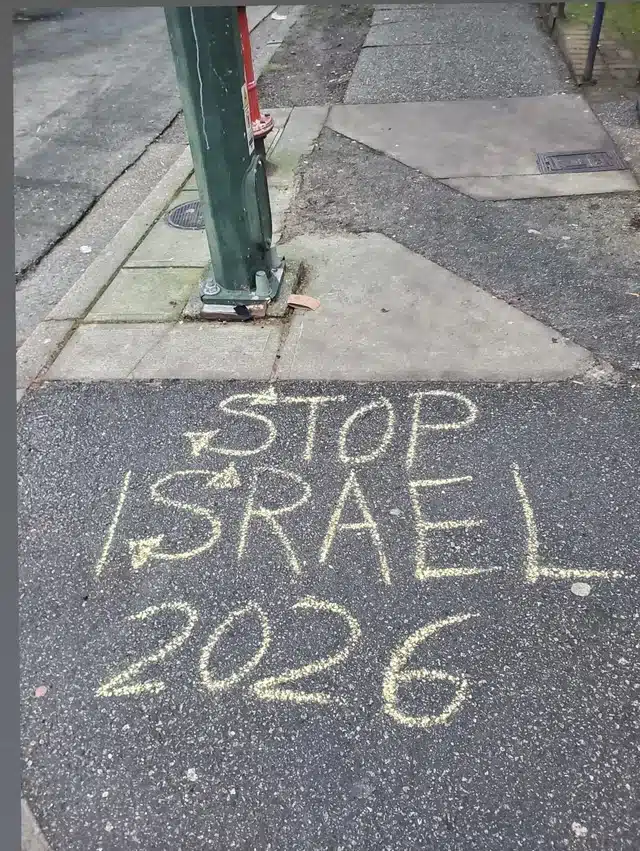
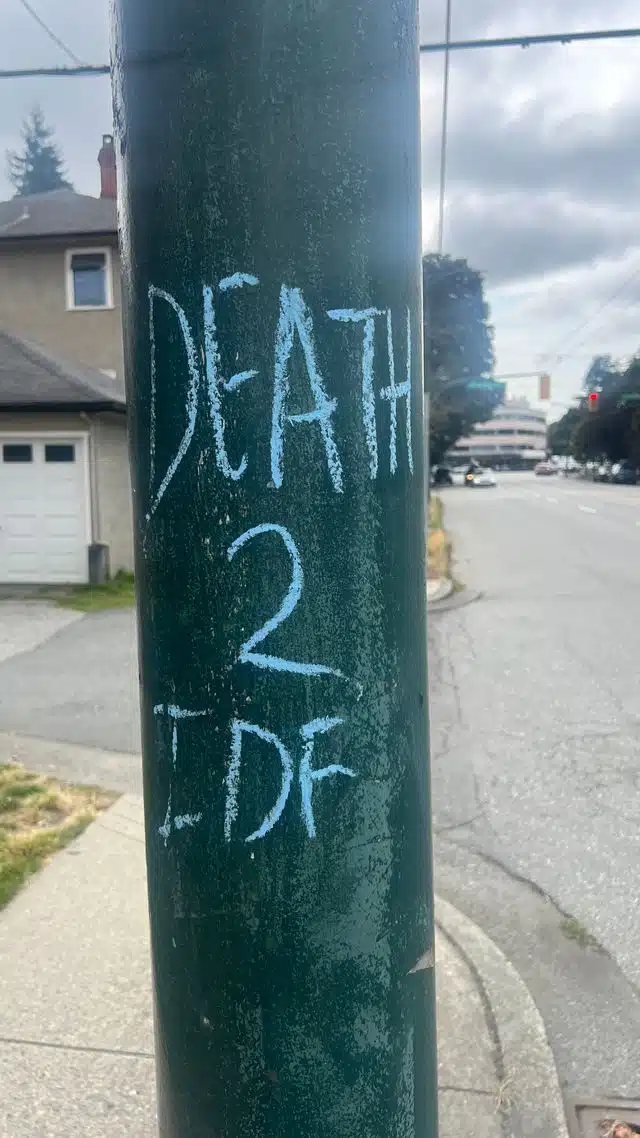
‘Old Wine in a New Bottle’
The pattern began in the aftermath of the October 7th Hamas massacre. Residents say the individual behind it, identified as Jason, first tore down “Bring Them Home” posters calling for the release of hostages held in Gaza. By the summer of 2025, he had become a regular presence at a busy intersection, standing for hours with a Palestinian flag. The chalk messages followed and have continued since.
Because the writing is done in chalk, it falls into a gray area. “Authorities treat it as temporary because it’s chalk,” Josh said. “It washes away, but he comes back and writes the same things in the same places every day. At that point, it becomes essentially omnipresent.”
Rain clears them. Residents scrub them away. Within hours, they reappear, often in the same locations. Over time, repetition fills the space the way permanence otherwise would.
Some of the messaging is framed to appear benign at first glance. Phrases like “Free Palestine” or “Gaza,” sometimes written inside hearts, appear alongside — or in close proximity to — explicit calls for violence and dehumanizing language.
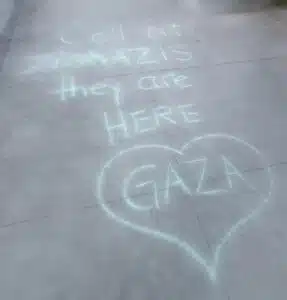
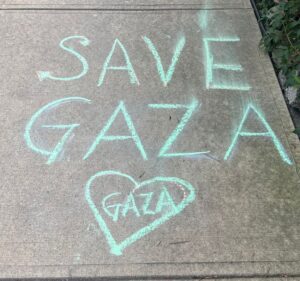
In other cases, permanent marker has been used on signage and public fixtures, leaving marks that do not wash away at all.
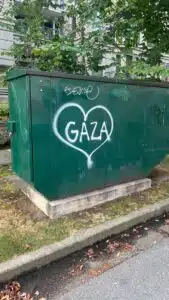
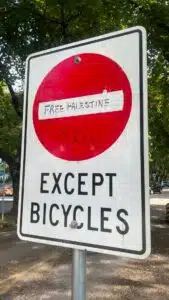
“It’s old wine in a new bottle,” Josh said, describing how antisemitism adapts over time.
Antisemitic and Anti-Western Ideology in Plain Sight
The messaging does not end on the street. It is documented, shared, and reinforced online, where the same claims and language appear across platforms.
On a GoFundMe page tied to his activism, Jason describes his own neighborhood as the “belly of the beast.” The phrase is commonly used in anti-Western ideological frameworks to describe the United States and its allies as a central source of global harm. Here, it is applied locally, casting the US — and, in this case, the neighborhood and its Jewish residents — as part of that target.
The imagery follows the same line. In one post, U.S. President Donald Trump appears wrapped in an Israeli flag, with an inverted red triangle positioned above his head, a symbol widely used by Hamas to mark targets. The image places Israel and the United States within the same frame, linking them as part of a broader system to be opposed.

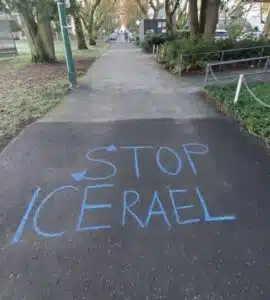
The same logic is applied to institutions. Posts tied to his activity place Israel, the United States, and agencies such as ICE under the same accusation, treating them as part of a single oppressive system.
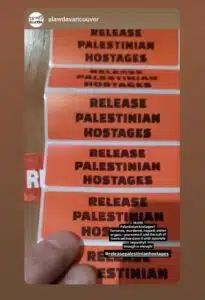
Posts connected to his activity have also been reshared by groups such as Al-Awda Vancouver, extending the reach of messaging that accuses Israel of “torture, murder, rape, [and] organ theft” with “absolute impunity.” The language is current, but the accusation is not. Claims of Jews harvesting organs echo centuries-old blood libels, repackaged in modern political language.
From Public Messaging to Direct Targeting
What began as public messaging gradually moved into personal targeting. Jason first wrote “Free Palestine from Joshua the Zionazi” at Josh’s bus stop. Soon after, posts about him began appearing online, initially under an alias and with his name misspelled. That changed as the campaign escalated. His full legal name was published alongside the accusation that he was an “IOF soldier,” based on his wearing of “Bring Them Home” dog tags. Flyers repeating the claim were later distributed throughout the neighborhood.
In one encounter, a neighbor filmed him and said, “We know where you live, Josh,” prompting him to remove his name from his building directory.
“I think I know what he is and isn’t capable of,” Josh said. “He is smart enough to understand the laws around graffiti and intentionally operates in a ‘free speech’ gray zone. It’s the followers in his network who are a bigger concern — who knows what they are capable of.”
Enforcement Falls Short
Josh and Steven have reported the activity, documented it extensively, and repeatedly removed the messages. “It can take 20 liters of water just to clean one area,” Josh said.
Despite this, the response has remained limited. “They’re looking at the medium, not the content,” he said. Chalk is treated as temporary, but its repeated use produces a sustained effect.
“Who are these messages actually for?” Josh asked. “Are they helping people in Gaza? No. They are intended to intimidate the Jewish community here in Vancouver.”
The messaging appears in high-visibility locations and returns often enough to remain constant without triggering enforcement thresholds. That is why it persists — not because it cannot be removed, but because removal alone does not stop it. “The attention — positive or negative — doesn’t disrupt it,” Josh said. “It reinforces it. The only thing that will stop it is real consequences.”
Take Action
CAM has launched Report It — a secure app to report antisemitic incidents anonymously and in real time. Don’t stay silent — download it today on the Apple Store or Google Play. See it. Report it. Stop it. Together, we can fight this hate.