|
Getting your Trinity Audio player ready...
|
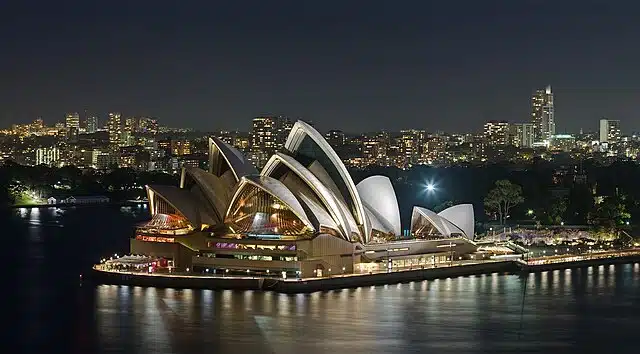
Australia’s largest contemporary art festival has opened amid controversy after exhibits and official materials accused Israel of committing genocide in Gaza.
The Biennale of Sydney receives funding from the Australian federal government and the state of New South Wales. The festival opened after months of warnings from Jewish leaders and philanthropists. They cautioned that the event could become a platform for antisemitic narratives.
Several exhibits and descriptions on the festival’s website refer to what they call “the genocide in Gaza” and “the genocide in Palestine.” Critics say presenting such claims as fact at a publicly-funded cultural institution risks legitimizing allegations of genocide — the gravest crime in international law.
Meanwhile, the controversy intensified after the appointment of Hoor Al-Qasimi as the festival’s creative director. Al-Qasimi is the daughter of the ruler of Sharjah in the United Arab Emirates. In past social media posts, she accused Israel of genocide. She also wrote, “None of us will be free until Palestine is free.” Her father has said that “the Zionist presence in Palestine is a cancerous growth within the heart of the Arab nation.”
The festival’s lineup has also drawn scrutiny. Eighty-three artists and collections from 37 countries are participating in the exhibition. Nearly half are Arab or Muslim artists. However, no Israeli artists were invited to take part. The only Jewish artist included in the program is American artist Michael Rakowitz, who has been openly critical of Israel.
Several participating artists referenced alleged genocide in their work or accompanying descriptions. For example, Turkish artist Aysenur Kara wrote on the Biennale’s official website that her work sought to “platform those facing genocide in Gaza right now.”
When Anti-Israel Rhetoric Crosses Line Into Antisemitism
Concerns about antisemitism connected to the festival surfaced well before the event opened. Last year, former Biennale board member Morry Schwartz confronted organizers about social media activity linked to participating artists. He warned that some artists were no longer targeting Israel alone but Jews more broadly.
“I noticed that two of the artists have ushered in an era in which all pretence has been discarded, and the attacks are now on ‘Jews,’” Schwartz wrote in a letter to the board. As an example, he cited a repost shared by a Biennale artist. The post claimed that “Jewish supremacy is a disease.”
More broadly, the dispute surrounding the Biennale reflects rising tensions within Australia’s cultural sector since the Hamas-led massacre in Israel on October 7. For decades, Jewish-Australian philanthropists have helped fund major arts institutions across the country. Since the attack, however, some have reduced or withdrawn their support. They say the decision follows what they describe as rising antisemitism and expressions of sympathy for Hamas within parts of Australia’s arts establishment.
Against that backdrop, the Biennale of Sydney has become a new flashpoint in the debate over antisemitism, political activism in cultural institutions, and the responsibilities of publicly-funded arts organizations.
Take Action
CAM has launched Report It — a secure app to report antisemitic incidents anonymously and in real time. Don’t stay silent — download it today on the Apple Store or Google Play. See it. Report it. Stop it. Together, we can fight this hate.