|
Getting your Trinity Audio player ready...
|
The New York City Council held a hearing on Wednesday on a proposed package of municipal-level legislative and funding measures to combat antisemitism.
Among its other elements, the five-point action plan, first unveiled by New York City Council Speaker Julie Menin last month, would enable police to set protest-free buffer zones to protect access to and from houses of worship and religious schools.
The need for buffer zones was highlighted by several recent protests at Jewish institutions in New York City, home to the largest Jewish community outside Israel.
In November, protesters shouted “Globalize the Intifada” outside Park East Synagogue in Manhattan, and chants of “We support Hamas” were heard at a demonstration last month in front of a Jewish yeshiva in Queens. In both incidents, Jewish passersby were impeded and harassed.
According to New York City Police Department (NYPD) data, a 182% year-over-year rise in antisemitic incidents was recorded in the city in January.
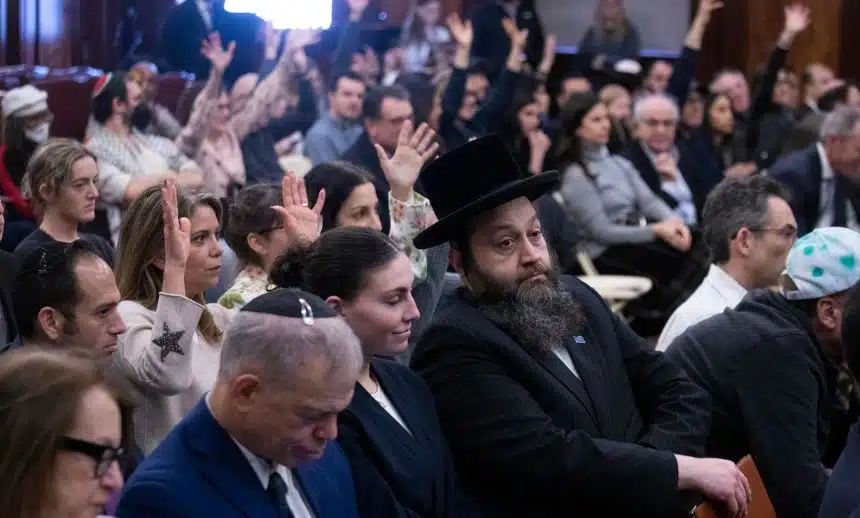
Wednesday’s City Council hearing, lasting ten hours, featured testimony from a broad range of Jewish, Christian, and Muslim supporters of the package, as well as far-left and Islamist voices of opposition.
A full recording of the hearing can be viewed HERE:
🔴 LIVE: Protecting Safe Access to Houses of Worship and Schools https://t.co/aS8TjcPAph
— New York City Council (@NYCCouncil) February 25, 2026
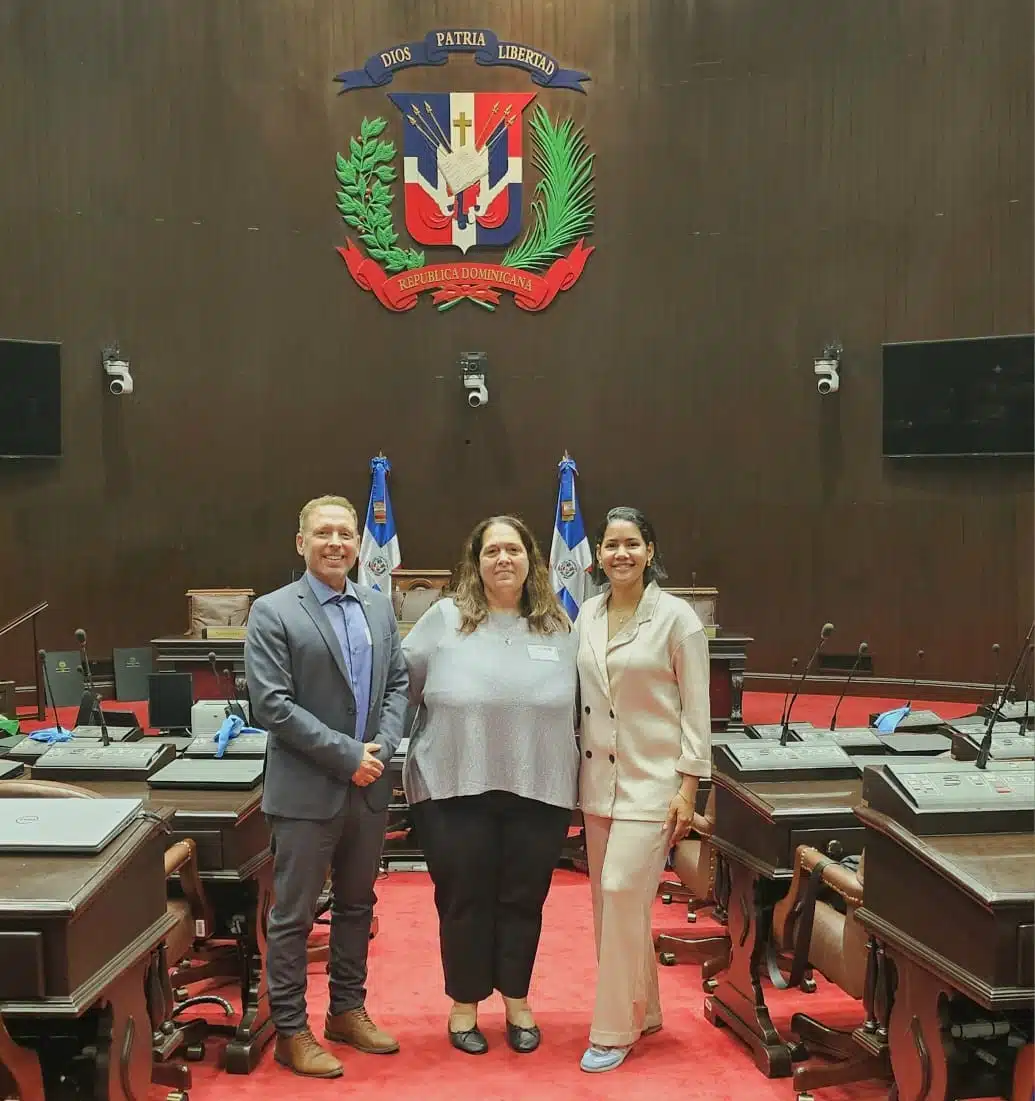
Combat Antisemitism Movement (CAM) Chief Government Affairs Officer Lisa Katz and Public Affairs Officer Natalie Sanandaji both spoke in favor of the measures.
“No one should have to weigh their physical safety against learning or worshiping,” Katz, who leads CAM’s work with North American mayors and is a former town supervisor of New Castle (New York), said. “No parent should have to hesitate at a school door. No elder should have to brace themselves before walking into a house of worship. And when Jewish New Yorkers must calculate risk just to pray, bring a child to school, or report an incident, that is not only a Jewish problem. It is a public safety failure for all New Yorkers.”
“Importantly, while these measures are urgently needed in response to rising antisemitism, they will also strengthen the city’s response to hate in all its forms,” she added. “Stronger systems to prevent and respond to antisemitism also protect New Yorkers targeted because of race, religion, ethnicity, identity, or any other protected characteristic. A city that builds stronger infrastructure to protect one community builds stronger infrastructure to protect all communities.”
Katz further noted the measures would “not silence anyone or prevent lawful assembly.”
“They protect safe access, reduce the risk of intimidation, and strengthen preparedness,” she stated.
Read Katz’s full testimony HERE.
Sanandaji, a Long Island native and survivor of the Nova music festival massacre in Israel, recalled, “I’m one of the few American survivors of October 7th. When I came back to New York City, the place I’ve always called home, I thought I would finally feel safe. I thought I’d be able to breathe again. But instead of relief, I felt tension, like my body was still in survival mode. I came home to angry crowds chanting in our streets, to slogans glorifying the very terrorists who carried out the massacre that I survived.”
“At a time when Jewish New Yorkers are feeling increasingly unsafe, we need concrete solutions to fight this hate,” she emphasized. “In New York, antisemitism is not theoretical. It’s happening in our schools, on our subways, on our campuses, and in our neighborhoods. For me, watching protests that glorify October 7th forces me to relive that day over and over again.”
“New York was supposed to be my safe haven, but it increasingly feels like a place where Jewish trauma is minimized and Jewish fear is dismissed,” Sanandaji said. “We can’t normalize calls for violence. We can’t allow intimidation to become background noise, and we cannot treat antisemitism as just another political disagreement.”
“Combating antisemitism requires leadership,” she concluded. “It requires accountability, and it requires a clear plan.”
Yesterday I testified at New York City Hall in support of a Five-Point Plan to Combat Hate before the New York City Council.
After nearly 7 hours of testimony, much opposing, I’m more certain than ever: the hate is real. That’s why this must pass.
Silence is not an option. pic.twitter.com/3VeftklXDt
— Natalie Sanandaji (@NatSanandaji) February 26, 2026
At City Hall, during debate on a bill to combat hate, opponents:
• Laughed as a mother described her son shot in the head for being Jewish
• Snapped in applause at the mention of Hamas
• Scoffed at the atrocities of October 7
The disrespect is appalling, though not surprising. pic.twitter.com/WXP03a1umn— Natalie Sanandaji (@NatSanandaji) February 25, 2026
To the pro Palestinian protester standing outside City Hall in their kefiyahs, protesting against a bill to protect Jews against antisemitism in NYC: why are you against this bill if you claim antizionism isn’t antisemitism? This bill shouldn’t bother you if that’s what you claim… pic.twitter.com/SaDQqyMW3h
— Natalie Sanandaji (@NatSanandaji) February 25, 2026