|
Getting your Trinity Audio player ready...
|
The Wisconsin Senate Committee on Judiciary and Public Safety held a public hearing on Wednesday where a proposed bill — SB 445 — to adopt the International Holocaust Remembrance Alliance (IHRA) Working Definition of Antisemitism into state statute and use it to evaluate discriminatory intent and enhanced criminal penalties was presented.
The bipartisan measure — sponsored by State Senators Rob Hutton, Rachael Cabral-Guevara, Dianne Hesselbein, Jesse James, Brad Pfaff, Patrick Testin, Jamie Wall, Van Wanggaard, and Bob Wirch — defines antisemitism using the IHRA outline, including its 11 contemporary examples.
A companion State Assembly bill — AB 446, sponsored by Representatives Ron Tusler, Alex Dallman, Barbara Dittrich, Bob Donovan, Jodi Emerson, Rick Gundrum, Nate Gustafson, Dan Knodl, Rob Kreibich, Dave Murphy, Jerry O’Connor, Sylvia Ortiz-Velez, Lisa Subeck, and Chuck Wichgers — was heard by the Committee on State Affairs in October.
“Each state agency and local governmental unit and each employee or official of this state or of a local governmental unit shall consider the definition of antisemitism adopted by the International Holocaust Remembrance Alliance on May 26, 2016, including its examples, when evaluating evidence of discriminatory intent for any law, ordinance, or policy in this state that prohibits discrimination based on race, religion, color, or national origin or that provides for enhanced criminal penalties for criminal offenses when the defendant intentionally selects the victim or group of victims or selects the property that is damaged or otherwise affected by the crime because of the victim’s or group of victims’ actual or perceived race, religion, color, or national origin,” the legislation — the full text of which can be read HERE — says.
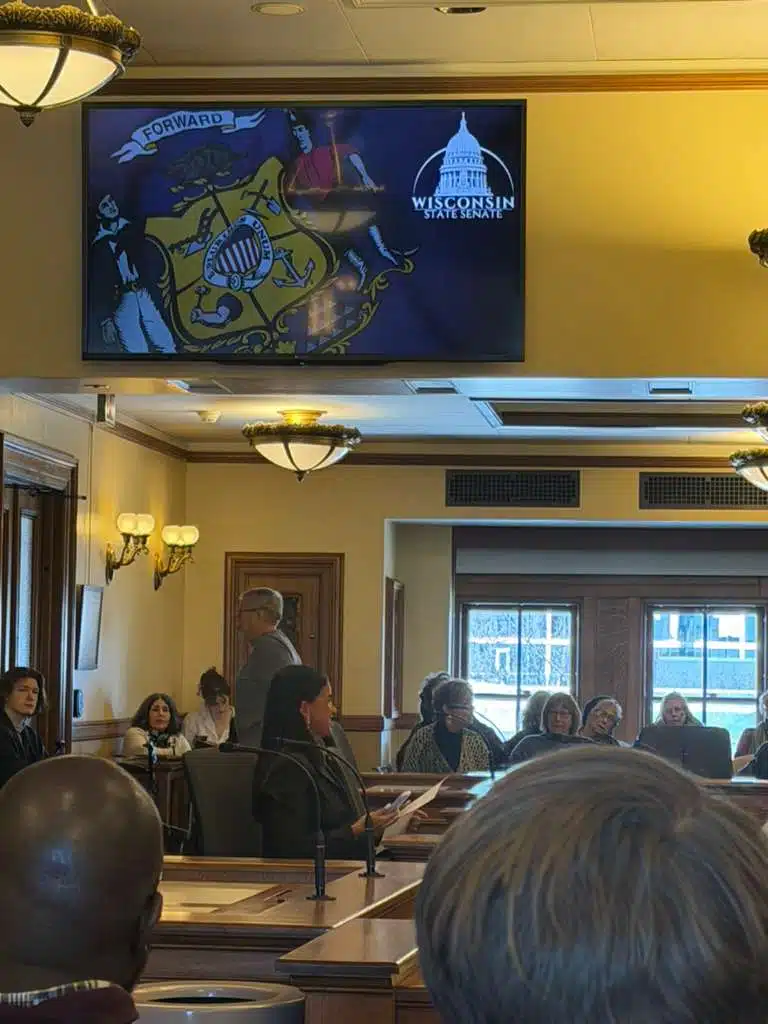
The bill is supported by the Combat Antisemitism Movement (CAM), and CAM Director of State Engagement David Soffer and Public Affairs Officer and October 7th survivor Natalie Sanandaji spoke before the committee at Wednesday’s hearing at the State Capitol in Madison.
“SB 445 will make a difference in combating antisemitism,” Soffer said. “The bill will help identify what is and, importantly, what is not considered antisemitism, and provide state institutions with a guide to understand which actions should be treated as antisemitic-driven activity. The time has come to listen to the vast majority of the Jewish community that is asking you to solve this problem.”
Read Soffer’s full testimony HERE.
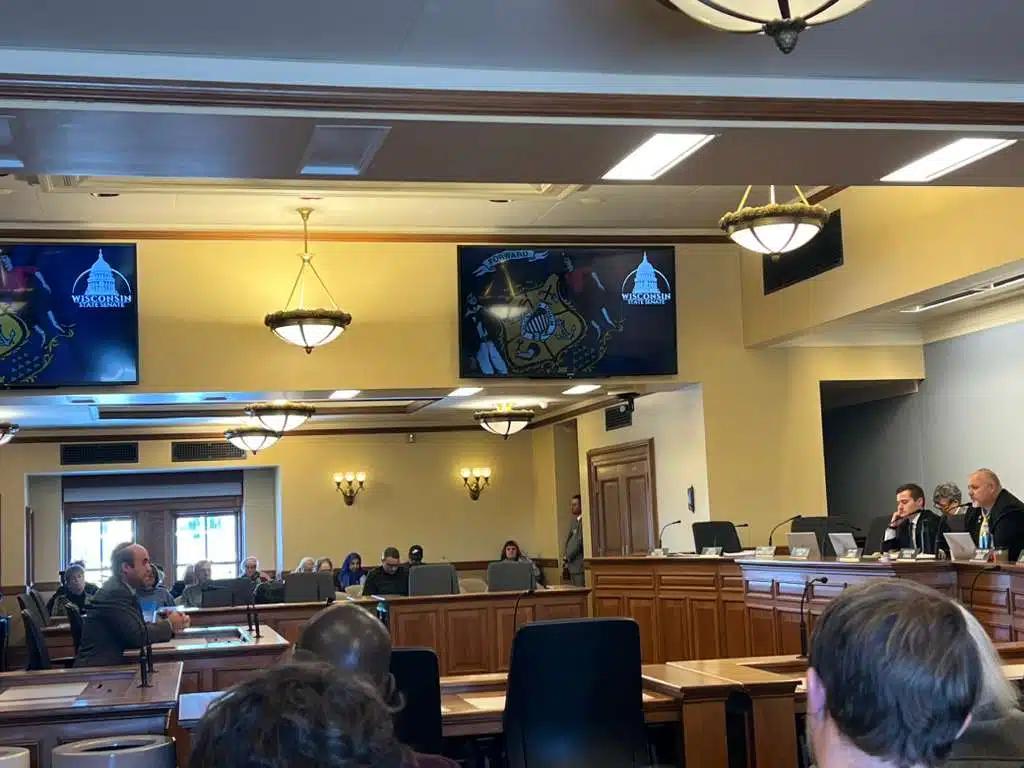
Sanandaji noted, “When people call for October 7th to be repeated, when they seek to ‘globalize the intifada,’ and glorify the people who committed the atrocities on October 7, they are not calling for peace. They are calling for the massacre of more Jews.”
Read Sanandaji’s full testimony HERE.
Written testimony was also submitted by CAM President of U.S. Affairs Alyza Lewin.
“The IHRA definition provides a framework for recognizing contemporary Jew-hatred and distinguishing it from a political debate,” Lewin said. “The definition does not silence, prohibit, or punish speech. It merely labels antisemitism.”
“It’s not antisemitic to criticize the policies of the Israeli government,” she added. “It is, however, antisemitic to demonize, delegitimize or apply a double standard to individual Jews, the Jewish people, or Israel as the Jewish collective. When Jews are targeted on the basis of the Jewish people’s shared ancestry and ethnicity rooted in the Land of Israel, that is also antisemitism.”
“Hate that is not addressed, does not evaporate, it escalates,” Lewin emphasized. “Antisemitic chants evolve into antisemitic violence. If we want to block this progression, we must be able to recognize, call out, and address all forms of contemporary antisemitism.”
Read Lewin’s full testimony HERE.
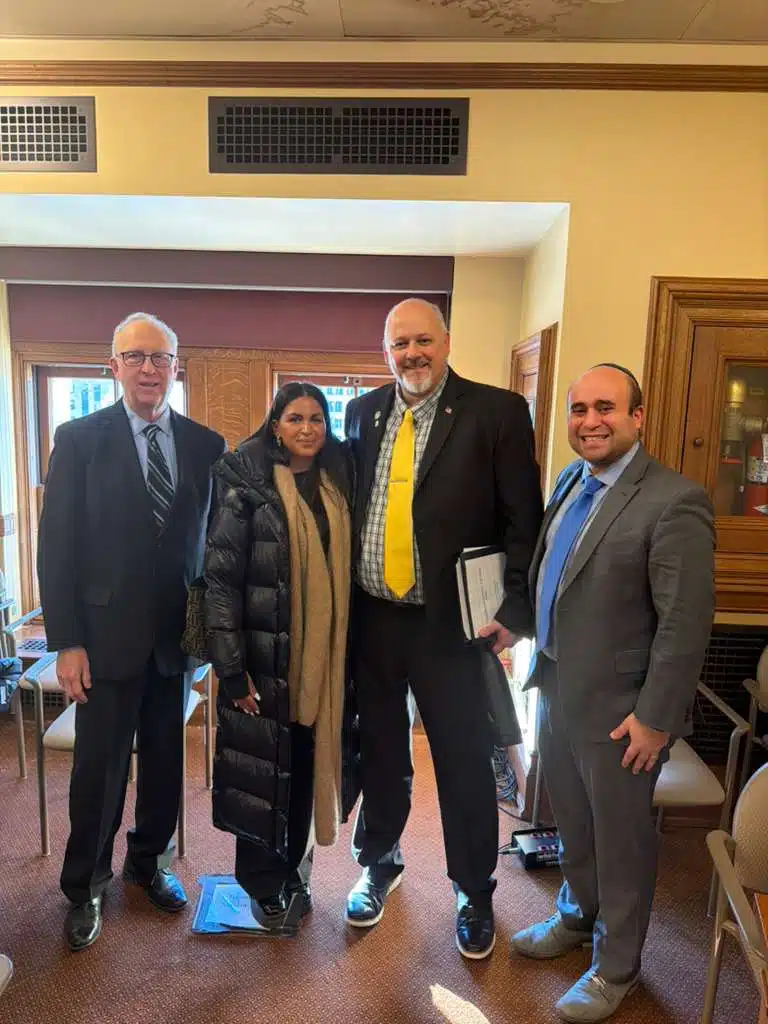
CAM previously participated in a special antisemitism briefing for Wisconsin state lawmakers and staff in November, and Soffer testified at the Committee on State Affairs hearing the previous month.
A total of 37 U.S. states have adopted the IHRA antisemitism definition, according to a database compiled by the Antisemitism Research Center (ARC) by CAM.
Over the past year, CAM has led an organized effort to engage and educate state legislators across the U.S. on antisemitism-related issues and potential policy remedies, such as the Wisconsin bill.
Legislative initiatives have also been put forth in Arkansas, Kansas, Kentucky, Missouri, Nebraska, Nevada, Oklahoma, and Tennessee, and six of these states — Arkansas, Kansas, Kentucky, Nevada, Oklahoma, and Tennessee — have seen new laws enacted since the start of last April.
At the end of June, lawmakers and executive officials from 17 states convened in Kansas City, Missouri, for the first-ever CAM-organized State Leadership Summit on Antisemitism.