|
Getting your Trinity Audio player ready...
|
Antisemitism legislation supported by the Combat Antisemitism Movement (CAM) advanced in three states — Iowa, Wisconsin, and Ohio — on Wednesday, marking progress in a nationwide effort to pass and enact policy remedies addressing rising hatred faced by local Jewish communities.
In Iowa, the House and Senate Education Committees passed HSB 646/SSB 3095 — a measure to require the state’s public K-12 schools, universities, and community colleges to issue annual reports on incidents of antisemitism, codifying an executive order issued by Governor Kim Reynolds last year.
HSB 646/SSB 3095 would “help track antisemitic incidents, create transparency around how institutions investigate antisemitism, and help to assess if any additional actions should occur,” CAM Director of State Engagement David Soffer said.
“I want to extend my gratitude to Governor Kim Reynolds for championing this vital piece of legislation and for her strong leadership on this issue,” Soffer added.
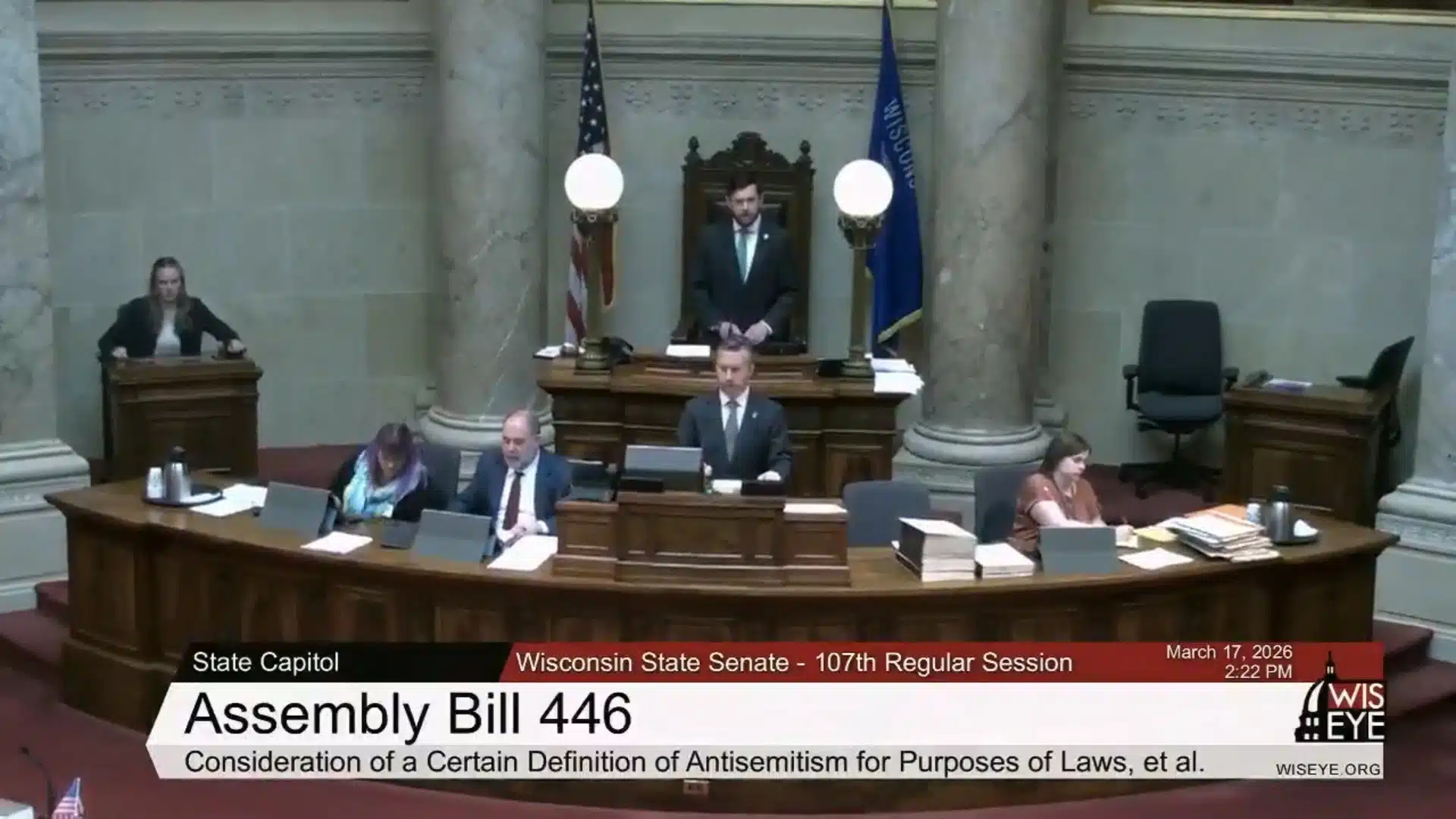
Meanwhile, the Wisconsin Assembly Committee on State Affairs voted 8-2 on Wednesday to approve AB 446, setting it up for a future full floor vote.
The Wisconsin bill would adopt the International Holocaust Remembrance Alliance (IHRA) Working Definition of Antisemitism into state statute and use it to evaluate discriminatory intent and enhanced criminal penalties.
“AB 446 will make a difference in combating antisemitism,” Soffer said at a Committee of State Affairs hearing in October. “The bill will help identify what is and, importantly, what is not considered antisemitism and help provide a guide to state institutions to understand best what actions should be treated as antisemitic-driven activity. The time has come to listen to the vast majority of the Jewish community that is asking you to solve this problem.”
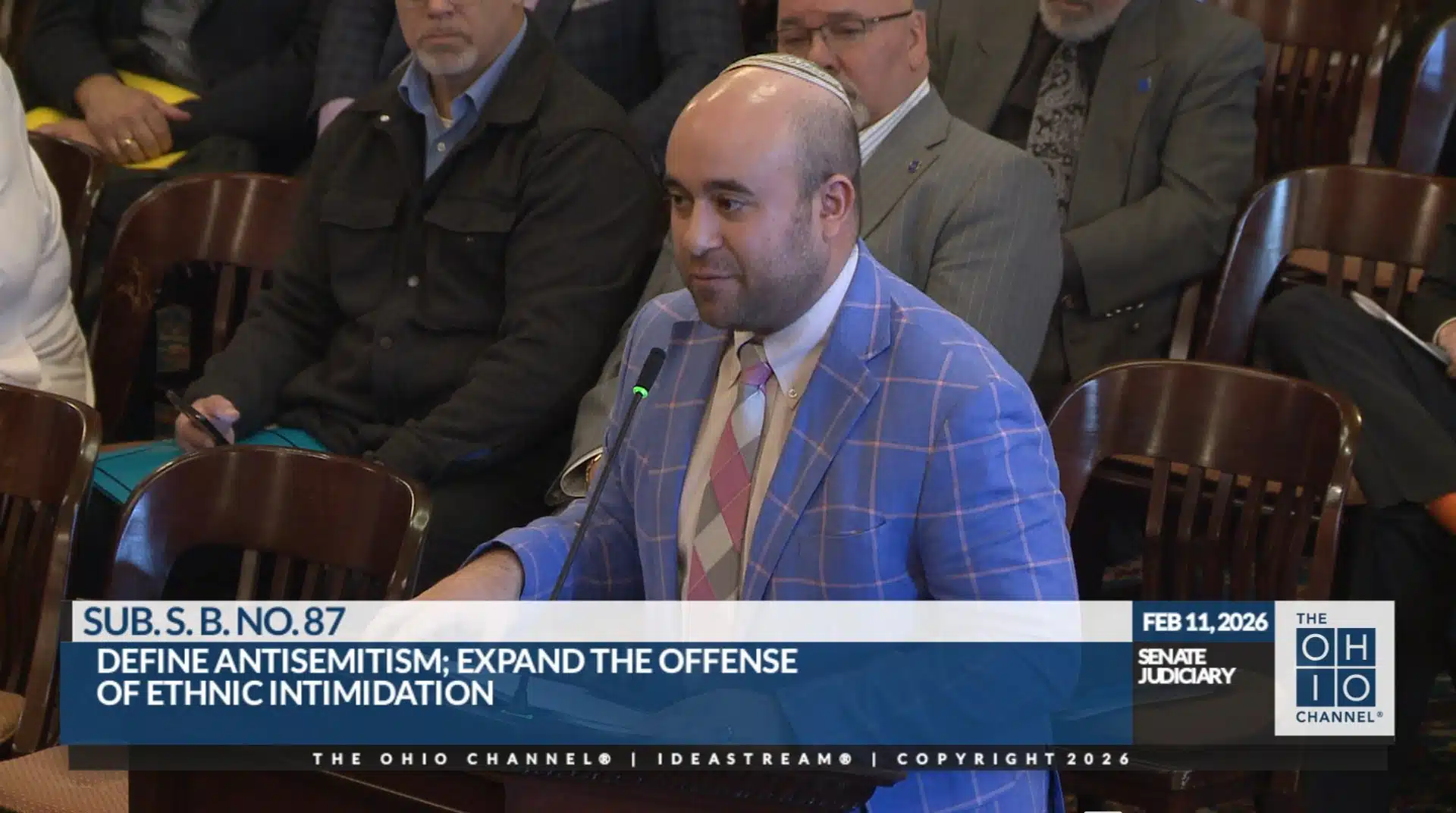
At the Ohio Statehouse in Columbus on Wednesday, Soffer testified at a Senate Judiciary Committee hearing on behalf of SB 87 — a bill to codify the IHRA antisemitism definition into state law.
“How do we combat antisemitism?” Soffer asked. “The first step must be to define what it is you are seeking to combat. SB 87 will help combat antisemitism. By understanding what antisemitism is, state agencies will be able to review whether actions are motivated by antisemitic intent.”
Soffer emphasized the importance of the legislation including the IHRA definition’s 11 examples of contemporary antisemitism, noting, “These examples are critical because they clarify how antisemitism manifests in the modern era. Historically, antisemitism has evolved over time; for thousands of years, the State of Israel did not exist, and antisemitism primarily took the form of religious hatred, bias based on origin, shared ethnic characteristics, and the stereotypes prevalent in earlier periods.”
“To effectively confront antisemitism today, policymakers must understand how it presents in the current generation,” he said. “Contemporary examples operationalize the definition by translating a general concept into a practical, usable framework that can be consistently applied in real-world policy, educational, and enforcement settings. Without these examples, the definition alone is insufficient to guide institutions in accurately identifying and addressing antisemitism.”
Later in the hearing, the committee amended the proposed legislation to add the examples.
Watch the full Ohio Senate Judiciary Committee hearing HERE.
A total of 37 U.S. states have adopted the IHRA antisemitism definition, according to a database compiled by the Antisemitism Research Center (ARC) by CAM.
Over the past year, CAM has led an organized effort to engage and educate state legislators across the U.S. on antisemitism-related issues and potential policy remedies.
Legislative initiatives have also been put forth in Arkansas, Kansas, Kentucky, Missouri, Nebraska, Nevada, Oklahoma, Tennessee, and Wisconsin, and six of these states — Arkansas, Kansas, Kentucky, Nevada, Oklahoma, and Tennessee — have seen new laws enacted since the start of last April.
At the end of June, lawmakers and executive officials from 17 states convened in Kansas City, Missouri, for the first-ever CAM-organized State Leadership Summit on Antisemitism.