|
Getting your Trinity Audio player ready...
|
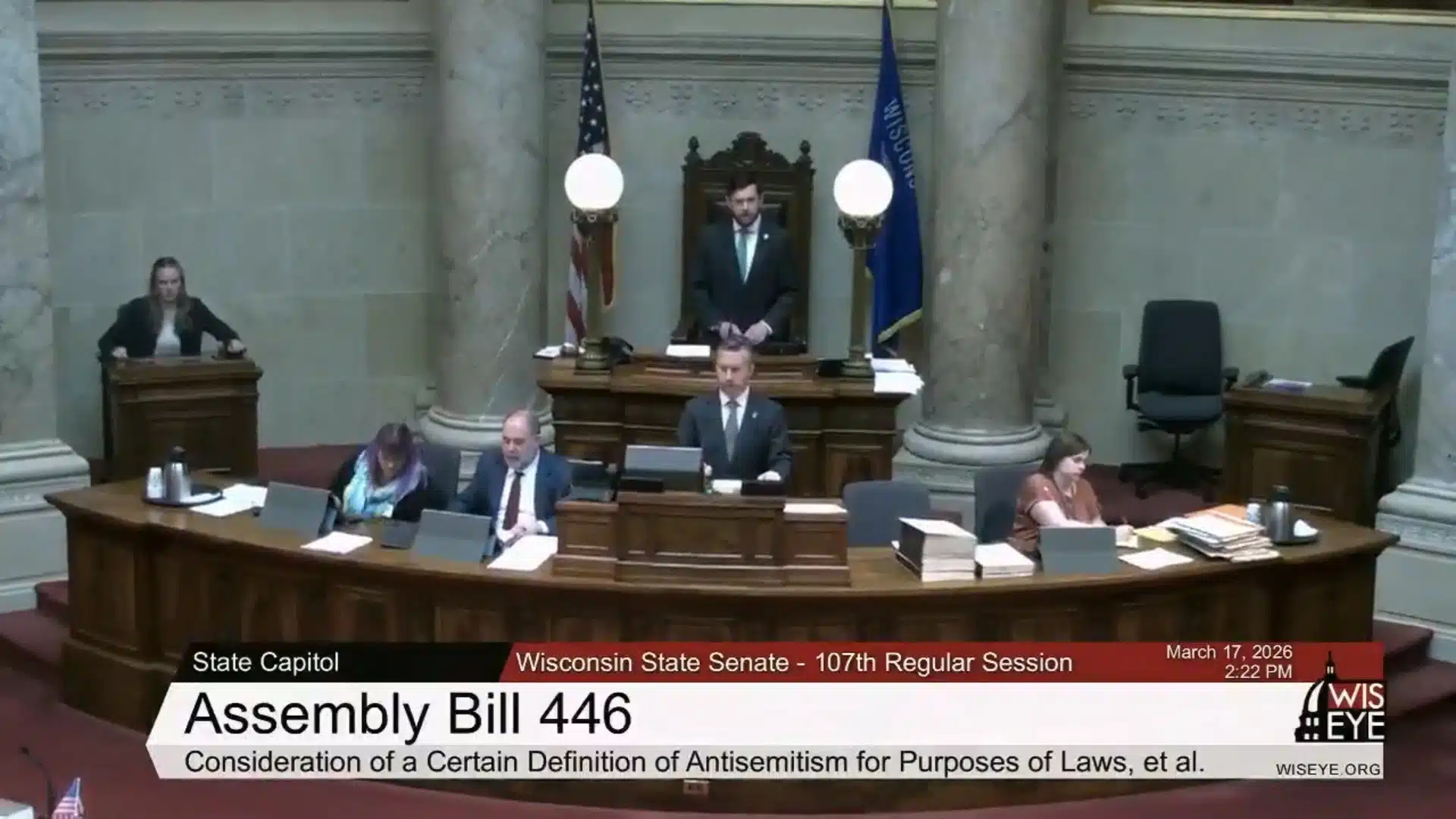
With the recent terrorist attack at a synagogue in neighboring Michigan offering an alarming reminder of the dangers of rising Jew-hatred, the Wisconsin Senate unanimously approved on Tuesday a proposed bill — AB 446 — to adopt the International Holocaust Remembrance Alliance (IHRA) Working Definition of Antisemitism into state statute and use it to evaluate discriminatory intent and enhanced criminal penalties.
The bipartisan measure — sponsored by State Senators Rob Hutton, Rachael Cabral-Guevara, Dianne Hesselbein, Jesse James, Brad Pfaff, Patrick Testin, Jamie Wall, and Van Wanggaard — defines antisemitism based on the IHRA outline, including its 11 contemporary examples.
AB 446 was passed by a 66-33 margin last month in the State Assembly, where it was sponsored by Representatives Ron Tusler, Alex Dallman, Barbara Dittrich, Bob Donovan, Jodi Emerson, Rick Gundrum, Nate Gustafson, Dan Knodl, Rob Kreibich, Dave Murphy, Jerry O’Connor, Sylvia Ortiz-Velez, Lisa Subeck, and Chuck Wichgers.
The legislation now goes to Governor Tony Evers for signature.
“Each state agency and local governmental unit and each employee or official of this state or of a local governmental unit shall consider the definition of antisemitism adopted by the International Holocaust Remembrance Alliance on May 26, 2016, including its examples, when evaluating evidence of discriminatory intent for any law, ordinance, or policy in this state that prohibits discrimination based on race, religion, color, or national origin or that provides for enhanced criminal penalties for criminal offenses when the defendant intentionally selects the victim or group of victims or selects the property that is damaged or otherwise affected by the crime because of the victim’s or group of victims’ actual or perceived race, religion, color, or national origin,” the legislation — the full text of which can be read HERE — says.
Combat Antisemitism Movement (CAM) Director of State Engagement David Soffer — who testified in favor of the legislation at hearings of both the Senate Committee on Judiciary and Public Safety and Assembly Committee on State Affairs — stated on Tuesday, “Today’s vote sends a clear and important message that antisemitism has no place in Wisconsin. By advancing AB 446, lawmakers have equipped state and local institutions with a widely recognized and practical tool to better identify and respond to antisemitic incidents.”
“The IHRA definition helps clarify what constitutes antisemitism and just as importantly what does not,” Soffer emphasized. “In the face of rising antisemitism, the first step is being able to clearly define and recognize it. Wisconsin has joined a growing number of states taking meaningful action to ensure that antisemitism is properly understood and addressed.”
CAM participated in a special antisemitism briefing for Wisconsin state lawmakers and staff at the State Capitol in Madison last November. Speakers at the briefing included CAM President of U.S. Affairs Alyza Lewin and Public Affairs Officer Natalie Sanandaji, in addition to Soffer.
A total of 37 U.S. states have adopted the IHRA antisemitism definition, according to a database compiled by the Antisemitism Research Center (ARC) by CAM.
Over the past year, CAM has prioritized educating state legislators across the U.S. on antisemitism-related issues and potential policy remedies.
In this time, CAM has tracked legislative initiatives put forth in Arkansas, Iowa, Kansas, Kentucky, Missouri, Nebraska, Nevada, Ohio, Oklahoma, and Tennessee, and six of these states — Arkansas, Kansas, Kentucky, Nevada, Oklahoma, and Tennessee — have seen new laws enacted since April 2025.
In June 2025, lawmakers and executive officials from 17 states convened in Kansas City, Missouri, for the first-ever CAM-hosted State Leadership Summit on Antisemitism.