|
Getting your Trinity Audio player ready...
|
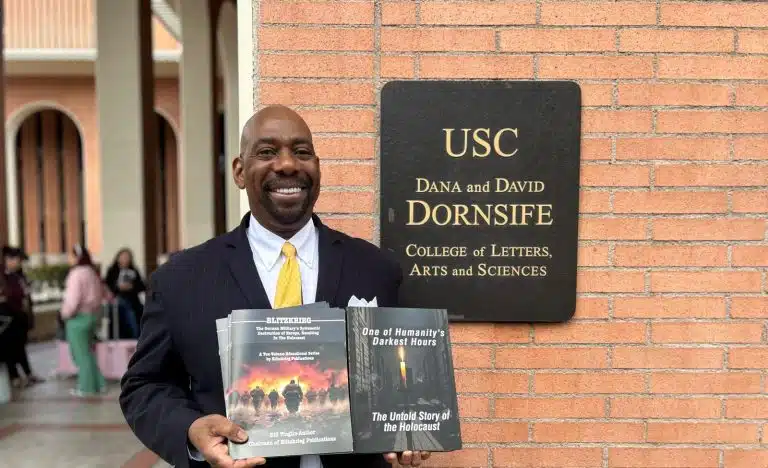
For more than three decades, Dr. Bill Tinglin has carried the testimonies of Holocaust survivors into classrooms across the United States.
An internationally-recognized educator and author of One of Humanity’s Darkest Hours: The Untold Story of the Holocaust, Tinglin has dedicated his career to ensuring that the lessons of the Holocaust are not confined to history books, but actively shape the character of the next generation.
Through initiatives such as “Tour for Tolerance,” a mobile, immersive Holocaust education program that brings survivor testimony directly to schools, Tinglin challenges students to both understand history and recognize their responsibility to confront antisemitism in the present.
During Black History Month, his work carries particular resonance. At a time when antisemitism is increasingly normalized and the Holocaust is openly denied, distorted, and inverted, Tinglin’s life’s work has underscored the vital need to defend historical truth. As an African American educator who has devoted his career to preserving Jewish memory, he stands at the intersection of two histories shaped by persecution and resilience.
In this Black History Month conversation with the Combat Antisemitism Movement (CAM), Tinglin reflected on why Holocaust education must engage not only the mind, but the conscience — and explained the urgency of cultivating principled Black-Jewish solidarity.
You founded several initiatives dedicated to Holocaust education and combating antisemitism. What first led you to make this work central to your life and career?
“My journey began not in a classroom, but in the presence of survivors,” Tinglin said.
For more than three decades, he has listened to men and women who endured ghettos, concentration camps, starvation, forced labor, and death marches. What struck him most was not only the magnitude of their suffering, but their determination to speak for the future.
“I had the sacred privilege of working directly with Holocaust survivors, listening to their testimonies, learning from their resilience, and carrying their voices into classrooms across the nation,” Tinglin explained. “What I heard was not only a story of suffering, but a plea — that the world must remember and that future generations must understand where hatred begins and what happens when it goes unchallenged.”
That plea reshaped his life. “As an African American educator, I recognized something deeply familiar — the danger of silence, the pain of dehumanization, and the urgency of memory,” Tinglin said. “I realized that hatred grows strongest where ignorance lives.”
He said that realization clarified his purpose. “I understood that Holocaust education is not only about Jewish history, but it is also about protecting humanity,” Tinglin noted. “It is about teaching young people to recognize the early signs of dehumanization, to reject indifference, and to choose courage over silence.”
From that moment forward, Holocaust education became a calling. “We teach students that language matters,” he added. “When the Holocaust is distorted or used as a political weapon, it does not educate; it erases.”
You created “Tour for Tolerance,” a mobile, immersive Holocaust education program that brings historical instruction directly into schools. Why did you believe a traveling exhibit was necessary — and what does it allow students to experience that a standard classroom lesson may not?
“Many students will never visit a museum. Many will never meet a Holocaust survivor,” Tinglin said. “If we wait for them to come to history, too many of them will never encounter it.”
“Tour for Tolerance” was designed to remove that barrier. The mobile classroom brings testimony directly into schools, combining survivor narratives with immersive technology and interactive learning environments that humanize the Holocaust.
“A textbook informs the mind. An experience reaches the conscience,” Tinglin said. Inside that space, students confront more than dates and facts. They grapple with how stereotypes were normalized, how misinformation spread, and how indifference enabled state-sponsored genocide.
“When students step into this learning environment, they do more than study history,” Tinglin continued. “They feel the weight of moral choices, the consequences of indifference, and the responsibility each generation carries to stand against hatred.”
Although the COVID-19 pandemic disrupted the physical tour, the mission expanded through digital platforms and immersive curricula. “Access to meaningful Holocaust education must be expanded, not limited,” he emphasized.
Having reached more than 100,000 students, Tinglin insisted the work is far from complete.
“At the same time, the survivor generation is passing from us,” he said. “Each year, their voices grow quieter, and our responsibility to carry their testimony becomes more urgent. We must now reach millions more.”
Holocaust education, he argued, cannot remain confined to a limited number of classrooms. “It must become a national and global priority — not only to preserve Jewish memory, but to ensure historical clarity in a time of distortion,” Tinglin said.
“Tour for Tolerance” reaches thousands of students each year. Beyond emotional reaction, how do you determine whether students leave with a clear understanding of what antisemitism is and how it operates today?
“Emotion is only the beginning. Understanding must follow,” Tinglin replied.
His programs measure impact through reflection and evaluation. Students are asked to define antisemitism in their own words, identify contemporary examples, and examine how stereotypes and conspiracy theories continue to operate.
“What matters most is when students begin to recognize antisemitism not as something distant, but as a pattern of dehumanization that still exists — and one that requires their response,” he said.
Tinglin often sees a turning point when participants realize antisemitism did not end with the defeat of Nazi Germany. “When a student says, ‘I didn’t realize this was happening today,’ or ‘I know how to speak up now,’ we know learning has moved from feeling to responsibility,” he stated.
For Tinglin, that movement from awareness to action is the true measure of success.
Through “Words of Bonds,” you have convened Holocaust survivors and African American elders for direct dialogue. What common ground has emerged — and where do those conversations become most challenging?
Throughout American history, Black and Jewish communities have shared moments of principled alliance, most notably during the Civil Rights Movement, when Jewish leaders and activists stood alongside Black Americans in the fight for equality under the law. Tinglin’s “Words of Bonds” initiative draws on that legacy by bringing Holocaust survivors and African American elders into direct dialogue.
“The deepest common ground is the understanding of what it means to be targeted simply for who you are,” Tinglin said. “Both communities speak of dignity under pressure, of faith in the face of injustice, and of the responsibility to turn suffering into wisdom rather than bitterness.”
At the same time, he is careful to guard against false equivalence. “Pain is not competitive,” he explained. “Each history is unique, and each deserves respect in its own truth.”
Dialogue, he posited, must build solidarity without blurring historical specificity. “When the dialogue is guided by empathy rather than comparison, something powerful happens,” he said. “People begin to see that the struggle against hatred is shared.”
Holocaust distortion today often appears as inversion — for example, equating the State of Israel with Nazi Germany. How do you address this kind of rhetoric with students in a way that is historically grounded and unambiguous?
“We address it with clarity and history,” Tinglin says. Students begin by learning what the Holocaust actually was: “a systematic, industrialized genocide built on racial ideology and the intent to eliminate an entire people.”
When that reality is understood, such comparisons are exposed as distortions of history. “When the Holocaust is distorted or used as a political weapon, it does not educate — it erases,” Tinglin said.
Historical precision, he insisted, was non-negotiable. “Without accuracy, memory becomes vulnerable to misuse,” Tinglin stated.
In some circles, antisemitism is dismissed when Jews are framed primarily through narratives of power or privilege. How do you help students understand Jewish history in its full context rather than through simplified ideological lenses?
“We teach the full story,” Tinglin said. Students learn that Jewish history is not a story of power, but of survival — centuries marked by expulsions, violence, discrimination, and scapegoating long before the Holocaust culminated in genocide.
“When students understand this long history of vulnerability, they begin to see why antisemitism cannot be dismissed simply because Jews are sometimes perceived as successful,” he noted.
Stereotypes about Jewish power, he added, were themselves part of the historical pattern of antisemitism. “Education replaces simplified narratives with historical reality,” Tinglin said.
Many educators feel hesitant to address antisemitism directly because they fear backlash. What does responsible Holocaust and antisemitism education require from schools right now?
“It requires courage and clarity,” Tinglin said. “Silence does not create safety; it creates confusion.”
Students are already encountering misinformation, conspiracy theories, and distorted history online, and avoidance leaves them unprepared. “Schools must provide accurate Holocaust education, clear definitions of antisemitism, and spaces for honest conversation grounded in facts and intellectual responsibility,” he continued.
Responsible education, Tinglin underscored, does not avoid difficult truths. It prepares individuals to recognize hatred and to stand against it.
How do you measure success?
“Success will be visible in the language and behavior of the next generation,” Tinglin said.
Tinglin hopes to hear people speak about Jews and the Holocaust with accuracy and respect. He wants to see fewer casual Nazi comparisons, fewer conspiracy-driven narratives, and greater willingness to challenge antisemitism publicly.
“This work is not simply about the past,” Tinglin said. “It is about the future. And as long as I have the opportunity to teach, to write, and to speak, I will continue carrying the voices of survivors — so that memory becomes understanding, understanding becomes responsibility, and responsibility becomes the courage to protect the dignity of every human life.”
Having listened to Holocaust survivors describe the systematic annihilation of the Jewish people, and having lived with the legacy of racial injustice in America, Tinglin knows that dehumanization does not begin with violence. It begins with words. It begins with distortion. And it begins with silence.
During Black History Month, his work stands as a reminder that solidarity is not symbolic. It is built through truth, education, and the courage to defend one another’s history — together.
For more information about Dr. Bill Tinglin and his work, please visit: billtingling.com