
|
Getting your Trinity Audio player ready...
|
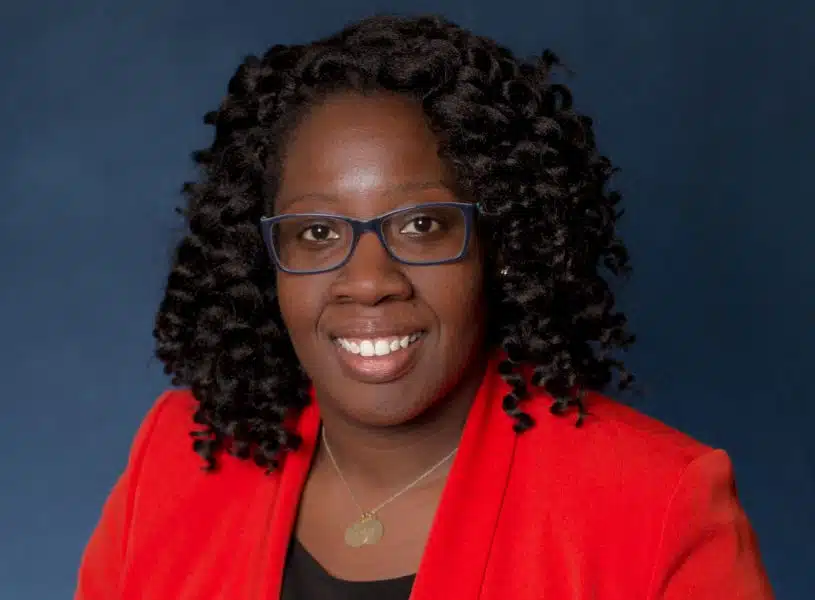
For many Jewish students across Europe, campus life now comes with a constant calculation — how visible is too visible? For Hanna Veiler, one of the most prominent Jewish student leaders in Europe, that question has shaped her experience from an early age and continues to define her work today.
As a leading voice in Jewish student life, Veiler has helped rebuild and expand Jewish student life at a time when many young Jews feel exposed, isolated, and under growing pressure to remain silent.
In an interview with the Combat Antisemitism Movement (CAM), Veiler speaks about growing up Jewish in Germany, the normalization of antisemitism in academic spaces, and why a new generation is stepping forward — often out of necessity.
You’ve spoken about growing up as one of very few, and at times the only, Jewish student in your school. How did that experience shape your sense of identity, and how did it influence the leader you have become?
“Throughout my life, I’ve always been one of a few or even most of the time the only Jew in the room,” Veiler said.
In the small city in southern Germany where she grew up, knowledge of Jewish life was extremely limited. Even when the Holocaust or antisemitism came up, Jewish experience was rarely at the center of the conversation. “I think the knowledge of dead Jews is quite high in Germany,” Veiler said. But when the Holocaust or antisemitism was addressed, she noted, “most of the time, it’s more about the Germans than about the Jews.”
On a political level, she said, Holocaust memory is often used to reassure German society that it has left its past behind. “The conversation about Jews and antisemitism and the Holocaust has more to do with the Germans themselves and their struggle for an identity in a post-war world than with the Jewish community and its actual struggles and problems and challenges,” she said.
At school, that broader cultural pattern became deeply personal. Whenever Jewish issues came up, she said, all eyes turned to her. “You kind of turn into an ambassador for the Jewish people and Israel and antisemitism at a very early age when of course you’re not prepared for it,” she recalled.
Veiler said the burden was especially complicated because she came from a secular family from the former Soviet Union. Even so, she had always known she was Jewish and understood early on that being visibly Jewish could carry risks.
That tension, she emphasized, helped shape her sense of responsibility from a young age. When Jewish identity was constantly noticed, questioned, or misunderstood, silence stopped feeling like a real option.
You spent time in Israel during your formative years, at a moment when you were still working through questions of identity and belonging. What did that experience ultimately clarify, or challenge, about where you saw your place as a Jew in Europe?
“I think growing up as a Jew in Germany from the former Soviet Union caused quite a big identity crisis,” she said.
Veiler first traveled to Israel at 18 through the Taglit-Birthright program. “We had never gone before, even though a lot of my family lives there,” she said.
At the time, she began to wonder whether Israel might offer the answers she had been searching for. “I thought maybe I have to move to Israel for some time,” she said. “Maybe that’s going to tell me who I am and where I belong.”
Unlike many structured programs for Jewish youth abroad, her experience placed her directly inside everyday Israeli life. “My gap year was really a lot of very hard physical work,” she said. “I lived the real life of Israeli society — very unfiltered.”
But the experience did not resolve her identity questions in the way she had expected, and adapting proved difficult. At 19, it was her first time living far from home, and socially she often felt out of step with Israelis her age, many of whom were serving in the military. “It was very difficult to adapt,” she said. “I missed my family, and I didn’t really feel like I was home.”
“I came back thinking that I need to work through my identity crisis in Europe,” she said.
Today, she says she still feels deeply connected to Israel. But the experience ultimately clarified something equally important — her role would be helping strengthen Jewish life in Europe rather than leaving it behind.
You didn’t just join Jewish student structures — you helped strengthen and expand them. What did you see missing at the time, and what pushed you to move from participation into leadership?
Veiler said her path into Jewish student leadership began when she saw just how much was missing.
After returning from Israel, she began studying at the University of Tübingen. There, she quickly noticed Jewish students had few organized spaces to connect. “There were probably five Jewish students at the university,” she said. “And there was really nothing for them.”
Veiler added, “There was no one organizing Shabbat dinners, no one speaking up if something antisemitic happened in the city.”
At the same time, a broader shift was beginning to take place within Germany’s Jewish community. The German Union of Jewish Students had recently been established, and new regional organizations were starting to emerge as young Jews sought stronger representation and a more active voice. “At that time, Jewish youth were beginning to organize themselves again,” Veiler said. “People wanted to become more politically active and more outspoken.”
Leaders in the nearby Jewish community in Stuttgart approached her about helping create a regional student organization. She agreed, seeing an opportunity to build something that had been missing in her own student experience. “I’ve always had this activist identity,” she said. “I always wanted to take responsibility and not just stay passive.”
She soon became president of the Württemberg Union of Jewish Students and remained in the role for two years. Her involvement continued to expand. She was later elected vice president of the German Union of Jewish Students and eventually became its president, while also serving as vice president of the European Union of Jewish Students.
Looking back, Veiler said the path felt less like a career plan than a response to the needs she saw around her. “When we speak about the Jewish community in Germany, it’s still a very small community,” she said. “Often organizations are not competing for leaders — they are searching for people willing to take responsibility.”
That dynamic, she said, shifted dramatically following the October 7th massacre. “After October 7th, a lot of people woke up,” she said. “You suddenly had what I call ‘October 8th Jews’ — people realizing that they need political representation and that they have to speak up for themselves.”
Where do you see antisemitism becoming normalized or excused most clearly today, particularly within academic or political spaces in Europe?
Veiler said that one of the most troubling developments in recent years was how antisemitic rhetoric was increasingly framed as legitimate political discourse, particularly in academic environments.
In practice, this has created an environment where rhetoric that would be recognized as bigotry in any other context is accepted, defended, or ignored when directed at Jews. Universities, she pointed out, have become spaces where extreme language about Israel can circulate with little pushback, even when it creates a hostile climate for Jewish students. “What we see very clearly is that antisemitism is often reframed as political debate,” she said. “Things that would never be accepted if they were directed at other minorities suddenly become acceptable when they are framed as criticism of Israel.”
She said the problem extended beyond universities into the political sphere, where antisemitic narratives were often tolerated when they are wrapped in causes seen as progressive. “In many cases antisemitism is excused because it is presented as part of a broader political cause,” she said. “And that makes it much harder to confront.”
For many Jewish students, the result is a constant calculation about how visible they can afford to be.
“Students ask themselves whether it is safe to wear a Star of David or to speak openly as Jews,” she said. “No one should have to choose between safety and pride.” Yet for many Jewish students across Europe today, that is exactly the choice they feel forced to make.
Addressing that reality, she said, would require universities and political leaders to treat antisemitism with the same seriousness they apply to other forms of hatred — even when doing so carries political or institutional consequences.
Looking five years ahead, what would meaningful success actually look like for Jewish students in Europe — not only in terms of safety, but confidence, visibility, and influence?
Veiler said that while security remained essential, the goal cannot be reduced to protection alone. Jewish life, she posited, could be defined only by the need to respond to antisemitism, but by the ability to exist beyond it. “For me, success would mean that Jewish students don’t have to constantly ask themselves whether it is safe to be visible as Jews,” she said.
That visibility, she underscored, must go far beyond the question of safety. It should reflect a reality in which Jewish voices are treated equally and respected across academic and public life. “Jewish students should feel confident speaking openly about who they are, about their Jewish identity, and about their connection to Israel,” she said.
At the same time, she believes the coming years will depend heavily on the strength of the next generation of Jewish leadership. In the October 7th aftermath, she said, many young Jews across Europe have become more politically engaged and determined to act. “We are seeing a generation that is becoming much more outspoken and much more organized,” she said.
Five years from now, Veiler said, success would mean that this momentum has translated into stronger institutions, more confident leadership, and a Jewish student presence that is both visible and influential across European campuses.
“The goal is not only that Jewish students are safe,” she said. “The goal is that they are visible, confident, and able to take part in every aspect of life, without antisemitism forcing them to hold back or define who they are. Success is when students are able to talk about other things and be other things than just Jews. I come from a family that has been told for the entire time of its existence that you’re not allowed to be anything else other than a Jew.”