
|
Getting your Trinity Audio player ready...
|
This op-ed was authored by Sacha Roytman, CEO of the Combat Antisemitism Movement (CAM). It was originally published by The Jerusalem Post.
Athens has long stood as a symbol of history, culture, and democratic values. A city where ancient legacy meets modern vibrancy. For many Israelis, it has also been a familiar and welcoming destination: close, accessible and in many ways culturally resonant.
That is why my recent visit felt so profoundly different.
After weeks of sirens and missile attacks in Israel, my family and I, traveling with three young children and another on the way, sought a brief moment of quiet. Athens seemed like the obvious choice. I had visited many times before and always experienced it as open, dynamic, and cosmopolitan, close to Tel Aviv in spirit.
But this time, something in the public atmosphere had shifted.
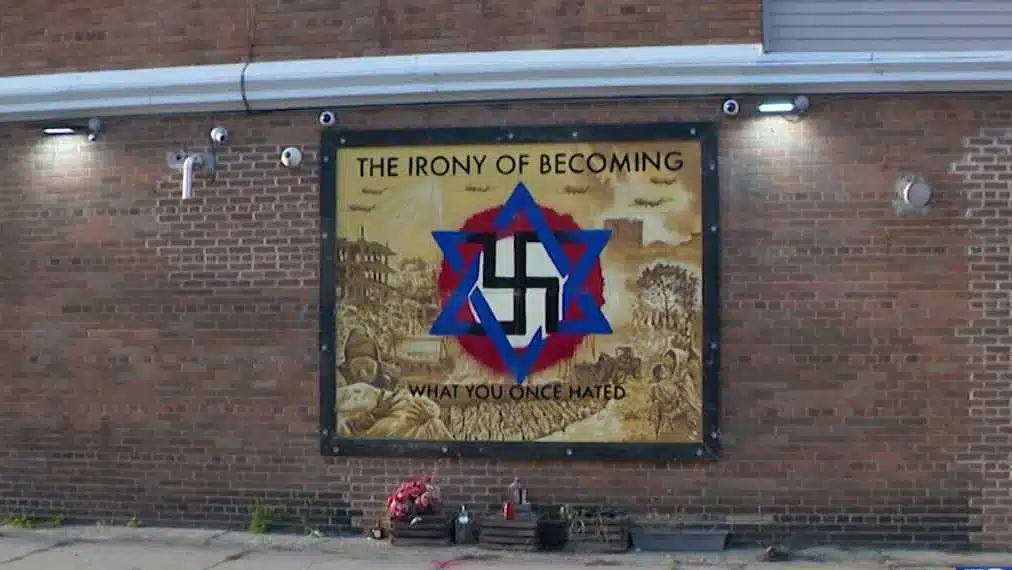
Walking through the city center, it was impossible to ignore the sheer volume of antisemitic and anti-Israeli messaging. Graffiti, banners, and slogans appeared across walls and storefronts, Israeli flags defaced with swastikas, calls for violence against “Zionists,” and rhetoric that crossed the line from political expression into something far more disturbing.
Of course, public space reflects local voices, and cities are entitled to their own forms of expression. But when millions of visitors are exposed to messages that normalize hatred, it ceases to be merely local. It becomes a broader moral and civic concern.
The moment this reality truly crystallized was not in reading a slogan, but in answering a question. One of my children looked up and asked: why is there a swastika on our flag?
There is no easy way to explain that to a child. Nor should there have to be.
This is not about discomfort. It is about boundaries, about what is considered acceptable in the public square, especially in a city that prides itself on democratic values and hosts visitors from around the world.
What is most troubling is not only the presence of such messages, but their normalization.
In recent days, our research team at the Combat Antisemitism Movement (CAM) identified a planned demonstration expected to feature banners supporting Hamas, Hezbollah, and other extremist Islamist organizations. Around the same time, a violent incident in central Athens saw a crowd chanting “Hezbollah” while attacking passersby.
These are not marginal cases. They are signs of a line that is steadily shifting.
At moments when Israeli civilians are under active missile fire, witnessing open expressions of support for organizations responsible for such violence, on the streets of a European capital, raises serious questions. Not only about public sentiment, but about leadership.
Because ultimately, this is also a question of governance.
When boundaries are not clearly set and enforced, silence risks being interpreted as indifference, or worse, acceptance. Cities do not control every act of expression within them, but they do shape the norms of what is tolerated in their public spaces.
Athens knows this well. As recently as 2022, under previous leadership, the city hosted the first International Mayors Summit Against Antisemitism, positioning itself at the forefront of a global effort to combat hatred. That legacy now stands in troubling contrast to the current reality on its streets.
This is not only a policy failure, it is a departure from history.
Athens is not just any city. It is the birthplace of democracy. It is also part of a European legacy that includes figures like Archbishop Damaskinos, who risked his life to save Greek Jews during the Holocaust and was later recognized as Righteous Among the Nations.
That is the Athens the world remembers. That is the Athens worth preserving.
Today, however, the city faces a test: whether it will actively uphold that legacy, or allow it to erode under the weight of normalization and neglect.
For my family, the answer came quickly. We chose to cut our visit short and continue our journey elsewhere.
But the broader question remains, not only for Athens, but for Europe as a whole:
What kind of public space are we willing to accept? And what kind of values do we choose to defend?
After a month living under Iranian missile threats, we took our kids and left Israel for a short break. We landed late at night in Athens (Greece) but the next morning, after just a 10-minute walk around the city, we went straight back to the hotel and booked the earliest flight… pic.twitter.com/wY9lHSaTw5
— Sacha Roytman (@SachaRoytman) March 31, 2026