|
Getting your Trinity Audio player ready...
|
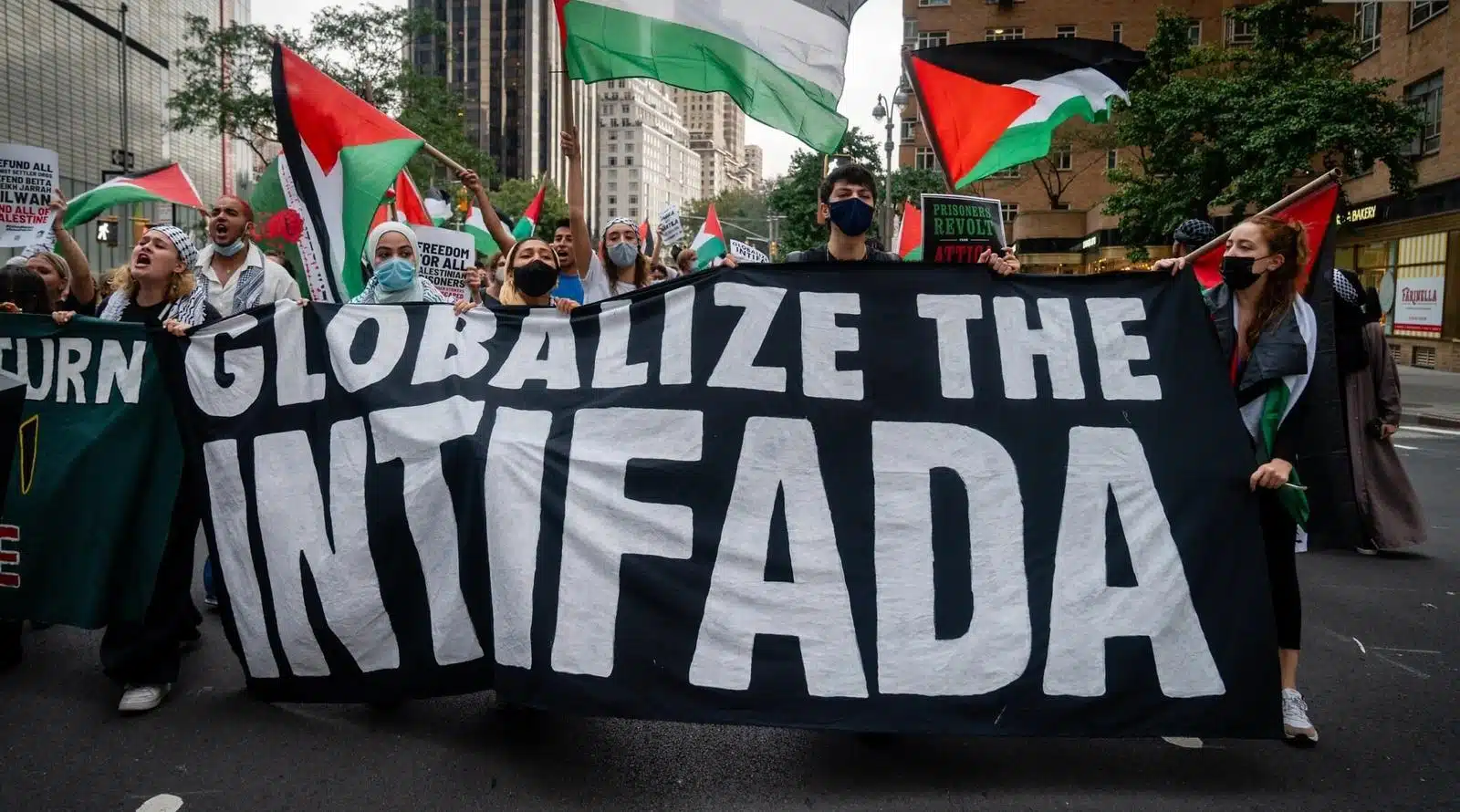
Few slogans so directly betray the vow of “Never Again” as the call to “Globalize the Intifada.”
The meaning of the slogan is inseparable from the history it invokes. The Arabic word “intifada” literally translates as “uprising” or “shaking off,” but in contemporary political usage it refers to two named campaigns of organized violence that deliberately targeted civilians, including Israeli Jews, through mass-casualty terror attacks.
In practice, the intifadas were defined by coordinated waves of stabbings, shootings, suicide bombings, and mass-casualty attacks that deliberately targeted Jews on buses, in restaurants, markets, hotels, and other everyday public spaces. To demand the globalization of the intifada is therefore to call for the export of this model of violence — its tactics, its logic, and its targeting of Jews — beyond Israel and into Jewish life worldwide.
The intifadas were marked by more than bloodshed. They imposed a sustained climate of fear in which Israelis lived with daily uncertainty over whether routine activities could turn deadly. The call to “globalize” the intifada seeks to export that reality, transforming Jewish communities worldwide into targets of the same intimidation.
This page traces how a slogan rooted in mass-casualty terror moved from the margins into protests, campuses, and cultural institutions, where it became normalized within activist networks. That normalization escalated into demonstrations staged outside synagogues and Jewish communal events, turning Jewish houses of worship into direct targets of intimidation. The slogan has since crossed from activism into formal politics.
What follows establishes — through historical record and contemporary evidence—what “Globalize the Intifada” has always meant, and what its spread has already produced.
The First Intifada: Origins, Tactics, and Impact (1987–1993)
The First Intifada began in December 1987 after local unrest in Gaza was rapidly inflamed through incitement. In the days preceding the uprising, Palestinians murdered an Israeli civilian, Shlomo Sakal, while he shopped in Gaza. Shortly afterward, an Israeli truck was involved in a traffic accident that killed four Palestinian laborers from Jabaliya. Within hours, false rumors spread through mosques and neighborhoods claiming the crash was a deliberate act of revenge. These claims fueled mass incitement, and violence escalated rapidly.
The First Intifada is often portrayed as a largely popular uprising. In reality, violence defined the period from its earliest stages. Palestinian factions carried out Molotov cocktail attacks, grenade assaults, and shootings, using firearms and explosives against both Israeli civilians and security forces. Over the course of the Intifada, approximately 200 Israelis were killed and many more were wounded.
Internal Violence and the Rise of Hamas
At the same time, the unrest unleashed systematic violence within Palestinian society itself. Internal killings became a defining feature of the period. Palestinian factions executed nearly 1,000 people accused of collaborating with Israel, frequently without credible evidence. Victims were stabbed, shot, clubbed, burned with acid, or hacked to death with axes. Contemporary reporting and later analyses indicate that, in many cases, accusations of collaboration served as a pretext for settling personal, political, or clan disputes rather than reflecting genuine cooperation with Israeli authorities.
PLO chairman Yasser Arafat later acknowledged that innocent Palestinians were among those killed and retroactively designated them “martyrs of the Palestinian revolution,” effectively legitimizing the violence after the fact.
During the First Intifada, Hamas emerged as an organized Islamist alternative to the PLO. Founded on the infrastructure of the Muslim Brotherhood in Gaza, the movement declared its commitment to armed struggle and positioned itself explicitly against both Israel and the PLO’s leadership. Drawing on mosque-based institutions and affiliated religious frameworks in Gaza and the West Bank, Hamas strengthened its organizational foothold during the uprising. Although it remained secondary to Fatah for much of this period, the Intifada enabled Hamas to consolidate structure, credibility, and influence, laying the groundwork for its later challenge to PLO dominance.
The Second Intifada: Suicide Bombings and Mass Terror (2000–2005)
The Second Intifada, also known as the Al-Aqsa Intifada, erupted in September 2000 and quickly became one of the deadliest terror campaigns in Israeli history. Many initially portrayed the uprising as a spontaneous reaction to then-Israeli Prime Minister Ariel Sharon’s visit to the Temple Mount. However, senior Palestinian Authority officials later admitted that they had planned the violence in advance. In early 2001, PA Information Minister Imad Falouji acknowledged that the uprising had been deliberately planned in advance. Fatah leader Marwan Barghouti later described how senior figures coordinated mobilization across the territories.
The uprising did not emerge from spontaneous unrest. Instead, Palestinian factions organized a sustained campaign of mass violence and psychological warfare. They directed terror at Israeli civilians as both a strategic objective and a tool of political pressure.
Suicide Bombings and the Assault on Civilian Life
Suicide bombings soon became the defining tactic of the Second Intifada. Terror groups targeted buses, restaurants, markets, nightclubs, hotels, and shopping districts. They deliberately chose crowded locations central to daily life. As a result, the attacks aimed to maximize civilian casualties and destroy any sense of public safety. Terror groups murdered more than a thousand Israeli civilians, including men, women, and children, and wounded thousands more.
Several attacks became seared into national memory. During Passover in 2002, a Hamas bomber entered the Park Hotel in Netanya and murdered 30 people, injuring 140 others. In June 2001, a suicide bomber killed 21 teenagers outside Tel Aviv’s Dolphinarium discotheque. Two months later, another bomber detonated inside Jerusalem’s Sbarro pizzeria, killing 16 people, including seven children, and injuring more than 130.
Daily life during the Second Intifada reached a level of danger unprecedented in Israeli history. Ordinary errands could become fatal miscalculations. Boarding a bus, stopping for lunch, walking through a market, celebrating a holiday, or dropping children off at school required constant vigilance. No place felt reliably safe, and no routine could be trusted. The campaign deliberately targeted the rhythms of civilian life. As a result, Israelis moved through each day knowing a single moment could determine whether they lived or died.
This history forms the foundation the modern slogan draws on and shapes how the phrase is understood today.
Let’s talk about the Intifada. pic.twitter.com/cW9ZkzgMKC
— Combat Antisemitism Movement (@CombatASemitism) June 5, 2025
The Origin of ‘Globalize the Intifada’ (2021): From New York Activism to Coordinated Incitement
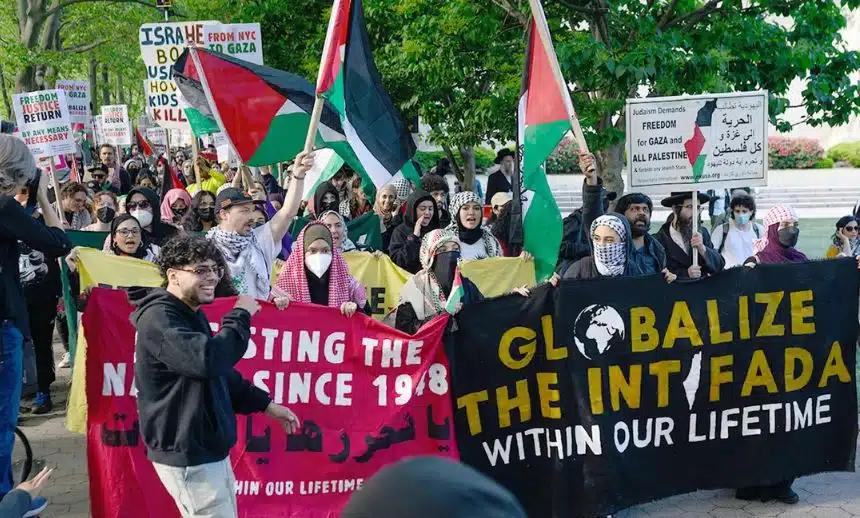
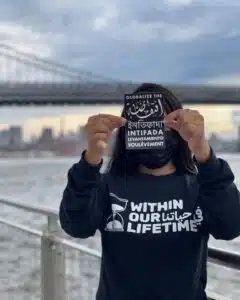
“Globalize the Intifada” emerged in the United States in 2021 through a coordinated activist campaign centered in New York–based networks. Groups including Within Our Lifetime (WOL), Samidoun, and Decolonize This Place (DTP) played a central role in popularizing and operationalizing the slogan, deploying it across protests, social media, and organizing materials.
A wider ecosystem of organizations — including Students for Justice in Palestine (SJP), Jewish Voice for Peace (JVP), CODEPINK, the Palestinian Youth Movement (PYM), The People’s Forum, Al-Awda, and the ANSWER Coalition — helped amplify the message and mobilize supporters, embedding the slogan across campus, cultural, and activist spaces.
Jewish Voice for Peace played a distinctive role within this landscape. By presenting itself as a Jewish organization, it helped normalize and legitimize rhetoric widely recognized as antisemitic, granting the campaign a veneer of moral authority it could not have achieved on its own.
Early Coordination and Public Launch
One of the earliest documented uses of the slogan appeared on June 11, 2021, during a demonstration outside the Museum of Modern Art (MoMA) in New York City. Promotional materials labeled the site “Occupied Manhattan,” with “Strike MoMA” slashed in red. This imagery sent a deliberate signal. The “decolonization” framework previously applied to Israel was now being transferred onto the United States itself. The protest was co-hosted by WOL and DTP, marking an early convergence of activist networks that would later popularize the slogan.
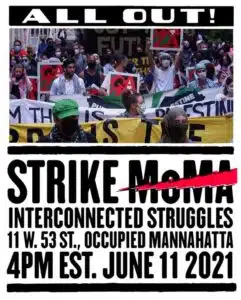
During the demonstration, protesters chanted, “From New York to Gaza! Globalize the Intifada!” This marked one of the earliest instances of the phrase entering U.S. activist spaces. Organizers framed MoMA not as a neutral cultural institution, but as a legitimate site of confrontation within a global struggle. Protest literature accused the museum’s leadership of “settler colonialism,” “apartheid,” and “imperialism.” It argued that cultural institutions function as ideological battlegrounds rather than civic spaces. In this framing, museums, universities, and art institutions were folded into the same worldview applied to Israel, redefining civilian spaces as legitimate sites of confrontation.
From a Single Protest to a Coordinated Campaign
Later that summer, WOL escalated its efforts from episodic protest to formal campaign. On July 30, 2021, the group released an online manifesto announcing “Globalize the Intifada.” The following day, it held a rally in Brooklyn to launch the campaign publicly. Samidoun, a network tied to the Popular Front for the Liberation of Palestine (PFLP), promoted the rally in advance. This signaled early coordination with extremist-aligned actors abroad. During the event, WOL founder Nerdeen Kiswani told the crowd, “I hope that a ‘pop-pop’ is the last noise that some Zionists hear in their lifetime.”
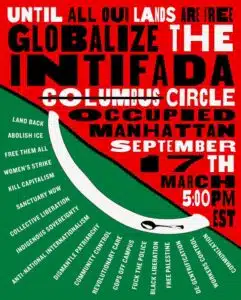
That fall, organizers expanded the campaign’s scope and ambition. On September 17, 2021, WOL organized a march at Columbus Circle. Promotional materials again labeled the site “Occupied Manhattan,” this time striking through “Columbus” and leaving only “Circle.” In doing so, organizers were explicitly recasting U.S. civic space as legitimate terrain for confrontation. The repetition underscored that the framing was deliberate and strategic. The “decolonization” narrative was no longer confined to Israel. Organizers now applied it to American cities, institutions, and public spaces.
The WOL Manifesto: A Blueprint to Target the United States
The manifesto established that “Globalize the Intifada” was not a slogan confined to Israel, but a transferable strategy intended for use against U.S. institutions and civic life. It cast the United States as “the belly of the beast,” portraying American institutions as enablers of “genocide” and “ethnic cleansing.” The document asserted that Palestinians and their supporters had the right to pursue “liberation by any means necessary” and urged activists to carry the ethos of the intifadas into their own neighborhoods.
It described the campaign as “an ongoing strike at the heart of empire.” Accompanying materials outlined a broader ideological program calling for “land back,” “kill capitalism,” “f*** the police,” “abolish ICE,” “cops off campus,” and “collective liberation.” New York City was framed as a “theater of operations,” positioning U.S. institutions as part of the same “colonial” structure the campaign claimed to oppose.
The manifesto also presented the campaign as explicitly transnational. It cited affiliated groups in Colombia, Mexico, Puerto Rico, the Dominican Republic, Bangladesh, the Philippines, and cities across the United States. “Mutual liberation” was framed as a shared global project. The core message was unambiguous: the intifada was a model of confrontation to be reproduced in American streets and against American institutions.
“Globalize the Intifada” was no longer an isolated chant. It became a portable strategy. By redefining U.S. cities, institutions, and cultural spaces as “occupied territory,” the campaign established a framework in which confrontation with Jews and Jewish-associated spaces was ideological, intentional, and justified.
Operationalizing Incitement: How ‘Globalize the Intifada’ Was Turned Into Action
After launching the campaign, WOL moved quickly to operationalize its rhetoric. The group released a rally toolkit designed to convert slogans into a reproducible protest infrastructure. It standardized chants, visuals, and protest conduct.
Activist networks across the country circulated the toolkit, pushing its most aggressive messaging into campuses, protest circles, and student environments far beyond New York. As a result, chants calling for Israel’s destruction and openly endorsing violence moved from fringe protests into mainstream activist spaces.
Core Messaging: Fixed Chants With a Clear Agenda
The toolkit centered on a set of approved chants designed to shape both the ideological direction and tone of each event. Collectively, they denied Israel’s right to exist, cast the United States as an imperial aggressor, and framed violent confrontation as legitimate and necessary.
The chants included:
- “From New York to Gaza, globalize the intifada.”
- “There is only one solution! Intifada revolution.”
- “1,2,3,4 occupation no more! 5,6,7,8 smash the settler Zionist state!”
- “Hey hey, ho ho! Zionism has got to go! Hey hey, ho ho! Israel has got to go!”
- “It is right to rebel — Israel go to hell.”
- “Israel bombs, USA pays. How many kids did you kill today?”
- “NYPD, KKK, IDF — they’re all the same.”
- “Not another nickel, not another dime. No more money for Israel’s crimes.”
- “Israel, you can’t hide. You’re committing genocide.”
The chants denied Israel’s existence, sanctified violence, and reduced “Zionists” to legitimate targets.
Security Guidance: Hiding Identities and Avoiding Law Enforcement
The toolkit also included explicit security instructions. Activists were directed to conceal their identities and avoid all contact with law enforcement. One instruction read, “Cover your face if you do not want to be identified.” Another warned participants: “Do not speak to the police” and “Do not record, post, or talk freely about anything that could get anyone in legal trouble.”
These directives reflected a clear awareness of legal risk. Anonymity and non-cooperation were treated not as optional precautions, but as integral to participation.
By standardizing language, visuals, behavior, and security practices, WOL made its ideology portable. The toolkit provided a template that could be replicated at demonstrations on campuses, in U.S. streets, and across aligned networks abroad.
The Terror Network’s International Arm: Samidoun and the PFLP
The international expansion of “Globalize the Intifada” has been advanced in part through the Samidoun Palestinian Prisoner Solidarity Network. Samidoun has been identified by multiple democratic governments as operating on behalf of the Popular Front for the Liberation of Palestine (PFLP), a terrorist organization designated by the United States, European Union, Canada, and Israel. Israeli authorities have designated Samidoun for operating on the PFLP’s behalf and identified it as part of the group’s overseas infrastructure.
The United States and Canada have likewise designated Samidoun under their counterterrorism frameworks, while Germany has banned and dissolved the organization’s activities domestically due to its extremist conduct and support for violence.
In October 2024, the U.S. Department of the Treasury designated Samidoun and Khaled Barakat under its global terrorism sanctions authorities. The designation identified Barakat as a member of the PFLP’s leadership and described Samidoun as a front organization supporting the PFLP’s external activity.
In this context, Samidoun functions as an international conduit linking localized activist campaigns with a broader transnational network tied to the PFLP. This structure has enabled rhetoric associated with “Globalize the Intifada” to circulate beyond isolated protests and into an ecosystem connected to a designated terrorist organization.
How ‘Globalize the Intifada’ Went Global
By 2022, activist networks had carried the slogan “Globalize the Intifada” beyond New York-based organizing circles and into protests across the United States, including cities and campuses with large Jewish populations. The phrase appeared with increasing frequency at anti-Israel demonstrations, no longer confined to a single network or location, but embedded within broader activist mobilizations.
Digital platforms sharply accelerated that spread. Platforms such as TikTok and Instagram reward speed, provocation, and emotional intensity. Short clips, chants, and slogans are optimized for rapid replication, stripped of context, and pushed algorithmically to new audiences. Automation further accelerates this process, amplifying the most inflammatory material at scale.
This dynamic normalizes language rooted in mass violence by transforming it into a familiar visual or auditory cue. Repeated exposure to chants invoking the intifadas signals that threats once associated with specific periods of terror are being rehearsed, normalized, and broadcast in real time. The result is an atmosphere in which intimidation travels faster than accountability.
Grand Central Terminal: ‘New York to Gaza, Globalize the Intifada’
On March 30, 2022, several hundred pro-Palestinian demonstrators gathered outside Grand Central Terminal in Manhattan before marching through Midtown. Protesters chanted, “From New York to Gaza, globalize the intifada,” and “There is only one solution — intifada revolution.” Signs at the rally read, “Intifada until victory.”
The demonstration pushed intifada rhetoric into one of the busiest civilian transit hubs in the United States. Language rooted in mass-casualty terror was no longer confined to activist spaces. Instead, it entered an everyday public setting used by commuters, tourists, and families. In doing so, the rally reframed rhetoric tied to violent uprisings as acceptable street protest at the center of American civic life.
Remember how we told you what “globalize the intifada” meant? Now NYC is starting to experience it. Hamas supporters in NYC have surrounded Grand Central Station and are attempting to breach the outer doors to reach police officers sheltering inside…because “Palestine.”… pic.twitter.com/HK4lhspjYy
— Emily Schrader – אמילי שריידר امیلی شریدر (@emilykschrader) November 11, 2023
Post-October 7: Celebrating Violence and Targeting Jews in New York City
After October 7, the slogan “Globalize the Intifada” shifted from provocation to celebration. Activists in New York publicly embraced violence and openly targeted Jews.
In the days following the massacre, protesters chanted slogans, displayed signs, and framed the attack as “resistance.” They praised and justified the violence without hesitation. On the day of the massacre, the group declared: “We must defend the Palestinian right to resist zionist settler violence and support Palestinian resistance in all its forms. By any means necessary. With no exceptions and no fine print.”
Nerdeen Kiswani has long endorsed “armed resistance.” She has stated that “abolishing Israel is the key to peace,” dismissing Israel as a “Zionist settler entity… masquerading as a country.” Her rhetoric rejects Israel’s right to exist and presents violence against Israeli civilians as both justified and necessary.
From Massacre to Mobilization
On October 8, 2023 — one day after Hamas murdered 1,200 Israelis, abducted 251 others, and carried out the deadliest day for the Jewish people since the Holocaust—thousands gathered in Times Square. The rally was organized by the Palestinian Youth Movement, The People’s Forum, Al-Awda, the ANSWER Coalition, and others. Multiple news outlets confirmed that WOL played a central and highly visible role in organizing, promoting, and leading the protest, despite not signing the joint statement.
Organizers described Hamas’s massacre, referred to as the “Al-Aqsa Flood,” as “an unprecedented liberation struggle.” They framed the attacks as an effort to “break out of their concentration camp,” recasting the slaughter of civilians as justified resistance. The joint statement asserted a “fundamental right to resist… by any means necessary” and urged supporters to confront Zionism not only abroad, but inside the United States.
One line captured the mindset clearly: “We mobilize in the belly of the beast because we understand that we have a unique role to play in combating material support for Zionism and weakening the handmaiden of U.S. global imperialism.” Demonstrators chanted “Intifada, intifada” and “Intifada revolution,” transforming a day of mass murder into a rallying point for expanding the very violence they praised.
This rhetoric recast October 7 from an atrocity into a mandate for escalation, confrontation, and further violence.
Targeting Jewish Institutions: From Celebration to Escalation
In the weeks that followed, WOL escalated further. The group published a map identifying dozens of Jewish and pro-Israel organizations across New York City. It labeled them as having “blood on their hands” and urged supporters to “KNOW YOUR ENEMY.” Many of the listed institutions had no connection to Israeli policy.
WOL then released a second map. This one named Israeli and American companies, along with transit hubs, as “offices of an enemy.” The group presented these locations as sites for “popular mobilization,” shifting from rhetoric to targeting.
On October 7, 2025, the second anniversary of Hamas’s October 7 massacre, WOL held another rally in New York City.
At the demonstration, speakers declared:
- “We did not act enough.”
- “We must show up stronger than we did the first October 7th.”
- “Louder than the first October 7th.”
These calls framed the massacre as a benchmark to surpass, not a crime to condemn.
Coming from a group that praised mass murder and openly promotes “Globalize the Intifada,” the intent was clear. Jewish institutions — and anyone associated with Israel — were deliberately marked as targets.
As the chant normalized in U.S. public spaces, it soon crossed the Atlantic. From there, it began appearing in high-profile European incidents.
London: When ‘Globalize the Intifada’ Crossed Into Criminal Incitement
In December 2023, activists unfurled a massive rooftop banner reading “GLOBALISE THE INTIFADA” near Regent’s Park in London. Police removed the banner and arrested nine people under public-order laws related to incitement and racially or religiously aggravated offenses.
Downing Street publicly condemned the slogan. Officials stressed that it did not constitute legitimate political critique, but a call to expand the violence of the intifadas beyond Israel. As a result, the incident sparked parliamentary debate over antisemitism, policing, and extremist rhetoric in public spaces.
Amsterdam: Mob Violence After a Football Match
By late 2024, the rhetoric no longer required organizers or chants to manifest.
In November 2024, Amsterdam experienced one of the most disturbing eruptions of antisemitic violence. Following a UEFA match between Ajax and Maccabi Tel Aviv, mobs poured into the streets, chased Israeli fans, assaulted them in alleyways, and carried out coordinated attacks across the city center.
One commentator described the rampage as “what ‘Globalize the Intifada’ looks like.” Although rioters did not chant the slogan itself, the violence mirrored its logic. Jews and Israelis were targeted in public spaces simply for who they were. Videos captured attackers giving Nazi salutes, shouting antisemitic abuse, and boasting that they were “looking for Jews.”
Dutch officials condemned the attacks as a pogrom. Jewish organizations filed emergency complaints and demanded enhanced protection measures. The night in Amsterdam showed that the ideology behind “Globalize the Intifada” does not require explicit slogans to operate. Its worldview treats Jews as legitimate targets for violence. That logic drove the attacks and echoed both the terror of the intifadas and the rhetoric promoted by the campaign.
Amsterdam marked a turning point. Rhetoric that had normalized threats against Jews now appeared alongside coordinated street violence.
By late 2023, “Globalize the Intifada” had become a fixture of campus activism in the United States, Canada, the United Kingdom, and Australia. What began as a fringe chant in street protests migrated into the center of student life. On campuses, the slogan was widely experienced by Jewish students as threatening.
Campus Incidents: ‘Intifada’ as Intimidation
Across universities in multiple democratic countries, chants invoking the intifadas moved from political speech into conduct widely experienced by Jewish students as threatening, exclusionary, and, in some cases, physically intimidating.
United States
New York University — October 2023
At a large demonstration near Washington Square Park, protesters displayed openly antisemitic imagery, including a sign depicting a Star of David thrown into a trash can with the words “Please keep the world clean.” Video from the protest also captured chants of “globalize the intifada.”
Cooper Union — October 2023
Later that same day, protesters entered a Cooper Union academic building and pounded on the glass walls of the library while chanting “Globalize the Intifada.” Jewish students sheltered inside as staff locked the doors to prevent the crowd from forcing entry.
Jewish students at the Cooper Union college in NYC were locked inside a school library on Wednesday for their own safety as a pro-Palestinian rally moved through the building.
Protestors were seen banging on the doors while chanting "free, free Palestine."
These students… pic.twitter.com/Rd8SyjRBJN
— Combat Antisemitism Movement (@CombatASemitism) October 26, 2023
Rutgers University — April 2024
A Rutgers Student Assembly town hall descended into chaos when hundreds of protesters flooded the room and chanted “There is only one solution — intifada revolution,” “Long live the intifada,” and “Globalize the intifada.” Campus police escorted Jewish students and the university president out for safety.
University of Pennsylvania — Late 2023 to Spring 2024
Protesters chanted “There is only one solution, intifada revolution” and “Long live the intifada,” vandalized campus buildings with intifada graffiti, praised Hamas, and circulated calls for a “global intifada.” Congressional testimony and university reports later documented more than one hundred related antisemitic incidents.
Columbia University — 2023–2024 Academic Year
By early 2024, “Globalize the Intifada” signs and chants appeared at most demonstrations. A Columbia University Senate report cited the slogan’s “divisive and threatening impact.”
Harvard University — November–December 2023
During a coordinated series of campus protests, demonstrators marched through Harvard University while chanting “Long live the Intifada” and “Globalize the Intifada,” carrying the slogans into academic spaces at the start of the academic year.
Canada
McMaster University — May 2024
At a campus encampment, Ontario Member of Provincial Parliament Sarah Jama publicly shouted “Globalize the Intifada.” The statement drew national backlash and formal censure from provincial leadership.
United Kingdom
Multiple Universities—Late 2023 to 2024
Across British campuses, protesters chanted “Intifada till victory” and “Globalize the Intifada,” often in close proximity to Jewish students. The Union of Jewish Students filed multiple complaints, reporting that the chants created a hostile environment. UK authorities later warned that such slogans could constitute harassment when used in a threatening context.
Australia
University of Sydney — April-May 2024
At the University of Sydney’s “Gaza Solidarity Encampment,” “Globalize the Intifada” was written prominently on a central whiteboard and repeatedly rewritten as part of the protest’s messaging, embedding the slogan into daily campus life.
Across campuses, “Globalize the Intifada” functioned less as political speech than as a tool of intimidation, appearing in protests, marches, encampments, and institutional spaces. For Jewish students, its repeated use — often alongside explicit praise for violence or exclusionary imagery — contributed to an atmosphere in which ordinary academic life became charged with hostility and threat.
But the intimidation did not stop at campus gates.
2025: When Intifada Rhetoric Reaches Synagogue Doors
By 2025, intifada rhetoric moved beyond campuses and protests and appeared directly at synagogue doors. What had already intimidated Jews in academic spaces now targeted Jewish houses of worship and communal events. Protest organizers no longer confronted universities or public plazas alone. They targeted synagogues — and aliyah events — treating Jewish worship and Jewish immigration to Israel as illegitimate acts.
Manhattan: ‘We Need to Make Them Scared’ — Park East Synagogue, Nefesh B’Nefesh Event Targeted
In November 2025, roughly two hundred protesters surrounded Park East Synagogue in Manhattan during a Nefesh B’Nefesh aliyah event. The New York and New Jersey branch of Al-Awda led the demonstration. The group has documented ties to Samidoun. The confrontation marked one of the clearest and most threatening uses of intifada rhetoric in the United States.
Demonstrators chanted:
- “From New York to Gaza, globalize the intifada”
- “Globalize the Intifada”
- “There is only one solution — intifada revolution”
- “Death, death to the IDF”
- “Say it loud, say it clear, we don’t want no Zionists here”
- “Resistance is justified”
- “Resistance, you make us proud, take another settler out”
- “We don’t want no two states, we want ’48”
- “No peace on stolen land”
- “Settlers, settlers, go back home, Palestine is ours alone”
From Chants to Explicit Threats
The most chilling moment followed. One protester shouted repeatedly, “We need to make them scared!” The crowd echoed the call in unison—not through a megaphone, but as a chant the group carried together. The repetition made the intent unmistakable.
Several protesters hurled explicit antisemitic abuse at Jews entering and leaving the synagogue. One woman screamed, “F***ing Jewish pricks,” at passersby. Another yelled, “You’re part of a death cult,” at a man wearing a kippah. A different protester carried a sign claiming, “Pedophiles and rapists are running our government to serve ‘Israel.’” Video captured another shouting, “You f***ing rapist c***s. You f***ing pedophiles. You f***ing Epstein pieces of s***.”
Protesters positioned themselves at the synagogue entrance, forcing guests to walk through a corridor of threats. Activist videos labeled synagogue-goers as “settlers,” collapsing Jewish religious identity and Jewish immigration to Israel into a category the ideology treats as a legitimate target.
The synagogue — and the aliyah event inside — became the protest’s focal point. Jewish worship and Jewish immigration to Israel were treated as illegitimate acts and framed as grounds for intimidation.
London: Jews Blocked at a Synagogue During Aliyah Event
That same weekend, protesters in London surrounded a synagogue during an aliyah event and blocked Jewish attendees from leaving. Demonstrators shouted:
- “We don’t want no two states — Palestine ’48”
- “From the river to the sea”
- “Zionism is f***ing treif”
- “Go away, Zio”
Videos captured protesters yelling that Jews “kill children” and calling attendees “baby killers.” Others accused people leaving the synagogue of supporting the murder of civilians. The rhetoric cast Jewish immigration to Israel as illegitimate and treated those attending the event as targets.
Police arrested two protesters. The Chief Rabbi condemned the incident as “pure antisemitism.” Senior government officials warned that the actions had crossed from political protest into direct intimidation at a Jewish house of worship.
The demonstration was an organized attempt to frighten Jews at a synagogue and delegitimize a core expression of Jewish identity: the decision to move to Israel.
The New York and London incidents exposed a coordinated pattern of intimidation aimed at Jewish life worldwide. Protesters targeted Jews at synagogues and those considering aliyah. In doing so, they signaled that no expression of Jewish identity — religious or national — was considered legitimate.
After years of circulation in activist spaces, the rhetoric soon appeared in the language of a public figure who would become mayor of the largest city in the United States — marking the slogan’s migration from protest into political power.
Bondi Beach: When ‘Globalize the Intifada’ Becomes Reality
On the first night of Hanukkah in December 2025, the slogan “Globalize the Intifada” ceased to be rhetorical and became lethal reality at Bondi Beach.
The attack targeted “Hanukkah by the Sea,” a public Hanukkah celebration organized by Chabad along Sydney’s beachfront. Families, children, and elderly community members had gathered to light candles together at the start of the Jewish holiday. The event had no political purpose and no connection to Israeli policy. It was an open expression of Jewish religious life in a public space.
Attackers opened fire on the crowd, killing at least 15 people and wounding many others. Law enforcement classified the assault as a terrorist attack and confirmed that the Jewish gathering itself was the target.
Among those murdered were a Chabad rabbi, a young child, and a Holocaust survivor. The victims spanned generations of Jewish life — a religious leader, a child just beginning life, and a survivor of history’s most systematic campaign to annihilate the Jewish people. All were killed in a single, targeted act of violence.
From Slogan to Terror Tactic
The Bondi Beach massacre represented the literal execution of what “Globalize the Intifada” demands in practice.
The logic mirrored that of the Second Intifada: mass-casualty violence directed at civilians, designed to terrorize Jewish life and render ordinary existence unsafe. The objective was to instill fear. A holiday celebration was turned into bloodshed to send a clear message that no Jewish space — even a religious gathering on the first night of Hanukkah — was beyond reach.
Bondi did not occur in isolation. It followed years in which activists harassed Jewish students, mapped Jewish institutions, and openly called for a globalized uprising in the very spaces where Jews live, worship, and gather. Language that glorifies terror never stays rhetorical. It becomes violent.
Zohran Mamdani: When ‘Globalize the Intifada’ Reaches Elected Office
New York City Mayor Zohran Mamdani’s refusal to denounce the “Globalize the Intifada” slogan reflects a long-standing pattern of anti-Israel and antisemitic activism. While in college, he co-founded a Students for Justice in Palestine (SJP) chapter that promoted the framing of terrorism as “resistance.”
Over the years, Mamdani has endorsed the Boycott, Divestment, and Sanctions (BDS) movement and pressured others to adopt it, insisting that candidates and public figures follow the same line. He authored legislation targeting Jewish charities, refused to co-sponsor a Holocaust remembrance resolution, and vowed to arrest Israel’s prime minister. He has repeatedly accused Israel of “genocide,” weaponizing language historically associated with the Holocaust. At every stage, he has minimized or dismissed Jewish fears of intimidation and violence, in line with a worldview that elevates anti-Israel extremism from protest rhetoric to political principle.
Park East Synagogue and the Normalization of Intimidation
That dynamic became unmistakable in November 2025, when protesters surrounded Park East Synagogue in Manhattan and shouted antisemitic chants during a Nefesh B’Nefesh aliyah event. Mamdani did not address the intimidation directed at Jews entering and leaving the synagogue. Instead, he wrote that the aliyah event itself was a “violation of international law.”
His response reframed the incident entirely. The danger facing Jews at a house of worship went unmentioned. The Jewish event became the object of condemnation.
For many New Yorkers, this confirmed a shift already underway. A slogan tied to deliberate attacks on civilians was no longer treated as incitement. It was being normalized as legitimate political expression by an incoming mayor of New York City.
When elected officials legitimize rhetoric that glorifies mass violence, they erode the line between political speech and language used to justify harm. Mamdani’s stance showed how quickly that erosion places Jewish communities at risk.
From Rhetoric to Power: Mamdani’s First Day as Mayor
On January 1, 2026, Mamdani was sworn in as mayor of New York City. Within hours, he revoked a slew of executive order issued by his predecessor, Eric Adams, including several used to confront antisemitism, regulate protest activity, and protect Jewish communities from intimidation. Mamdani dismantled this entire framework on his first day in office.
Among the revoked measures was New York City’s adoption of the International Holocaust Remembrance Alliance (IHRA) Working Definition of Antisemitism. Adams had implemented the definition to guide law enforcement, education, and community relations in identifying anti-Jewish hate, including certain forms of anti-Zionist rhetoric. Mamdani eliminated that standard immediately.
He also rescinded the city’s anti-BDS restrictions, which had barred city agencies and officials from supporting or participating in boycott, divestment, and sanctions campaigns against Israel. In addition, he revoked safeguards limiting protests at or near synagogues and other houses of worship. Adams had enacted those measures to protect vulnerable religious institutions from harassment and intimidation.
On his first day in office, Mamdani dismantled every measure designed to protect Jewish life in New York City. Rhetoric that once belonged to protests now shaped policy.
When Speech Becomes a Threat: Governments Respond to ‘Globalize the Intifada’
U.S. Congress: Recognizing the Slogan as Incitement
As the slogan spread, and before it entered formal political power, some governments had already begun to draw legal and institutional lines.
In Washington, Congress moved to confront the slogan directly. On July 17, 2025, a bipartisan group of U.S. lawmakers introduced H. Res. 588, the first congressional measure to explicitly address the chant “Globalize the Intifada.”
Lead sponsors Reps. Rudy Yakym and Josh Gottheimer warned the slogan constituted “a call to violence against Israeli and Jewish people across the world.” They emphasized that its proliferation has already increased the risk facing Jewish communities.
The resolution urges government officials at every level to condemn the chant whenever it appears at demonstrations or in public forums. It further calls on authorities to treat its use as a warning indicator when assessing threats to Jewish institutions and public safety.
Rep. Gottheimer underscored that the danger extends beyond speech. “Words like these incite violence, fuel hate, and put Jewish families at risk,” he said.
With H. Res. 588, Congress made its position clear: calls to “Globalize the Intifada” are not abstract political critique, but language closely associated with real-world violence against Jews. Failure to confront it, lawmakers warned, only compounds the threat.
New South Wales Moves to Outlaw ‘Globalize the Intifada’ After Bondi Beach Massacre
Following the December 2025 Bondi Beach terrorist attack, in which 15 Jewish civilians were murdered during a public Hanukkah celebration, the Australian state of New South Wales announced proposed legislation to restrict use of the slogan “Globalize the Intifada.”
New South Wales Premier Chris Minns said the measures would treat the chant as extremist incitement when used in public demonstrations, particularly in contexts involving intimidation, threats, or public safety risks. Under the proposal, police would be authorized to prohibit chanting or displaying the slogan alongside extremist symbols, shut down unauthorized demonstrations, and require the removal of face coverings used to conceal identity.
The move reflected an official determination that the slogan’s public use — especially after the Bondi Beach attack — could no longer be treated as protected political expression divorced from consequence.
Cultural Incitement: How ‘Globalize the Intifada’ Entered Music, Fashion, and Art
While governments debated the political meaning of “Globalize the Intifada,” the slogan was already embedding itself in culture. Music festivals, apparel lines, art spaces, and digital creators adopted it as an aesthetic of rebellion. Once absorbed into cultural spaces, the phrase became easier to repeat, harder to challenge, and far more influential, especially among young audiences.
Music and Streaming Platforms: Turning Violent Rhetoric Into Entertainment
By 2024, “Globalize the Intifada” had entered indie and alternative music. The Australian band Teenage Joans released a track titled “INTIFADA,” lifting the term directly into youth culture. Across genres, artists began inserting intifada language into mainstream entertainment.
The trend accelerated in 2025. At the Glastonbury Festival, musician Bob Vylan led the crowd in chanting “Death to the IDF,” a moment streamed to millions worldwide. The following day, the UK-based Community Security Trust (CST) recorded the highest daily total of antisemitic incidents in the first half of 2025. CST documented 26 reports tied to hostile online and offline reactions following the Glastonbury chants.
The surge showed how eliminationist rhetoric on public stages can rapidly translate into real-world anti-Jewish hate. It also demonstrated that slogans like “Death to the IDF” function in the same way as calls to “Globalize the Intifada.”
Another track, “Boom Boom Tel Aviv,” surged on TikTok with lyrics glorifying rocket attacks on civilians.
Streetwear and Apparel: Making Incitement Wearable
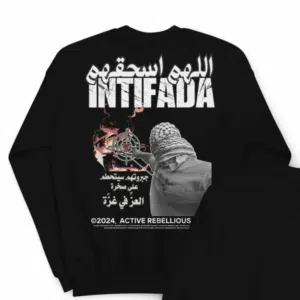
As the slogan spread through music and social media, it began appearing on clothing. Dozens of small brands marketed hoodies and T-shirts featuring “Globalize the Intifada,” often paired with imagery of armed struggle.
At the University of Michigan, the TAHRIR coalition sold sweatshirts with the slogan beside a keffiyeh-clad figure holding a rifle. Jewish students described the design as threatening. University administrators declined to intervene despite formal complaints.
International labels followed. In Denmark, the streetwear brand Netwalker13 released a “Global Intifada” line featuring slogans such as “From tha river to tha streets” and “O Allah, crush them,” alongside drawings of a gunman. The company advertised, “We don’t sell to Zionists.”
Visual Art and Murals: Turning Violence into a Cultural Aesthetic
Art spaces became another channel for spreading the slogan. In Oakland, the EastSide Arts Alliance staged a 2025 exhibit titled If Every Poster Was a Stone. The show went beyond historical reference. It romanticized the violence of the First Intifada, including street attacks on civilians. Curated by the Palestinian Youth Movement Bay Area, the exhibition explicitly framed protest posters as the contemporary equivalent of the First Intifada’s “stones,” presenting art not as reflection but as a tool of confrontation and mobilization.
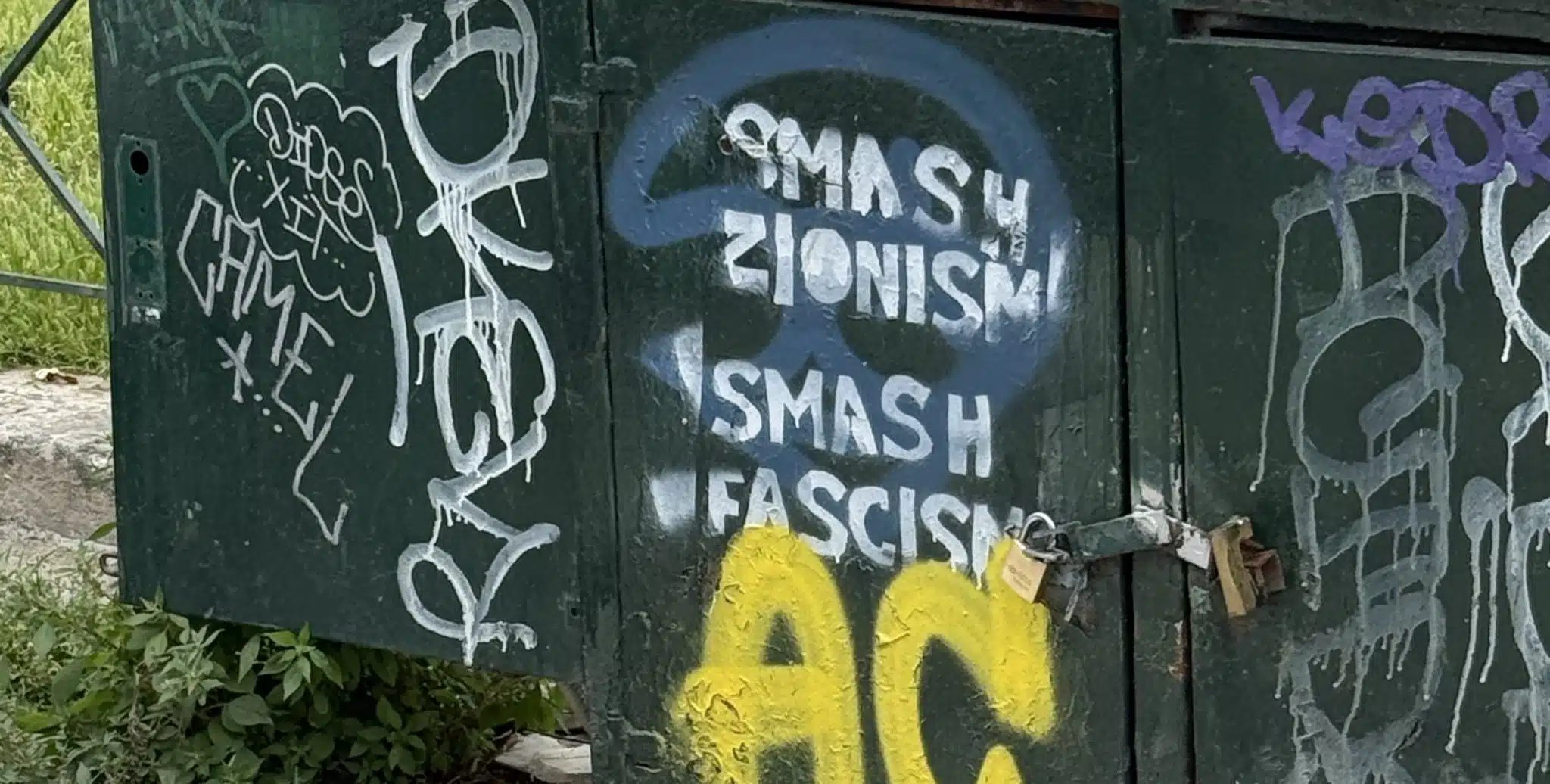
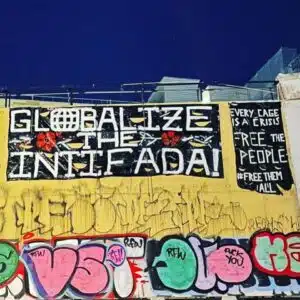
Across Europe, murals echoed the same message. Artists blended Palestinian symbols with masked fighters, slingshots, and intifada slogans. In doing so, they turned terror into street art and blurred the line between political engagement and the celebration of violence against civilians.
Many murals appeared near schools, transit hubs, and cultural centers. These placements mattered. Younger audiences could absorb the imagery without confronting the history it invokes. Activists relied on that absence of context to widen the slogan’s appeal.
TikTok, Memes, and How Algorithms Supercharge Intifada Incitement
Social media carried the slogan far beyond any protest. TikTok and Instagram Reels pushed short, stylized videos into millions of feeds. Coordinated chants appeared alongside music and rapid edits. Algorithms rewarded provocation, elevating intifada rhetoric to users who had never encountered the term before.
As a result, violent language became a repeatable visual and auditory aesthetic. Its meaning did not change, but its reach exploded.
What creators framed as defiance, Jewish communities experienced as threat. What artists labeled “decolonial expression,” survivors recognized as endorsements of bus bombings, restaurant attacks, synagogue shootings, and street ambushes.
From Aesthetic to Identity: When a Slogan Becomes a Brand
Once “Globalize the Intifada” appears on hoodies, album art, or curated playlists, it becomes more than a chant. It becomes identity — something people choose to wear, display, and promote.
Some insist the phrase is symbolic. Yet the groups that popularized it use it to threaten Jews, praise mass murder, and celebrate movements built on deliberate attacks against civilians. Cultural packaging does not dilute that meaning. It accelerates and mainstreams it.
As the slogan embeds itself deeper into music, fashion, and design, extremists gain mainstream cover. What openly endorses violence against Jews begins to circulate as culture — and to evade accountability because of it.
Why ‘Globalize the Intifada’ Meets the IHRA Definition of Antisemitism
“Globalize the Intifada” meets the International Holocaust Remembrance Alliance (IHRA) Working Definition of Antisemitism because it endorses and promotes violence against Jews.
The intifadas were organized campaigns of mass-casualty attacks that deliberately targeted Jewish civilians in buses, cafés, markets, streets, and houses of worship. Calling to “globalize” that model explicitly urges the expansion of such violence beyond Israel and applies it to Jewish communities worldwide.
Under the IHRA definition, justifying or endorsing harm against Jews constitutes antisemitism. The slogan does precisely that by invoking a historical campaign of anti-Jewish terror and urging its replication. It also engages another core IHRA concern: collective targeting, by treating Jews everywhere as legitimate stand-ins for Israel and holding Jewish identity itself responsible for perceived political grievances.
The evidence documented throughout this page — harassment on campuses, intimidation at synagogues, threats at Jewish events, and acts of mass violence — demonstrates how the slogan functions in practice. It does not criticize a government or policy. It mobilizes a framework of violence against Jews.
For these reasons, “Globalize the Intifada” is antisemitic incitement under the globally recognized standard used by governments, institutions, and security agencies to identify and combat anti-Jewish hatred.
Take Action
Slogans like “Globalize the Intifada” function as vehicles for intimidation, harassment, and the targeting of Jewish institutions — and, in the most extreme cases, have been linked to acts of mass violence. When such rhetoric appears — at protests, on campuses, outside synagogues, or online — it should never be dismissed as harmless speech.
If you witness or experience antisemitic incidents, including chants or messaging that glorify or call for the globalization of violence against Jews, report them.
The Combat Antisemitism Movement’s “Report It” app allows antisemitic incidents to be documented in real time, creating a verified record that supports accountability, community protection, and informed response. Reports help expose patterns, identify escalation, and ensure that rhetoric tied to threats or violence is taken seriously by institutions and authorities.
Users can submit reports directly through the CAM “Report It” app. Download it on the Apple App Store or Google Play, and report incidents securely and anonymously when needed.
Documenting antisemitism — especially when violent language is normalized — is a necessary step toward prevention, protection, and accountability.
Conclusion: When a Slogan Becomes a Reality
For survivors of bus bombings, café explosions, stabbings, shootings, and suicide attacks, the word intifada is not abstract. It carries names, graves, and lives erased in seconds. It recalls children murdered on their way to school, families killed during holiday meals, and cities forced to rebuild after each attack. Millions of Jews lived through those years with the same dread — watching the news, fearing the next headline, and knowing that any victim could just as easily have been their own.
What began as a fringe chant did not remain at the margins. Over time, “Globalize the Intifada” moved into street protests and university campuses, into music, fashion, and visual culture, and into political discourse. The phrase was reframed as activism. Its meaning did not change. Only the willingness to deny it did.
The record documented here establishes a clear trajectory. A slogan rooted in mass-casualty terror was normalized by activist movements, amplified by cultural spaces, accelerated by social media, and excused by political actors. As its use spread, intimidation followed — moving from speech to targeting, and from targeting to violence.
By 2025 — and unmistakably by 2026 — the intifada was being globalized in practice. Jews were harassed on campuses, surrounded at synagogues, mapped as enemies, and targeted at public religious gatherings. Amsterdam showed how the ideology operates even without the chant itself. New York and London revealed it at synagogue doors. Bondi Beach exposed its final meaning in blood.
The Choice Institutions Can No Longer Avoid
At this point, institutions now face a choice. They can continue to treat “Globalize the Intifada” as political speech and accept the violence that predictably follows. Or they can recognize it for what it is: an explicit call to replicate the terror of the intifadas against Jews worldwide.
History has already shown what an intifada means. Allowing its globalization is complicity.
Frequently Asked Questions
1. What does ‘Globalize the Intifada’ mean?
“Globalize the Intifada” is a call to export the violence of the Palestinian intifadas beyond Israel and apply it against Jews worldwide. In modern political usage, intifada refers to organized campaigns of mass-casualty attacks, including suicide bombings, shootings, stabbings, and coordinated assaults deliberately targeting Jewish civilians in public spaces. The slogan urges supporters to replicate that model of violence wherever Jews live.
2. Is ‘Globalize the Intifada’ political speech or a call to violence?
“Globalize the Intifada” is a call to violence. The slogan urges the expansion of the intifadas, which were organized campaigns of mass-casualty attacks targeting Jewish civilians. It does not advocate policy change, protest, or diplomacy. It invokes a specific historical model of violence and calls for its replication beyond Israel. Because of that meaning, governments and security agencies treat its use as a warning sign of potential harm to Jewish communities.
3. Does the slogan have a non-violent meaning?
No. While intifada in Arabic can linguistically translate as “uprising” or “shaking off,” its modern political meaning is defined by violence. Both the First and Second Intifadas involved systematic attacks on civilians, including suicide bombings, shootings, and stabbings. In contemporary usage, the term is inseparable from that history, and calls to “globalize” it explicitly invoke those tactics.
4. Why do Jewish communities outside Israel view the slogan as a threat?
The slogan explicitly calls for exporting a campaign that targeted Jews on buses, in cafés, markets, streets, and houses of worship. “Globalize the Intifada” applies that model to Jewish life worldwide, treating Jews everywhere as legitimate targets regardless of nationality or political affiliation.
5. How do extremist groups use the slogan?
Extremist groups use the slogan to glorify armed violence, praise perpetrators as “martyrs,” and legitimize attacks on Jewish civilians and institutions. It is commonly used alongside imagery of weapons, calls for “resistance by any means,” and rhetoric that frames Jews as collective enemies. When challenged, these groups often claim the slogan is symbolic, while continuing to deploy it in contexts that encourage intimidation and violence.
6. Why do security agencies monitor use of the slogan?
Security agencies monitor the slogan because it functions as an operational warning sign. In multiple countries, authorities have documented its repeated appearance alongside extremist organizing, including networks linked to designated terrorist organizations. Its public use has consistently coincided with surges in threats, harassment, and, in some cases, violence targeting Jewish institutions — making it a relevant indicator in threat assessments rather than protected political expression.
7. How does social media accelerate the spread of the slogan?
Algorithms reward sensational chants, visuals, and short videos, pushing them into youth culture at scale while stripping away historical context. That repetition makes the slogan familiar to new audiences and lowers the social cost of repeating language tied to mass violence.
8. Why is ‘Globalize the Intifada’ considered antisemitic?
The slogan endorses a campaign that targeted Jews as Jews. Under the International Holocaust Remembrance Alliance (IHRA) Working Definition of Antisemitism, justifying or endorsing harm against Jews qualifies as antisemitic. The chant meets that standard by promoting the expansion of a violent anti-Jewish campaign.
9. How is chanting ‘Globalize the Intifada’ different from criticizing Israeli policy?
Criticism of Israeli policy addresses government actions and political decisions. “Globalize the Intifada” invokes a violent uprising and urges its expansion. It contains no call for diplomacy, reform, or negotiation — only confrontation and the replication of violence.
10. What should institutions do when the slogan appears?
Institutions should treat the slogan as a warning sign. They should document incidents, notify security partners, and provide visible support to Jewish students, staff, or congregants. Clear public messaging should explain that the chant invokes a history of organized attacks on civilians and is not ordinary political expression, but language rooted in a documented history of mass-casualty violence against civilians.