|
Getting your Trinity Audio player ready...
|
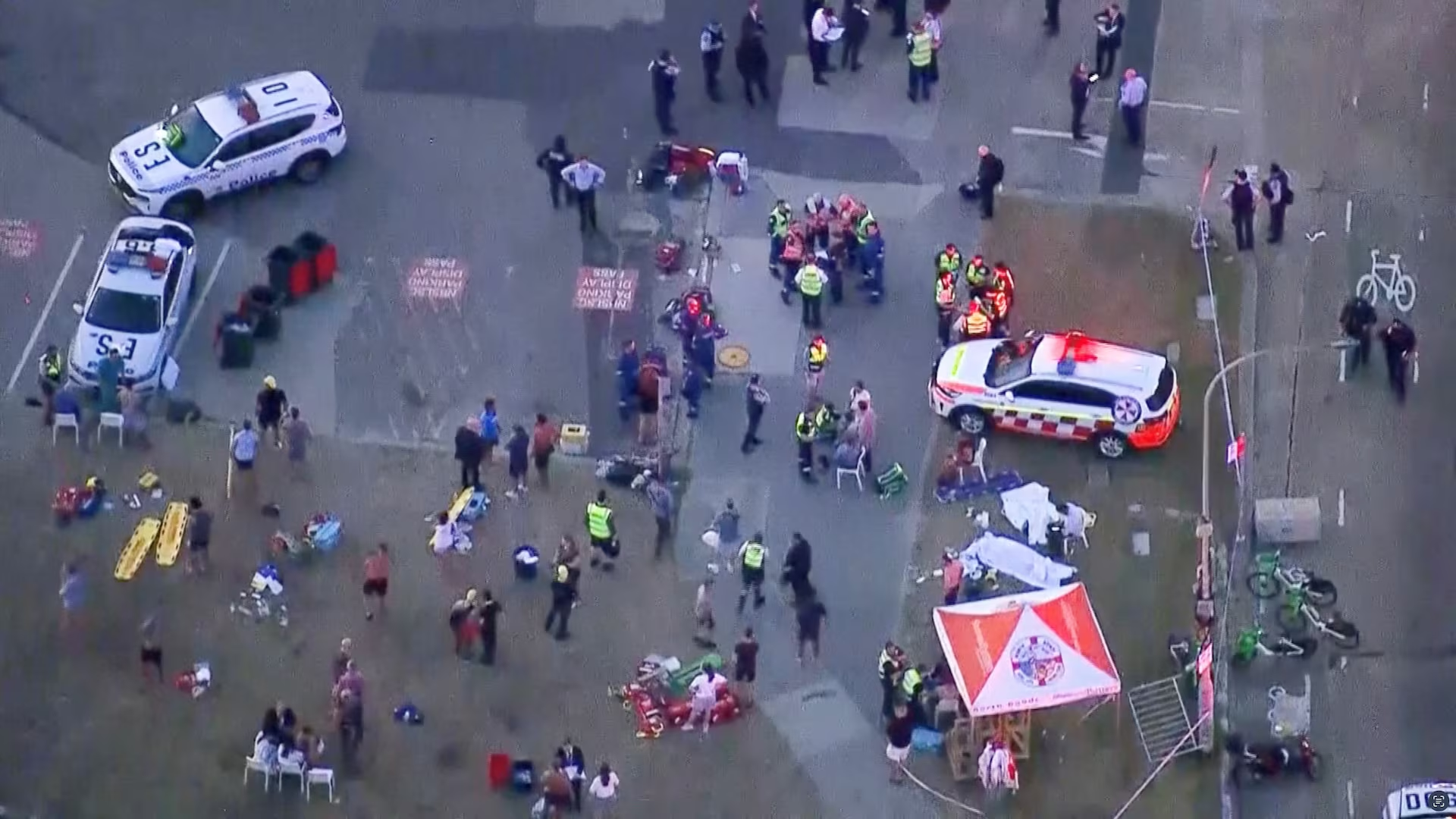
The massacre of 15 people this past Sunday at a Hanukkah menorah-lighting ceremony in Bondi Beach, near Sydney, marked the worst-ever act of antisemitic violence in Australian history, and the deadliest terrorist attack targeting Jews around the world since the October 7th massacre in Israel two years ago.
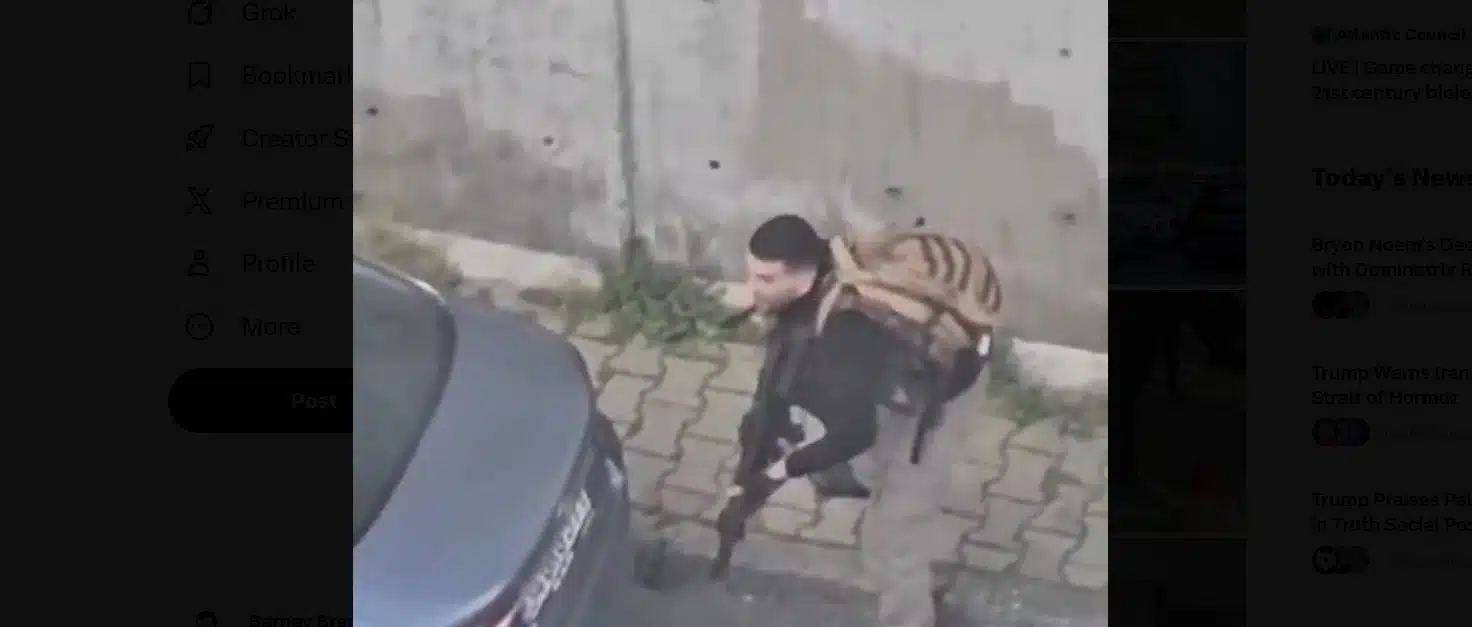
The shootings were perpetrated by a father-son duo — Sajid Akram, 50, and Naveed Akram, 24 — who are believed to have pledged allegiance to the Islamic State (IS) terrorist organization beforehand. Sajid Akram was killed by police at the scene, and Naveed Akram was wounded and taken to a hospital, where he remains in custody.
The attack came against the backdrop of a post-October 7th surge of antisemitism in Australia. Earlier this month, the Executive Council of Australian Jewry (ECAJ) reported it had documented 1,654 incidents of antisemitism in Australia between October 1, 2024 and September 30, 2025 — a figure that “remains at about three times the total of any year prior to the worldwide wave of antisemitic incidents that followed” October 7th.
A Prior Warning
Last January, the Antisemitism Research Center (ARC) by CAM warned of the rising threat of antisemitic violence in Australia, highlighting a spate of incidents involving physical threats and vandalism.
Examples included Jewish houses of worship in Sydney defaced with swastikas, the phrase “Gas the Jews” graffitied at a Sydenham train station, the vandalization of the home of an Australian Jewish leader, and an arson attack at Adass Israel Synagogue in Melbourne, among other incidents.
“The increasingly violent manifestations of antisemitism in Australia are clear, and many Jews in Australia feel abandoned,” the ARC wrote at the time. “Australian authorities must take action to address this growing problem before the situation gets even worse.
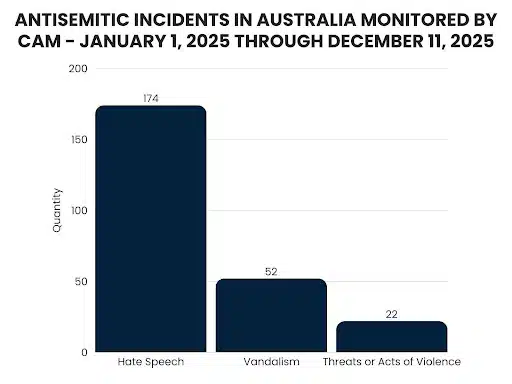
Approximately 30 percent of the incidents of antisemitism monitored by the ARC in Australia between January 1 and December 11 of this year involved violent threats or acts and vandalism.
In August, Australia expelled the Iranian ambassador from the country over the Tehran regime’s orchestration of attacks on Jewish institutions in Sydney and Melbourne.
Anti-Israel Hate Incites Violence
Just two weeks before Sunday’s atrocity, vandals targeted Bondi Beach with antisemitic graffiti, scrawling “Israel commits genocide,” “F*** the IDF,” “F*** Zionism and Israel,” “Free Palestine, F*** Israel,” and “Israel has blood on their hands,” on a number of buildings and bollards.
While it is unclear whether that particular act vandalism was connected to Sunday’s attack, public expressions of hate speech of this nature underscored how deeply antisemitism has permeated parts of Australian society.
A survey commissioned by CAM ahead of the Australian Mayors Summit Against Antisemitism, held in Gold Beach in September, found that less than a quarter of Australians (24%) described general public attitudes to Australia’s Jewish population as very positive (9%) or slightly positive (15%), while 28% of respondents felt attitudes toward Jews were very negative (8%) or slightly negative (20%).
The most common category of antisemitism today is its anti-Zionist forms, and vitriol toward Israel creates a broader environment hostile to Jewish cultural and political expression and incites malign actors to attack Jewish communities.
A total of 61.7 percent of the antisemitic incidents recorded by the ARC this year through December 11 exhibited clear rhetorical indicators of Israel-related or anti-Zionist antisemitism.
Two years ago, anti-Israel demonstrators celebrated the October 7th attacks with “Gas the Jews” chants in front of Sydney’s iconic Opera House, and this past August protesters marching across Harbour Bridge chanted “Long Live the Intifada.”
On the second anniversary of October 7th two months ago, a “Glory to the Martyrs” protest was held in the Sydney suburb of Bankstown, and a man was arrested for allegedly aiming a gun at a synagogue in Neutral Bay.
Two days later, a University of Sydney staff member harassed Jewish students, asking “Are you a Zionist?” and slurring them as “f*cking filthy Zionist[s]” who “colonized us.”
Antisemitism on Rise Across Ideological Spectrum
The leading ideological category for antisemitic incidents in Australia in 2025 has been far-left, at 59.3 percent, mirroring global trends monitored by the ARC.
Antisemitism linked to far-right ideologies is also plaguing Australia, however. In early November, for example, an Australian white nationalist group staged an antisemitic rally outside the New South Wales Parliament in Sydney, with a speaker declaring, “The Jewish lobby is destroying our nation.”
A total of 19.8 percent of incidents in Australia tallied by the ARC this year were in the far-right category — slightly higher than the 18.2 percent in the United States and significantly higher than the 10.7 percent in Canada.

A Heightened Threat on Jewish Holidays
Antisemitic terrorists have been known to time attacks for Jewish holidays, aiming to take advantage of large communal gatherings to wreak death and destruction.
In early October, an Islamist terrorist murdered two Jewish worshipers and wounded three others outside a synagogue in Manchester, England, on Yom Kippur, the holiest day of the Jewish year. A neo-Nazi assailant targeted a synagogue in Halle, Germany, in 2019.
The white supremacist gunman who massacred 11 Jews at Pittsburgh’s Tree of Life synagogue in October 2018 — the deadliest antisemitic attack in U.S. history — struck during Shabbat services.
In Israel, the Palestinian terrorist group Hamas has also conducted major attacks on Jewish holidays — most notably the October 7th massacre on Simchat Torah in 2023, as well as the Park Hotel Passover Seder suicide bombing in Netanya in 2002, among others.
Even before October 7th, Hanukkah has been generally accompanied by a spike of antisemitic incidents globally, as the eight-day winter holiday’s high visibility — with menorahs on display in prominent open locations and the windows of private homes — provides an easily-accessible, target-rich environment for Jew-haters (this trend was tracked in detail by the ARC in 2023 and 2021).
Action Needed to Safeguard Australian Jewish Lives
Following Sunday’s Bondi Beach attack, CAM CEO Sacha Roytman stated, “We call on the Australian authorities to not just hunt down all those involved but take a far stronger stance against incitement against Jews in all of its forms, from the far-left, the far-right, and Islamist preachers. The moment for action has long passed.”
The death of 15 Jews at the hands of Islamist attackers at a public Hanukkah celebration clearly demonstrates that the Australian government, at the national and local levels, must do more to protect the Jewish community and identify and confront antisemitism in all its contemporary forms — particularly its anti-Zionist iterations that drove Sunday’s horrific violence.
Australia’s Jewish community has a rich heritage, with Jews playing a integral role in the country’s history. However, further passivity by Australian authorities in the face of rising antisemitism will only invite more bloodshed, putting the viability of Jewish life in Australia in grave jeopardy and undermining the cohesion of Australian society as a whole.