|
Getting your Trinity Audio player ready...
|
CAM’s Antisemitism Research Center (ARC) documented 43 antisemitic incidents linked to Halloween celebrations across nine countries between Oct. 29 and Nov. 1.
The incidents, which included Nazi glorification, Holocaust mockery, and antisemitic caricatures, were tracked in the United States, Canada, Mexico, Brazil, Colombia, Chile, Spain, Switzerland, and Japan.
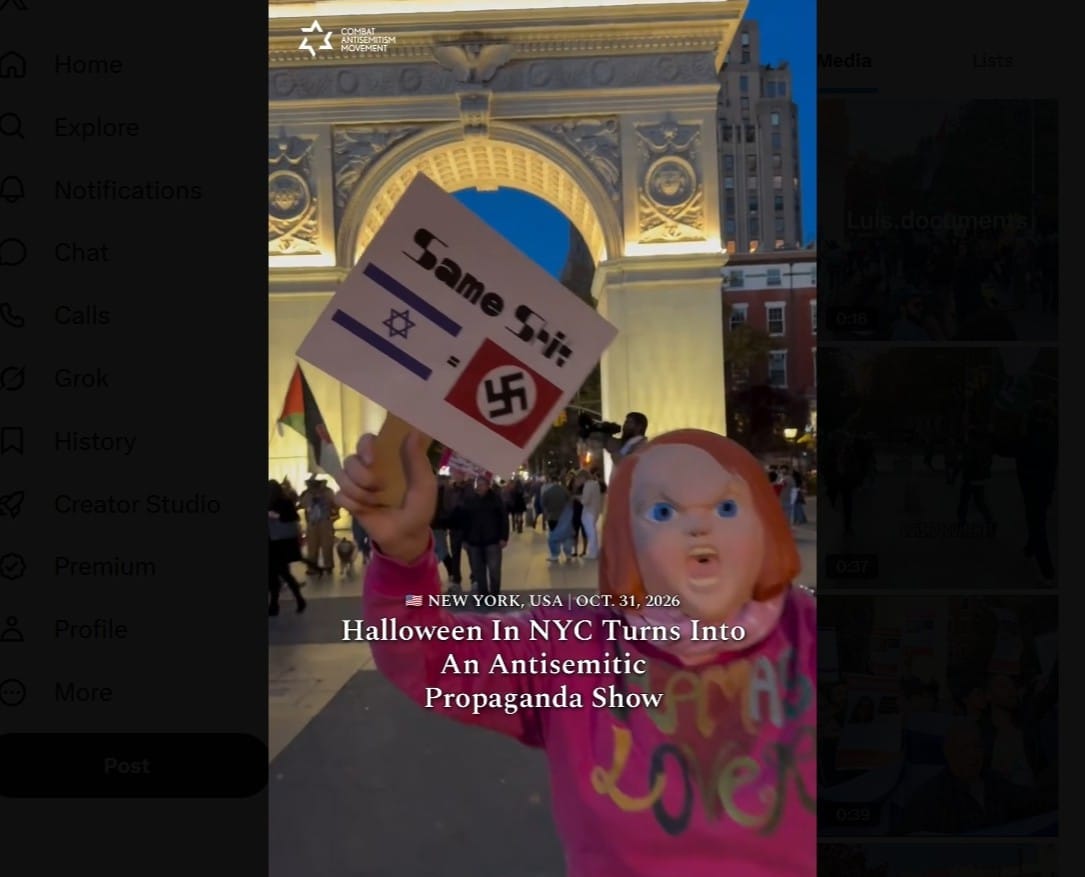
The United States and Canada accounted for the largest share of incidents. A Halloween event at Washington Square Park in New York City alone featured more than ten overt manifestations of antisemitism.
🇺🇸 New York, USA, Oct. 31, 2026:
Halloween in NYC turned into an antisemitic propaganda shitshow.In Washington Square Park, a sign equated the Israeli flag with the Nazi swastika.
Every other sign pushed blood libels and lies about Israel.
This is antisemitism, out in the open.
— Combat Antisemitism Movement (@CombatASemitism) November 1, 2026
Of the 43 incidents, 39 were classified as examples of classical antisemitism, including Nazi imagery, “blood libel” motifs, and age-old tropes portraying Jews as wielding disproportionate financial and political power.
The incidents spanned the ideological spectrum: 23 were attributed to far-right motives and 12 to far-left motives.
Nazi Costumes on Display
The most common antisemitic trend identified this Halloween was the open display of Nazi uniforms and swastikas. Incidents in this category spanned four continents, with several involving minors.
In Langley, British Columbia, a teenager dressed as Adolf Hitler, complete with a swastika armband, performed a Nazi salute at a public Halloween street party.
Halloween, Langley, BC.
Photos posted by a proud mom (she didn’t even blur the kid’s face, I did)An article about it was titled: “Viral Hitler Costume at Canadian Halloween Party Sparks Fury as Some Defend It as ‘Edgy Humour'”
Edgy Humour.
@Tafsikorg
@l3v1at4an https://t.co/sdF7swDvTi— Masha Kleiner (@mashakleiner) November 3, 2026
In Cole Harbour, Nova Scotia, an adult man went trick-or-treating while pushing a stroller and wearing a black SS officer’s uniform with a swastika armband.
Mein Kostüm! Who is Cole Harbour’s Cosplay Nazi?
Another Halloween in Nova Scotia, another racially-charged wardobe malfunction… (story link in replies)
Mentions: Col. Klink Mark Carney Matt Goreham Russell Hubley https://t.co/kuiAB3Yt2e
— Frank Magazine NS (@Frank_Mag_NS) November 2, 2026
Similar incidents were monitored in Latin America. In Mexico, teenagers wore brown SA-style Nazi uniforms and swastika armbands, while another man appeared in an SS uniform. In Chile, a child gave a Nazi salute at a Halloween event, and someone dressed in a KKK robe walked the streets of Santiago. In Colombia, a man in an SS uniform performed a Nazi salute during a public parade. In Brazil, a boy dressed as a Nazi soldier appeared alongside another costumed as a chained Jew.
In the United States, two men wearing Nazi uniforms bar-hopped in Nashville, one carrying a red gas can in an apparent reference to the gas chambers of the Holocaust.
I’m still in shock. For some reason, these guys thought it was a good idea to go bar-hopping in these absolutely disgusting Halloween costumes on Broadway.
So, internet, do your thing. Walking around in a Nazi uniform while carrying a gas can is never OK. And shame on the people who lined up to take pictures with them.
— Maren Angus (@Maren_Angus) November 1, 2026
In Pittsburgh, a woman dressed as Hitler was admitted to a comedy club, while the Chi Psi fraternity at the University of Michigan promoted a “Hallowcaust” party using the phrase “Get gassed up.”
U Michigan GroupMe chat earlier today … we have no words. https://t.co/oOhIjIJ35r
— StopAntisemitism (@StopAntisemites) November 1, 2026
In Japan, youths paraded a swastika flag and gave Nazi salutes.
halloween, japan https://t.co/V5tVfSbWGY
— 𝚓𝚒𝚖𝚖𝚢 (@202accepted) October 31, 2026
Monsters, Money, and Blood: Old Tropes in New Costumes
Halloween also revived familiar antisemitic stereotypes demonizing Jews as bloodthirsty and greedy. The imagery, largely directed at Israel and religious Jews, drew on centuries-old antisemitic myths.
The most concentrated examples appeared at Halloween festivities in Manhattan’s Washington Square Park. Revelers wore demonic masks featuring bloodied Stars of David, while signs accused Israel of killing children, labeled it a terrorist state, and equated the Israeli flag with the Nazi swastika.
An Israeli flag marked “TERRORIST” was placed on the ground for people to trample. Others wore a “HAMAS LOVER” hoodie and a Pikachu costume with a militant-style headband. The recurring imagery of blood and child-killing echoed the medieval “blood libel,” the false accusation that Jews ritually murder children.
Similar rhetoric appeared in the Spanish capital of Madrid, where a costume depicted an Orthodox Jew through antisemitic caricatures, including fake sidelocks and a hooked nose, holding a severed hand with bloodied hands beside an Israeli flag bearing a bloody handprint.
Political displays targeting Israeli leaders also drew on traditional antisemitic imagery. In Ontario, Canada, someone wore a devil-horned mask of Israeli Prime Minister Benjamin Netanyahu and called Israeli Minister of National Security Itamar Ben-Gvir the “scariest monster alive,” while a Netanyahu effigy was hanged from a balcony in Montreal’s Rosemont neighborhood.
The stereotype of Jewish greed was equally prominent. In New York City, men dressed as Hasidic Jews waved dollar bills, and two young men in rabbi costumes joked they get to “save every penny,” before adding “Free Palestine.” In the Georgetown neighborhood of Washington, DC, a “GREEDY KUSHNER” sign was displayed. In Canada, a Hasidic costume was paired with a partner covered in cash. Similar Hasidic caricatures appeared in other locations, including in Ponce, Puerto Rico.
Taken together, these incidents demonstrated how Halloween activities can become vehicles for the normalization and amplification of longstanding antisemitic tropes and revealed how deeply-rooted antisemitic stereotypes continue to surface in contemporary public spaces. They also underscored how quickly criticism of Israel often devolves into blatant Jew-hatred.
Read more:
Zara Pulls Children’s Halloween Costume Likened to Nazi Concentration Camp Uniforms
Pennsylvania High School Halloween Parade Float Replicating Auschwitz Gate Sparks Outrage