|
Getting your Trinity Audio player ready...
|
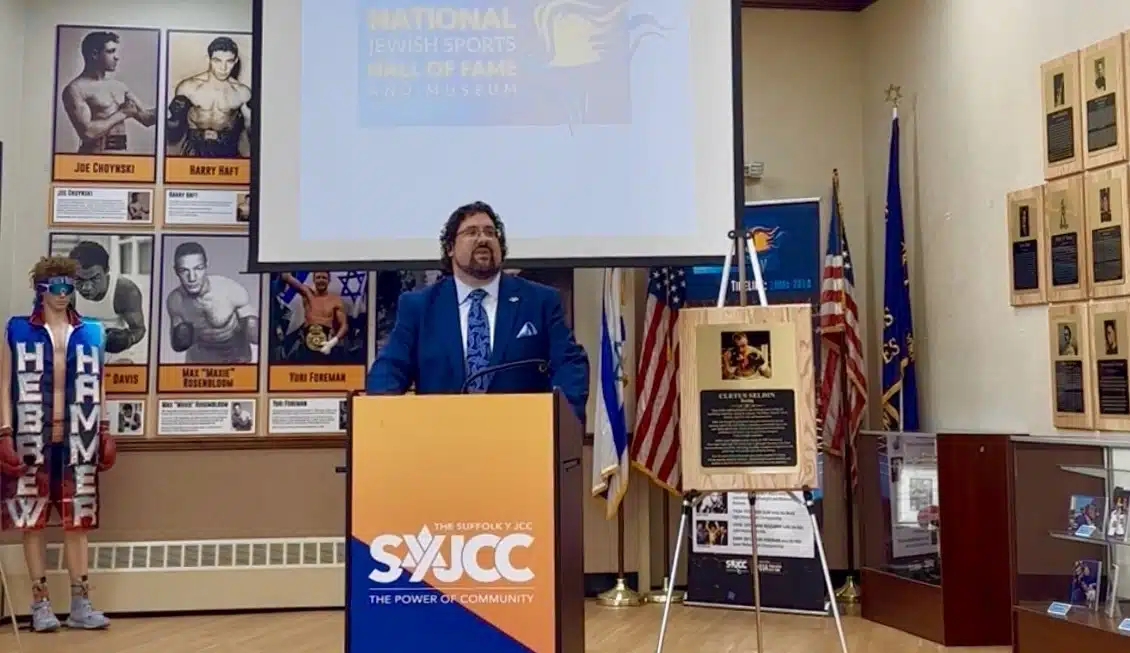
Jason Bartow chairs the National Jewish Sports Hall of Fame and Museum, housed at the Suffolk Y Jewish Community Center in Commack, New York. A native Long Islander, a Solomon Schechter Day School alumnus, and a Vassar College graduate, he also serves on the Election Committee of the International Jewish Sports Hall of Fame in Israel.
Founded in 1993, the National Jewish Sports Hall of Fame had largely faded from public view by the time Bartow became involved in 2019. He saw not only something worth saving, but an opportunity to turn the institution into a source of Jewish pride at a time when many Jews feel pressure to conceal their identity.
In a conversation with the Combat Antisemitism Movement (CAM), Bartow reflected on the Hall’s revival, rising antisemitism, and the role sports can play in strengthening Jewish identity.
What drew you to the Hall of Fame, and was there a Jewish athlete who inspired you growing up?
Bartow had been on the board of the Suffolk Y JCC for years. A lifelong baseball player and travel baseball coach, he believed in what sports could teach beyond the field. When the Hall went quiet, he was disappointed to see it lose momentum. “There’s such potential here,” he recalled thinking. “Let’s not just have plaques. Let’s get athletes here. Let’s get video messages. Let’s set up specialty exhibits.” With the support of JCC leadership, he began rebuilding the Hall around that vision. COVID delayed the effort almost immediately, but the first induction ceremony eventually took place in 2023. Since then, the Hall has inducted athletes and broadcasters including Mathieu Schneider, Jeff Bukantz, Aaron Krickstein, and Kenny Albert. It has also mounted specialty exhibits such as “Pucks and Pioneers.”
Asked which Jewish athlete inspired him most growing up, Bartow answered without hesitation. “Aaron Krickstein,” he said. He watched the young tennis player beat top-ranked opponents on the world stage. “His father’s a doctor. I was like, oh, it can’t get more Jewish than this,” he said. Following Krickstein in the pre-internet era meant hunting through newspaper box scores for tennis results buried deep in the sports section. When the Islanders later acquired Schneider during his college years, he became even more curious about the Jewish figures he encountered through sports. “You start unearthing, well, who else is Jewish?” he said. “And then you find out that for years and years, I’m listening to the Yankees on the radio being broadcast by two Jews, John Sterling and Suzyn Waldman.”
You relaunched the Hall during one of the hardest periods for Jewish identity in a generation. How does that shape what the Hall of Fame is doing?
Bartow grew up in the 1980s and 1990s, in a world that looked nothing like the one his children now navigate. “Even people who didn’t know the region understood that this was a democratic country, a country where people had rights,” he said. “We were coming out of the Soviet Jewry Drive with Natan Sharansky, Operation Moses out of Ethiopia. These were huge issues that everybody knew about.”
Then came October 7th and the wave of anti-Israel activism that followed. Bartow worked in political campaigns before insurance, and the coordination behind what followed on campuses looked familiar to him. “When we would go to rallies, you had the freshly printed sign. You could still smell the ink,” he said. “You think it’s a coincidence that on all the college campuses, it was all the same signs, all the same tents?”
Against that backdrop, the Hall of Fame became something more than a museum. Bartow sees it as an opportunity to highlight stories of Jewish achievement at a time when many young Jews are searching for pride and connection.
“We have a platform,” he said. “In the world of athletics, there has been some really exceptional Jewish achievement.”
The message, he said, cuts across every kind of Jewish observance. “There is so much pride to take in your heritage,” he said. “It doesn’t matter how observant you are, if at all. What is significant is being able to walk around and say, yes, I’m Jewish. I’m proud I’m Jewish. It is a part of who I am.”
How are young Jewish people navigating their identity right now?
Bartow’s son is a hockey player, six feet tall, 190 pounds. When the JCC sends a team to the Maccabi Games, he won’t wear the team backpack afterward. “He’s like, ‘Well, I don’t want anyone to look at it,'” Bartow said. “They feel like if they’re not too outwardly Jewish, they won’t get stared at.”
He sees this everywhere he looks. “Is it a Magen David necklace? How outwardly Jewish can you be?” he said. “It’s a reality that a lot of people are facing.”
Athletes competing at the highest levels who embrace their Jewish identity openly send a signal to every kid making that same calculation. “The modern athletes are like, ‘Yeah, I didn’t even think it was a thing. But now that I’m retired, I’ve come to realize how important it is that I tell young people I was a Jewish athlete. You can be a Jewish athlete. There is nothing that limits you.'”
What misconceptions about Jews and athletics does the Hall of Fame help challenge?
The stories come from the inductees themselves. “Every now and then, you’ll get an athlete who will talk about growing up, how it wasn’t easy,” Bartow said. “They were called names. ‘What are you doing here? You should be an agent, not an athlete.’ Sometimes it’s joking, but to suggest that because I’m Jewish, I can’t be an athlete, that in itself is an antisemitic concept.”
The misconception runs deeper than jokes. Bartow traces it back to the 1920s and 1930s, when Jewish boxers were winning world championships. “To see these strapping Jewish boxers winning, that says to you, especially that generation, still a lot of off-the-boat people or first-generation kids, we’re not just second-class citizens,” he said. “We are literally fighting our way to the top.” The Hall of Fame’s newest exhibit, “Gloves and Grit,” honors figures like world heavyweight champion Max Baer, who fought wearing a Jewish star on his trunks. “The world of Jewish sports doesn’t start and end with Sandy Koufax and Hank Greenberg,” Bartow said. One of his favorite recent examples is Jack Hughes, who won gold for Team USA at the Winter Olympics. “Jack Hughes is the first person to score a game-winning Olympic ice hockey goal and have a bar mitzvah,” he said.
What has surprised you most about the athletes’ reactions to being inducted?
When Bartow calls to tell athletes they have been selected, the conversation often goes somewhere he never expected.
“You hear in their voice how much it means to them,” he said. “Everyone has a story.” Many have won championships, MVP awards, or even Stanley Cups, but the Hall’s recognition often resonates differently.
“I’ve won the Stanley Cup,” Bartow recalled one athlete telling him, “but being recognized in the Jewish Hall of Fame has such meaning to me and my family and my kids and eventually my grandkids.”
What struck him most was a pattern that surfaced in conversation after conversation. “Sometimes it was laying dormant, but it was always there the whole time with them,” Bartow said. “And a lot of them will say, ‘I didn’t realize that’s what pushed me. That’s what motivated me.'”
If someone walks into the Hall of Fame knowing very little about Jewish history, what do you hope they leave with?
“That’s the question that shaped our vision,” Bartow said. The answer, he said, is simpler than it might sound. “I had no idea. This is so amazing. I can do anything.”
The names on the walls are not distant historical figures. They’re NHL Commissioner Gary Bettman, Olympic gold medal gymnasts Aly Raisman and Kerri Strug, retired NFL defensive tackle turned professional wrestler Bill Goldberg, legendary NBA broadcaster Marv Albert, and ESPN anchor Linda Cohn. “You see these people and you go, I know them. And they’re here. And they achieve. And I can achieve,” Bartow said. “If you walk out of those doors and you have that sense of pride and you are jazzed up to go out into the world and take that pride with you and carry it forward,” he said, “that’s what we want to inspire.”
What gives you hope when you look at the next generation of Jewish athletes?
The athletes succeeding on the national stage aren’t ducking the question, Bartow said. “It would be very easy for a number of people not to answer, to say, ‘Let’s leave that alone,'” he said. “But if the topic is broached, they will talk about it. They’re not afraid.”
The Jewish major leaguers who chose to represent Team Israel in the World Baseball Classic are one example.
“Not hiding it,” he said.
He sees the same pride in athletes who learn they have been inducted into the Hall of Fame. Many tell him they want to attend in person, return the following year, or bring their children with them.
Bartow keeps coming back to the pattern in their voices, the surprise in their own words when they realize that the thing they carried with them their whole careers had a name, and the name was Jewish.
“Keep fighting, keep believing, keep dreaming,” he said, “but always be proud of who you are.”