|
Getting your Trinity Audio player ready...
|
The following is an op-ed authored by Combat Antisemitism Movement (CAM) CEO Sacha Roytman and originally published in The Jerusalem Post:
This week at CAM we honored a group of Ethiopian Jewish women, all of them first or second-generation immigrants to Israel. We helped produce a book telling the stories of forty of them, women now leading their communities and their country forward. I sat and listened to them for ninety minutes, and I could not hide my tears. I was watching pure Zionism, the real thing, and feeling how badly that word has been hijacked by people who simply hate Jews.
We live in a time when too many speak about Zionism as if it were a modern political invention. They reduce it to a conflict, distort it into an ideology of power, turn it into an accusation. They shout against Zionism without ever asking what it truly means to the Jewish people.
Zionism did not begin with Theodor Herzl. He gave modern voice to an ancient longing, but he did not create it. The bond between the Jewish people and Zion was already written into our history, spoken in our prayers, and rooted in our Torah long before he was born. It began with the first command to go. Lech lecha. Go forth.
Those words open Parashat Lech Lecha, the parasha of my Bar Mitzvah, maybe one reason I always felt that Israel was not just an idea for me, but a calling. Lech lecha me’artzecha, umimoladetecha, umibeit avicha, el ha’aretz asher areka. Go from your land, from your birthplace, from your father’s house, to the land that I will show you (Genesis 12:1).
That is where the Zionist journey begins, not with a political congress, not with a campaign, not with a slogan, but with a promise — a people, a land, a destiny. For thousands of years, Jews carried that promise through exile. We pray toward Jerusalem, we end our Passover seders with “Next year in Jerusalem.” We break glass under the chuppah to remember that even in moments of joy, Jerusalem could not be forgotten.
That is Zionism. It is not colonialism but return, not supremacy but belonging. It is the affirmation that the Jewish people, like every people, have the right to live freely in their ancestral homeland.
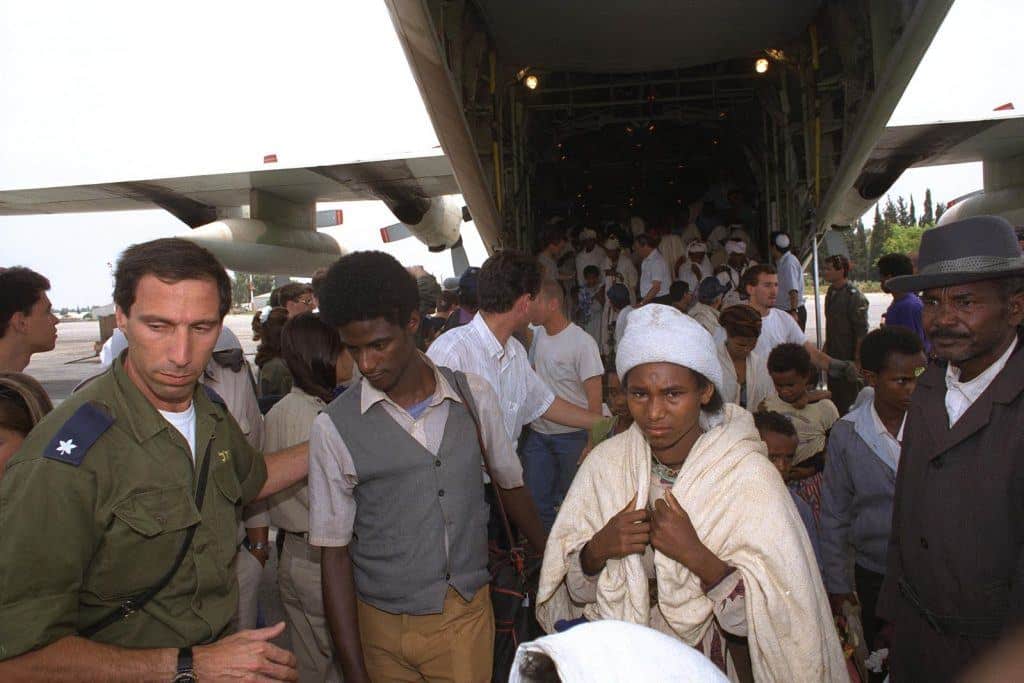
And few stories reveal that truth more powerfully than the story of Ethiopian Jewry. For some 2,500 years they lived largely in isolation from the majority of world Jewry, cut off from much of the rest of the world, from its politics, its news, its history.
Many did not know that Israel had been reestablished in 1948; word reached them only later. They had never heard of Theodore Herzl. They did not learn of the Holocaust until years after it happened. And yet through all those centuries, they preserved their Jewish identity with courage and faith. They lived far from Jerusalem, but Jerusalem never left them. That is why their story is one of the greatest answers to modern anti-Zionism: their Zionism owed nothing to congresses, headlines, or modern events.
It was ancient, it was theirs, and it is the story of every Jew on earth.
Anti-Zionism tries to tell the world that Zionism is foreign, artificial, white, colonial, recent. Ethiopian Jews prove the opposite. They prove that Zionism belongs to no single color, language, accent, or geography, that the Jewish people are ancient, diverse, and united by a bond deeper than the categories the world tries to impose on us. Zionism is not about making Jews the same; it is about bringing home a people scattered across the earth and letting each community carry its own story into the shared story of Israel.
The Zionism of Ethiopian Jews is my Zionism too. It comes from the same promise God made to Abraham, a promise repeated through the generations, but spoken first in Lech Lecha. I still feel those words. They traveled through wars and centuries and generations until they reached me at my Bar Mitzvah, and at eighteen I took them seriously: I moved to Israel, because I truly believe in my history, my people, and my God.
We all need heroes, and one of mine is Racheli Tadessa Malkai, Founder and Chairman of the Ethiopian Women Empowerment Association who is partenring with CAM. Her energy, determination, and sense of purpose inspire me. She built something extraordinary, helping Ethiopian women in Israel take pride in their identity as Jews, as Zionists, and as leaders. When challenges arise, she does not complain; she creates solutions. She builds, she lifts others, she moves an entire community forward.
I have known Racheli since CAM began supporting her work after October 7, 2023. I knew then that she was a remarkable leader, but watching hundreds of women this week looking to her as a role model, I felt humbled to stand beside her.
Under the leadership of Hadas Bar-Erez, who has been with CAM for nearly seven years, we were proud to support the launch of a book at the official Israeli President’s Residence in Jerusalemt. Hosted by Israel’s First Lady, Michal Herzog, the event celebrated the release of Women and Roots, the stories of forty extraordinary Ethiopian women.
One of them is my friend Tsion Abunie, with whom I had the honor of serving in the IDF, a role model not only for Israelis of Ethiopian descent but for all Israelis.
Their stories are Zionism in its truest form. Not the imagined “Zionism” shouted about on campuses by people who have never opened a Jewish prayer book. Not the “Zionism” as distorted by those who want to erase Jewish history. Not the “Zionism” as reduced by activists who see Jews only through the lens of power and identity politics, never through the lens of memory, survival, faith, and return.
That is why anti-Zionism is not only wrong; it is ignorant. It ignores Abraham hearing Lech lecha. It ignores the Torah, and Jerusalem in our prayers, and the Jews of Ethiopia who dreamed of Zion long before modern politics discovered the word.
It ignores the Jews of Yemen, Morocco, Iraq, Iran, Poland, France, Russia, India, Argentina, and America. It ignores the fact that Israel is not a foreign project planted in the Middle East, but the return of an ancient and indigenous people to the land that shaped its identity, language, faith, and destiny, and it ignores the living miracle of modern Israel — a country where Jews from every corner of the earth continue the unfinished work of rebuilding a nation.
Moreover, this is not only ancient history or my own conviction. This month, CAM’s Antisemitism Research Center (ARC) released a new national survey of American Jews. In it, 78% affirmed that Israel is the ancestral homeland of the Jewish people, and 65% agreed that Zionism meant recognizing Jews as a people rooted in the Land of Israel.
For thousands of years, Jews carried Zion in their hearts. This week, in a room full of Ethiopian women in Jerusalem, I watched what it looks like to carry Zion forward.