|
Getting your Trinity Audio player ready...
|
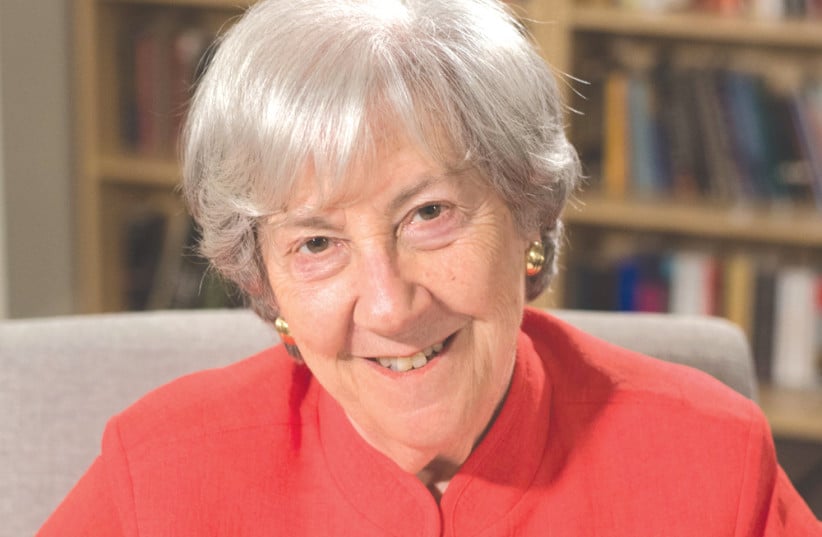
For decades, Professor Ruth Wisse has remained among the foremost interpreters of Jewish intellectual and political life. A scholar of Yiddish literature, Jewish history, Zionism, and antisemitism, she has spent her career examining how Jewish civilization sustains itself across generations — and what happens when that chain of transmission breaks.
Wisse founded the Department of Jewish Studies at McGill University, where she taught from 1968, before joining Harvard in 1993 as its first Martin Peretz Professor of Yiddish Literature. She taught there until her retirement in 2014, and is currently Distinguished Senior Fellow at the Tikvah Fund and a member of the Combat Antisemitism Movement (CAM) U.S. Advisory Board. Among her many books spanning both literature and politics are The Schlemiel as Modern Hero (1971), I.L. Peretz and the Making of Modern Jewish Culture (1991), If I Am Not for Myself: The Liberal Betrayal of the Jews (1992), The Modern Jewish Canon (2000), Jews and Power (2007), No Joke: Making Jewish Humor (2013), and her memoir Free as a Jew (2021). She has written for Commentary Magazine since 1976, and her essays appear regularly in The Wall Street Journal, Mosaic, and National Affairs. In 2007, President George W. Bush awarded her the National Humanities Medal. Earlier this year, she delivered the National Endowment for the Humanities Jefferson Lecture, one of the most prestigious honors in American intellectual life.

Wisse recently sat down with CAM for an in-depth conversation on her life’s work. The discussion explored Jewish civilization, American identity, Israel, and Wisse’s enduring argument that antisemitism is rarely about Jews themselves, but about the political forces that organize against them and the societies they seek to reshape. What followed was an hour in the company of one of the most intellectually fearless voices in the Jewish world today.
You’ve spent your career studying and teaching Jewish literature not simply as a body of texts, but as a record of how Jews have understood themselves across radically different historical conditions. What does literature preserve that history alone cannot, and what is lost, intellectually and morally, when that tradition is no longer central to Jewish education?
Wisse goes back to where it began, in Montreal in the 1940s and 1950s. “We were very lucky to get to Montreal,” she says, “and there couldn’t have been a better place to grow up.”
Quebec’s educational system at the time was entirely sectarian. When Jews began arriving in larger numbers in the 1920s, the law resolved the question by classifying them as Protestant. Not everyone accepted that. “Very brilliant and capable and enterprising young people, mostly men, of course, who in another generation would have become professors or rabbis,” she says, “went into building Jewish day schools instead.”
Wisse attended one of them, the Jewish People’s School. “The principal of the school, when he retired, translated the Greek philosopher Epictetus into Hebrew,” she says. “The vice principal put out five volumes of Midrash. These were our teachers, and we studied literature.”
Those teachers understood something about literature that the academy would later try to theorize. Literature wasn’t a subject. It was a form of national conversation. “Everything was in it,” she says. History, argument, memory, criticism, identity, faith — all of it arrived through the same text, experienced first alone and then together. “You see how other people respond to something that you’ve responded to, and it’s not necessarily the same. The teacher then comes in and puts this in a historical context. So you begin to study this wonderful gem of your own experience within a different light as well.”
What that classroom practice cultivated was the distinctly Jewish tradition of looking at a text not with deference but with argument. “You develop the critical faculties that have been a staple of Jewish intellectual life forever, because you’re not given this text and expected to bow before it,” she says. “The rabbis have taught us that every text is to be looked at critically. So it becomes part of a collective experience, and then it becomes part of a literary tradition, which is also, in our case, a national religious tradition. These things are inextricably bound up and very rich.”
When she carried that understanding into American academic life, she found the field moving in the opposite direction. “As the field of literary studies became more and more theoretical, my own approach to it became more and more resistant,” she says. Moving into Yiddish literature gave her the freedom she needed. “There it was understood that this was a body of texts, so I could teach it in my own way,” she adds.
You’ve described the period from 1948 to 1973 as a kind of “Time of Grace” for Jews, particularly in the United States, a moment when Jewish life was marked by an unusual sense of security, legitimacy, and alignment with American ideals. To what extent did that period shape, and perhaps limit, how American Jews came to understand both their place in the United States and the nature of the society around them?
“The most important thing that happened in the post-war period, I might almost say for the world entire, but certainly for the Jewish people, was the resurrection of Israel.” She uses the word intentionally. Jesus is believed to have been resurrected after three days. “But the Jewish people collectively accomplished a miracle that is unmatched in the history of nations,” she notes. “In three years, from 1945 to 1948, this people that had been reduced literally to ashes recovered its sovereignty in the land of Israel that had been under foreign domination for two millennia. Nowhere in the history of nations, and nowhere in Jewish history, is there any kind of phenomenon to match that.”
The Holocaust itself, she argues, is often misread when framed primarily as a Jewish story. “It is a story about the descent of Western civilization to its absolute nadir. We will always now know Germany probably as much because of Goebbels as we do about Goethe.”
In America, Jews found themselves more at home than they had ever been. “That’s when I went into Jewish Studies. That’s when the Association for Jewish Studies was formed. Because everybody was feeling that same thing — let’s bring the Jews into the conversation. Let’s bring them into higher education. It was a true spirit of coexistence and toleration.”
At the foundation of that spirit, for Wisse, is something characteristically Jewish. When she once confronted her father with a statistic showing that in the year her family arrived in Canada, the country’s immigration policy toward Jews was, infamously, that “none is too many”— she expected outrage. His response has stayed with her ever since. “Yes,” he said. “But we were four of them.”
“Ours is a civilization of gratitude,” she says. “This is what we specialize in.”
She dates the end of that grace period to 1975, when the United Nations passed its resolution equating Zionism with racism. “People did not understand that at the time, and still don’t, but it did change everything,” Wisse says.
It was in those good years, she argues, that American Jews made their most consequential error. When the idea of a Holocaust museum in Washington first surfaced, she was opposed from the beginning. “I thought this was the worst thing that we could do.” Her objection was to what the museum represented as a public act directed at America.
“We had come from the ashes to build the State of Israel, this great thing that we had done. And we were going to come to the United States of America and tell them the story of the triumph of antisemitism in Europe, and the failure of Jewish political strategy.” Had it been framed that way, she says she could have accepted it. It was not.
“This is told as a kind of redemptive story. A story of a kind of collective crucifixion.” The thinking behind it, she argues, did not come from within. “It did not come from the guts of the rabbinic tradition at all. It came from the people who had been exposed to Nazism. It was a response to Hitlerism.”
“What kind of pedagogic nonsense is it to think that you show how this great people was decimated, and the pornography of it all, and you expect people to extrapolate from that that this is what you should not be doing? Why should kids not come and say this is what we should be doing?”
The Passover Haggadah, she says, shows how Jews have always understood the relationship between darkness and liberation. “The whole purpose of the first part is to reinforce how amazing it is to get to the second part. We never got to the second part.” The museum tells neither the story of antisemitism honestly, “because it is afraid to tell you about that,” nor the story of liberation. “It tells you a story about how easy it is to destroy the Jews, and that there will never be any cost for doing it.”
The Holocaust, she says, has not merely been forgotten. “They use it negatively. They invert it against us.”
No one involved, she says quickly, acted from malice. “Everyone thought they were on the side of the angels,” she says. “It was Jimmy Carter under whose aegis the museum was built. He would not have okayed a museum to the resurrection of Israel.”
What American Jews failed to articulate clearly in those years, she argues, was something fundamental about the relationship between their two loyalties. “They talk about dual loyalties,” Wisse says. “I would see it as a doubled loyalty. What Israel stands for, America stands for, and I cannot think of a single way in which these two things should ever be a choice.”
That clarity never came. “As long as the going was good and Jews were popular, they were happy with its popularity. But when Jews began to be under attack, they were not ready. You couldn’t expect that to last unless it was reinforced.”
Jewish American Heritage Month tends to emphasize integration and success. How does that narrative sit alongside the current surge in antisemitism, and how does that tension shape how American Jews understand their place today?
Wisse does not see it as a tension so much as a failure of clarity.
“Antisemitism actually is the greatest threat to America,” she says. “We have to make it clear that this is not primarily a threat to the Jews, but that this is a threat to the country.” Jews are often cast as the canary in the coal mine, but Wisse is precise about the responsibility that metaphor carries. “The function of the canary that is sent into the coal mine is to see where the point of danger is, so the canary can be sacrificed so that the rest of the miners will be protected. If we play that role at all, then we are the ones who have to warn against the dangers of antisemitism.”
What makes that warning so difficult for Jews to sound is something built into their nature. “The most difficult thing for us is to attack. We do not want to attack. All we want is acceptance from those who attack us. We have a disincentive to attack those who are against us, because those are the very people we hope will not be against us.”
What antisemitism does to a society, she argues, goes deeper than hatred. “What you do is you invert the culture. You invert good and evil. You invert right and wrong. But you invert truth and falsehood, which is more elemental even than good and bad.”
Against that inversion, there is only one serious answer. It is the deliberate transmission of foundational values. “Democracy is not transmitted biologically. Who is going to transmit it if not the teachers? And they have not been doing this job.”
Jewish civilization, she argues, has survived not through power or geography but through transmission. “You teach. You inculcate. There is nowhere in America that this is actually being done.”
The inheritance may have been interrupted, she suggests, but it has not been lost. “And that has to be nurtured.”
You’ve argued that antisemitism is not primarily about Jews, but about those who organize politics against them. How does that understanding change the way antisemitism should be analyzed today?
To understand antisemitism correctly, Wisse argues, you first have to stop calling it by its name.
She proposes the word “antiism” — a term that strips away the pretense that this phenomenon is about Jews at all. “It is more appropriate to just identify it as a movement of grievance and blame, which organizes politics against the Jews.” That definition leads directly to one of her central arguments. “The organization of politics against the Jews is never about the Jews.”
What antisemitism ultimately reveals is not the character of Jews but the character of the movements that deploy it. “These are always anti-democratic forces, anti-liberal forces, forces of destruction. They are the destroyers, as opposed to the builders.”
Jews, she explains, represent something that anti-democratic movements find intolerable — the principle of coexistence. “We are not occupiers. We are not expansionists, neither through our religion nor our nationality. What we do need is acceptance from others.” The consequences of refusing that acceptance, she says, reach far beyond the Jews. “Those who cannot coexist with us become ultimately very dangerous to the polity, because what they are really trying to undermine is that principle of coexistence and of cooperation.”
The vehicle shifts across centuries but the structure never does. Fascism could never penetrate Jewish life from within because “we don’t have that sense of nationalism.” Communism was the more dangerous threat precisely because it presented itself as the realization of Judaism’s ideals. “The communists said, listen, we are the apotheosis of Judaism. Everything that is implicit in Judaism has now come to fruition in this modern form of equalization that we represent.” That made communism “a moral threat and an intellectual threat in a way that fascism never could be and never was.” Today, the vehicle is what is often called the “Red-Green Alliance,” a political convergence of anti-colonialist Marxist movements and Islamist forces organized around the Palestinian cause.
Antisemitism also serves concrete political functions. “It’s the politics of the pointing finger — how it deflects attention from those pointing the finger, and how it diverts attention from internal problems which are not being solved.” Above all, it builds coalitions. “Nothing else can build a coalition as easily as the coalition of forces against the Jews.”
The confrontation, she insists, cannot be primarily defensive. “American Jews now have to take on, belatedly, this responsibility for pointing out that the forces trying to destroy us are really trying to destroy America.”
If Jewish American heritage is not only something to commemorate but something to carry forward, what are American Jews responsible for understanding, or defending, at this moment?
“Every celebration of Israel that we can do,” she says, “and to say that the resurrection of Israel is the great miracle and the great hope for nations in the modern world — that is our greatest gift to America and to the world.” She understands how that can sound. “How could the greatest thing about America be teaching about the importance of Israel? And yet you see the degree to which it is central, because of the enemies against it, but also because of what it represents positively, that makes others rise.”
“The greatest thing that we can share with others is definitely the Sabbath,” she says. She notes the irony that, as part of Jewish American Heritage Month, President Trump declared a national Sabbath. She also points to Charlie Kirk’s book about the Jewish Sabbath. For Wisse, the more important question is this: “Why do we leave it for others to do on the national level what we don’t?”
What troubles her most is the number of Jews, particularly among younger generations, who have turned away from these inheritances altogether. “I think it could be proven that there is a direct correlation between the ferocity of the war against the Jews and the number of Jews who will slink away or turn against it.”
“We have to be the ones to fight it harder than anyone else does, because it is aimed at us,” she says. “But we have to make the point that it is never about us. It’s never only about the Jews. Ever.”
And then she returns, as she has throughout the conversation, to obligation rather than threat. “We have to lead the fight against it, intelligently and creatively, and always emphasizing the good. Always emphasizing our confidence in life and in love.”
That is what her teachers in Montreal understood, and what she has spent a lifetime teaching, defending, and passing on.
Watch Professor Wisse deliver the 52nd National Endowment for the Humanities Jefferson Lecture HERE: