A new documentary short film series teaches students to recognize the thinking patterns that allow antisemitism and extremism to take hold.
Seeds of Doubt grew out of its founder’s shock at what followed the October 7th massacre, the deadliest massacre of Jews since the Holocaust. Before Israel launched a single airstrike in Gaza, people around the world were already celebrating the slaughter perpetrated by Hamas, excusing it, and calling it “resistance.”
Sherry Wicker, founder of 360Perspectives, resolved to build a different kind of intervention. She partnered with an Emmy-winning filmmaker, Oren Castro, to develop a series that reaches students before ideological certainty sets in.
The series has already produced two films, the first of which is now being piloted in classrooms.
The films confront binary thinking, ideological conformity, and moral absolutism — the patterns that fuel extremist worldviews.
When Empathy Is Weaponized
In 2023, a radicalization-prevention advocate challenged an assumption Wicker had made during one of her school presentations — that storytelling matters because it builds empathy. The man, whose father was murdered in the 2012 Wisconsin Sikh temple shooting, told her that empathy can also be weaponized.
Suicide bombers, he explained, are often seen as highly empathetic members of their own communities. Their empathy is directed toward the group they believe they are protecting, and that focus can help rationalize violence against those outside it.
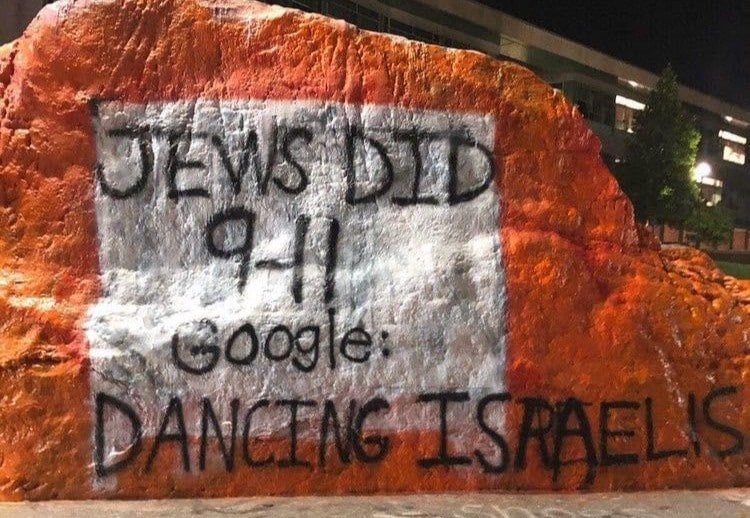
That framework explained something Wicker had watched play out in schools. Antisemitism may draw condemnation when it arrives with a swastika, then be excused when it is dressed up as concern for Gaza. “All of a sudden it’s social justice to hate you,” she said.
Before Beliefs Harden
Facts matter. But facts alone rarely succeed once beliefs become part of someone’s identity, she argued. At that stage, correction can arrive too late. Repeating a false claim to rebut it can also reinforce the association in a listener’s mind. Seeds of Doubt seeks to reach students before an ideology hardens into unquestioned certainty.
Wicker described that work as beginning “earlier in the funnel.” It teaches students to spot warning signs. “If you’re in a space that doesn’t allow you to ask questions, you’re not in a good space,” she noted.
Wicker’s aim is to interrupt the thinking that leaves people vulnerable to antisemitic and other extremist ideologies.
Reality Tests Ideology
The first film follows three people who once held strong ideological beliefs. Each began to question those beliefs when their movements’ conduct contradicted what they claimed to stand for.
One participant had belonged to an Antifa circle that romanticized Mao Zedong and China’s Cultural Revolution. She knew how destructive that period had been, yet felt unable to say so. The gap between the movement’s rhetoric and reality became her first seed of doubt.
Wicker sees binary thinking at the heart of that process. A worldview that sorts people into “us” and “them” leaves little room for nuance, complexity, or tolerance for different views.
The second film brings together voices from Iran, Cuba, and Venezuela. It examines what Wicker describes as an inversion of reality, in which governments that harm their own people are recast as victims while blame shifts to American policy. She sees similar patterns in narratives deployed against Israel.
Wicker wants the films to leave viewers with intellectual humility. “You really don’t know everything. No one does,” she said. She hopes viewers will pause and ask, “If I’m wrong about this, what else could I be wrong about?”
Activism Masquerading as Education
Wicker said it was legitimate for schools to teach history through more than one lens. Her concern is that programs meant to broaden students’ perspectives have, in many cases, been taken over by groups focused on activism, which she considers detrimental to students.
Through Seeds of Doubt, students explore how radicalization develops and learn to recognize early warning signs, including binary thinking, moral absolutism, pressure to conform, grievance, fear, and the need for belonging or certainty.
After watching the film, students participate in a guided discussion on extremism through a partnership with Dr. Miri Bar-Halpern, Director of Trauma Training and Services at Parents for Peace. They reflect on their own reactions and consider how empathy, dehumanization, and ideological rigidity can shape behavior. The program aims to help students remain curious, tolerate complexity, question their assumptions, and recognize when a worldview is becoming rigid or extreme.
Wicker has also put that concern into practice. She has partnered with the Los Angeles County Office of Education on an event about extremism and education, and she has brought similar conversations into high schools. After the Netflix series Adolescence generated questions at one school about how to recognize online radicalization, she organized a lunch program on warning signs. An obsessive preoccupation with Hitler, or escalating hostility toward Jews and Israel, Wicker explained, can signal that a young person is moving toward extremism. The goal was to help students recognize those warning signs in a friend.
“You should care for your own selfish reasons because extremism impacts you,” she said.
Truth Over Ideology
The classroom pilot measures more than students’ immediate reactions. Participants complete surveys before watching, immediately afterward, and one week later. The final survey asks whether the film changed how they behave. “We’re trying to change behavior,” Wicker said.
One student later reported hearing a political view he normally would have dismissed. This time, he asked questions instead. “That is a huge win to me,” Wicker stated.
The films ask students to question ideological certainty, not to suspend moral judgment. Students should weigh claims against evidence and recognize that some acts are plainly wrong. The October 7th massacre demands such clarity.
In Wicker’s view, people can experience the same reality differently without creating separate truths. “There is one truth and there’s different experiences of that truth, and that can be complicated,” she said. “But there is one truth. And if we pretend that we live in a world that doesn’t have truth, you can make people do pretty atrocious things.”
Seeds of Doubt asks students to test their beliefs against evidence and recognize the moment when concern for one group becomes permission to dehumanize another.
Watch the first episode of “Seeds of Doubt” HERE:
Watch the trailer for the second episode HERE: