|
Getting your Trinity Audio player ready...
|
The following analysis was authored by Tablet Magazine columnist and CAM Editorial Advisor Lee Smith:
It looks like pro-Hamas activists picked on the wrong city.
Last week, a Philadelphia-based organization called Philly Bike On Your Left, which describes itself as an anti-Zionist cycling collective, planned to ride through the fashionable Rittenhouse Square neighborhood on a mission: to intimidate and boycott Jewish-owned restaurants.
“No business for Zionists!” according to flyers advertising the November 8 event. “These Zionist Establishments must go! Not in our city!”
But it’s not your city, is the message local residents sent. It’s the city of brotherly love, not Jew hate.
For three years, since the October 7th massacre, U.S. cities from coast to coast have been subjected to anti-Israel and antisemitic protests, targeting Jewish neighborhoods, schools, and synagogues. The pro-Hamas demonstrators block traffic, threaten store owners, and issues threats of violence they sometimes fulfill.
So it was good news for all of America, when hundreds of Philadelphians, Jews and non-Jews, came out to defend their neighbors, their local businesses, and stood for their city,
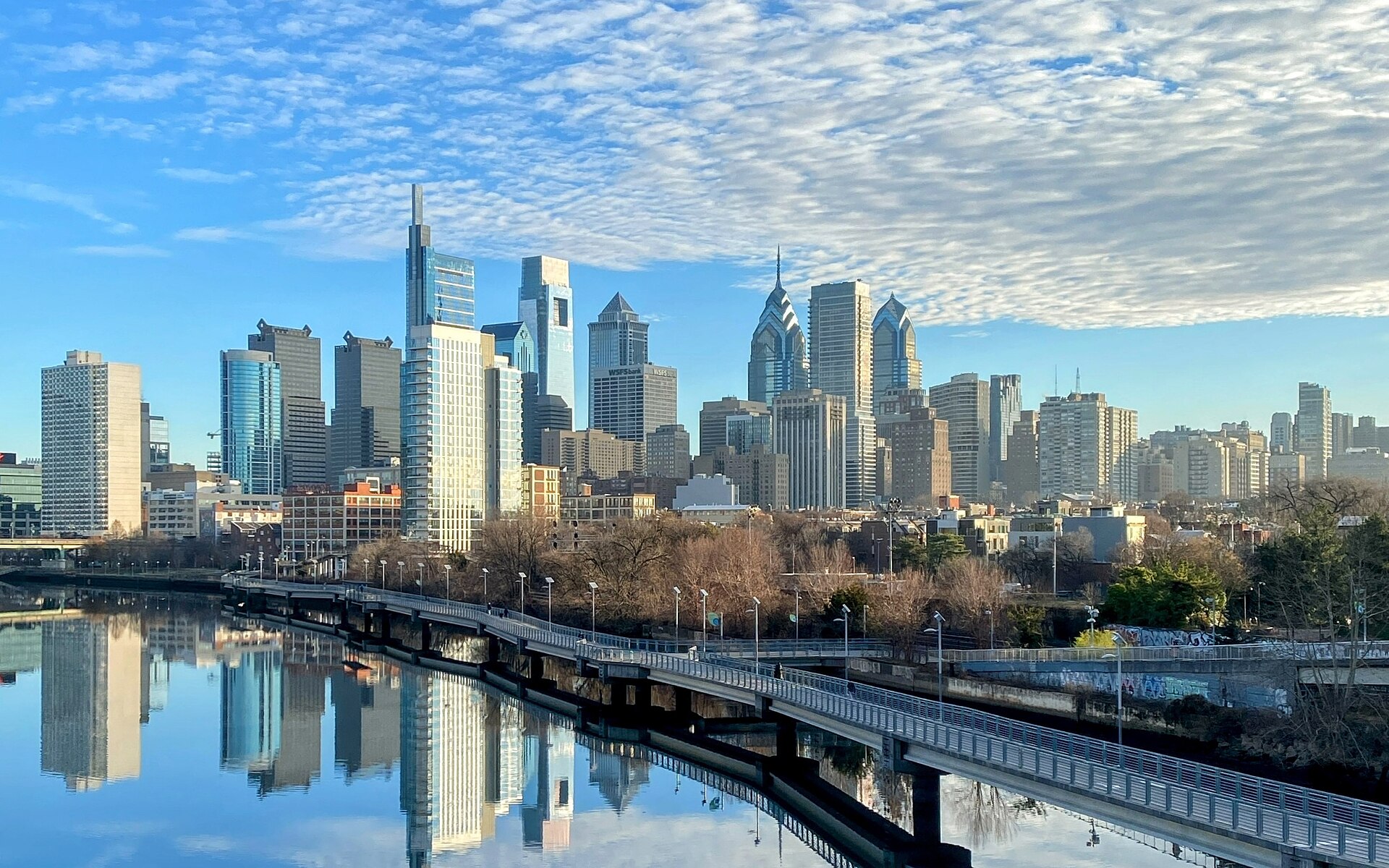
Philadelphia is home to one of America’s largest and oldest Jewish communities, dating back to the colonial period, with Congregation Mikveh Israel tracing its origins to the eighteenth century.
There are approximately 162,000 Jews in Philadelphia itself and 350,000 across the metro region, including suburban towns to the west and northwest of the city along the Main Line, the historic Pennsylvania Railroad corridor. And there are sizeable populations of Jews in suburbs to the north like Cheltenham, a center of suburban Jewish life — where conservative author and broadcaster Mark Levin attended high school.
Benjamin Netanyahu graduated from Cheltenham five years after Levin. Israel’s prime minister spent much of his adolescence in suburban Philadelphia. At the time, his father Benzion Netanyahu, the preeminent historian of medieval Spanish Jewry, taught at Dropsie College. In 1993, the pioneering American institution of advanced Jewish scholarship was moved to the University of Pennsylvania and became the Herbert D. Katz Center for Advanced Judaic Studies.
Speaking at UPenn in 1999, Israel’s longest serving prime minister recalled that “a pretty good portion of my intellectual capital was developed in this city.”
Philadelphia was also once among America’s leading industrial centers, too. It entered a long post-war decline that accelerated during the 1970s. Sylvester Stallone said he set his 1976 Oscar-award winning movie Rocky in the city where he spent his adolescence because it’s a scrappy working-class town that embodied the struggles of his protagonist — a down-on-his-luck boxer who wanted a chance to prove himself.
And in the 1990s, the “City of Brotherly Love” beat the count and rose from the canvas, thanks in part to its growing reputation as one of America’s great restaurant cities.
One of the principal entrepreneurs who drove the town’s restaurant renaissance is Philadelphia-born Jewish restaurateur Stephen Starr, who received the James Beard Award for Outstanding Restaurateur in 2017. Another is Michael Solomonov, the Israeli-born chef who opened Zahav in 2008 and introduced American diners to contemporary Israeli cuisine. By the time Zahav won the James Beard Award for Outstanding Restaurant in 2019, the city had become a destination for dedicated foodies.
Thus, by threatening Jewish-owned restaurants, the anti-Israel zealots were targeting a business community that helped revive the city. And this isn’t the first time they tried to intimidate Philadelphia’s Jewish restaurateurs.
A day after the October 7th attacks, the Philly Palestine Coalition (PPC) held a rally to celebrate the bloody orgy of murder, rape, torture, and kidnapping. “I think that we should all give an applause right now to Hamas for a job well done,” one activist told a cheering crowd. The PPC later shared footage of those remarks on Instagram.
The next day, a statement issued by Starr’s restaurant group publicly condemned Hamas, calling its actions “indefensible and barbaric.” Three weeks later, the PPC included Starr’s restaurants in its boycott “Zionist” businesses.
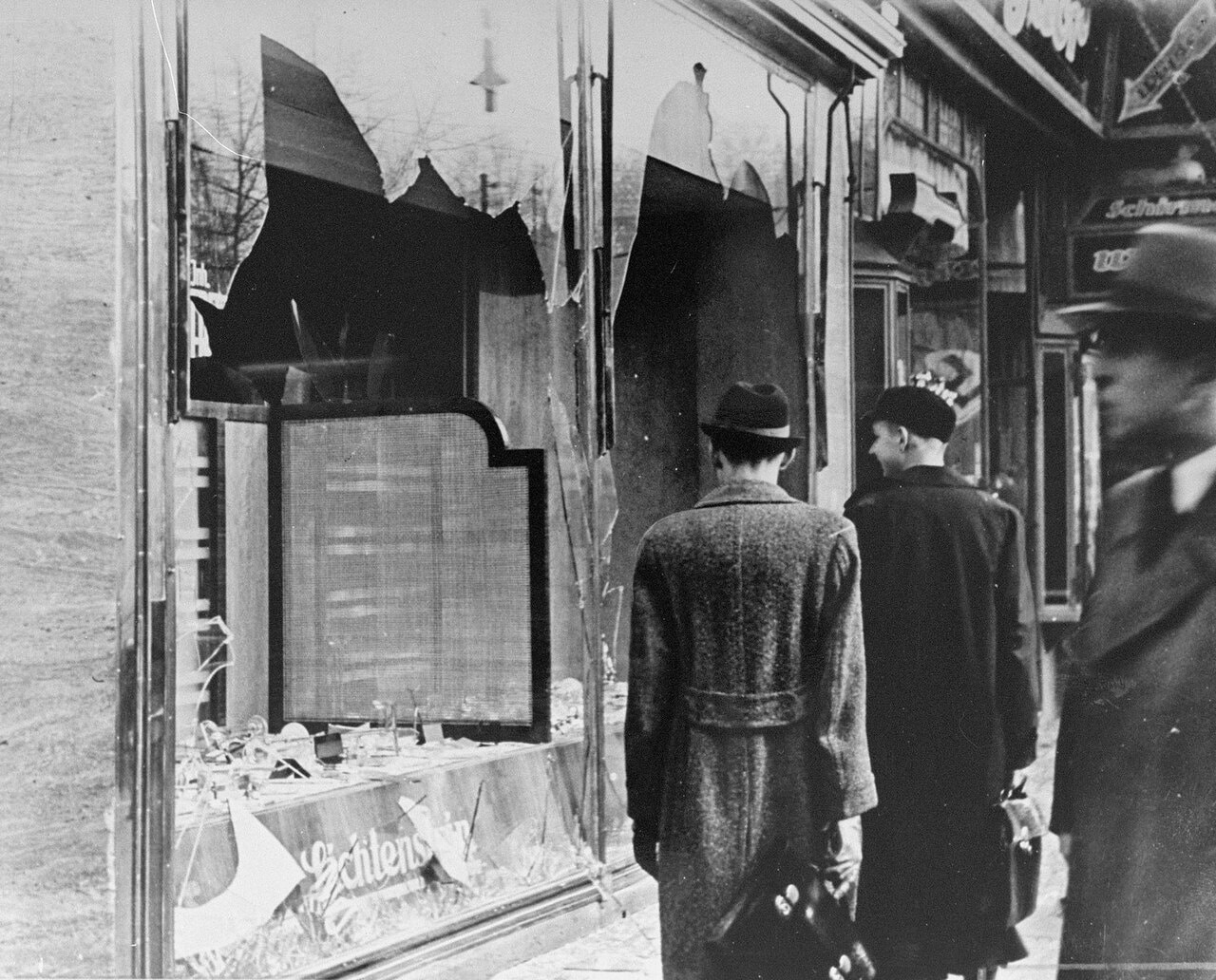
And then three years later, on the anniversary of the 1938 Nazi pogrom in which Jewish businesses, homes, and synagogues were attacked throughout Germany and Austria, the PPC co-sponsored a Kristallnacht-inspired boycott targeting Jewish-owned eateries.
The six restaurants included Goldie, Dizengoff, and K’Far Café, all part of CookNSolo, the restaurant group co-founded by Solomonov. CookNSolo had raised more than $100,000 for United Hatzalah, Israel’s volunteer emergency medical service. On the day of Hamas’s massacre, approximately 1,500 United Hatzalah volunteers helped rescue and treat wounded civilians and recover the dead.
Also on the boycott list were Mac Mart, owned by Marti Lieberman; and Schlesinger’s Deli, owned by former Philadelphia city councilman Allan Domb; and Huda, owned by Yehuda Sichel, who had raised several thousand dollars to help Israeli children injured or traumatized by Hamas terrorists.
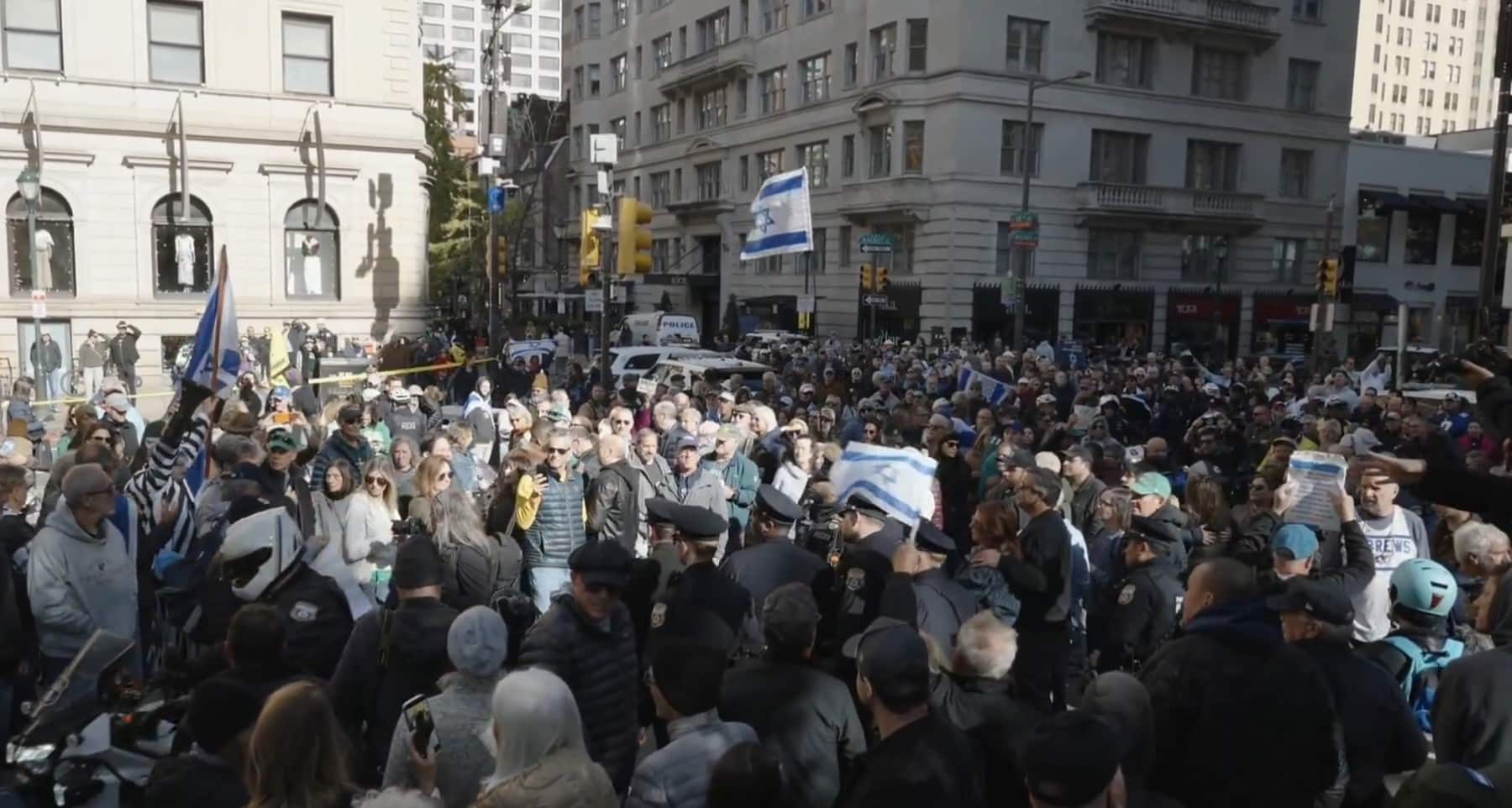
The police estimated that around 200 counterprotesters faced down approximately 300 pro-Palestinian demonstrators, including 200 cyclists. Hundreds of other Philadelphians crowded into the listed restaurants to support them, and lines of reinforcements wrapped around the block.
As the boycotters rode through Rittenhouse Square, crowds of Philadelphians waved Israeli flags and booed them. “Shame!” they chanted. “Show your faces!” they demanded of the masked terror supporters.
Residents carried signs saying “Jew-hatred is un-American” and “Curb Your Antisemitism.” The cyclists, chanting “Free Palestine” and “From the river to the sea,” struggled to move through streets and many abandoned the ride. The effort to intimidate Jewish businesses had turned into a public repudiation of the boycott.
Pennsylvania Governor Josh Shapiro denounced the demonstration as “blatant antisemitism designed to intimidate and drive Jewish businesses out of our communities.” Philadelphia Mayor Cherelle Parker said that “singling out businesses because their owners are Jewish is unacceptable and has no place in our city.”
Notably quiet was Chris Rabb, the congressman-elect whose district includes the targeted restaurants. The Democratic Socialists of America candidate campaigned on an explicitly anti-Israel platform, accusing it of “genocide” in Gaza, and appeared alongside pro-Hamas influencer Hasan Piker. Raab is also connected to the boycott’s organizers.
According to a report in the Washington Free Beacon, Rabb recently signed a letter alongside the PPC and another group sponsoring the ride, Philadelphia Black Alliance for Peace, urging Governor Shapiro to secure the release of Mumia Abu-Jamal. The former Black Panther is serving a life sentence for the 1981 murder of Philadelphia police officer Daniel Faulkner. Its signatories, including the new House of Representatives member, threatened political consequences for Governor Shapiro and other officials who refused to support Abu-Jamal’s release.
And yet Raab had nothing to say about the Hamas fans threatening his constituents.
Domb, the owner of Schlesinger’s Deli, challenged the incoming congressman’s silence. “He’s going to be my congressman,” Domb told the press. “When an owner of a business in his district, who happens to be Jewish, is threatened by a group of people who say they want to shut me down, it seems to me that my congressman should speak up about that.”
The episode also raises questions about Pennsylvania’s legal and political response to antisemitism.
The International Holocaust Remembrance Alliance (IHRA) working definition recognizes that antisemitism may be expressed through rhetoric concerning Israel. The Pennsylvania Human Relations Commission already incorporates the IHRA definition into its educational guidance. And last month Democratic State Senator Judith Schwank introduced bipartisan legislation to incorporate the IHRA definition into Pennsylvania law. The measure remains in committee.
The Philadelphia boycott offers legislators a concrete example of why identifying contemporary forms of antisemitism has become a pressing public question. Still, the people who crowded into Philadelphia’s restaurants to defend their neighbors needed little help recognizing antisemitism: they stood their ground and fought for their city.