|
Getting your Trinity Audio player ready...
|
The following op-ed was authored by Adi Rabinowitz Bedein, an international lecturer, founder of the Network for Innovative Holocaust Education (NIHE), and director of the Oz BaNegev Visitors Center in Kibbutz Nahal Oz. A third-generation descendant of Holocaust survivors, she is active in October 7th education and commemoration across the Gaza border area.
As my work has become increasingly focused on the memory and commemoration of October 7, I have been asked more than once how I can speak about these events if I was not even here that day. For me, the answer is quite simple. I was not there during the Holocaust either, and yet I have been involved in Holocaust education and teaching for years. To engage with the memory of an event, you do not have to be someone who experienced it firsthand. You need to know how to listen to those who were there, study the story in depth, and understand the responsibility we have to pass it on.
This is precisely the meaning of our profession as educators and practitioners of memory, to study an event, research it, listen to those who experienced it, and know how to convey it to others. In fact, simply having been inside a traumatic event does not necessarily make a person capable of conveying it. Sometimes, it is precisely the proximity to trauma that makes it difficult to see the broader picture, put it into words, or understand our own place within it.
I thought about this often during my work as a researcher with Edut 710, when I was looking for people willing to give filmed testimony about what they had experienced on October 7. Again and again, I encountered people who told me, “It’s not my story” or “I don’t have a story.” When I tried to understand why, I discovered that beneath that sentence there was
almost always a comparison. I was only in the safe room. I didn’t fight. I didn’t go outside. I wasn’t injured. I didn’t lose anyone. Other people have a much more significant story than mine.
A woman who heard terrorists running through her building said that she has no story, just as a young man who stood at the window of his home and watched terrorists attack the synagogue where his father, the community rabbi, was located can say that the story is not his. He saw them throw a grenade, and for several days he was convinced that his father had been killed. Only later did he learn that a miracle had occurred in the synagogue, that the people inside had survived, and that his father had been hospitalized. Amid the chaos of those days, he simply did not know. And still, when we spoke about the possibility of documenting the story, he explained to me that it was not really his story. Others were there. Others fought. They had the right to tell it.
There are, of course, many reasons why people respond this way. Perhaps there is modesty in it, perhaps guilt, perhaps even shame that they did not do more while others went out and fought. But it seems to me that there is also something broader at work here, a hierarchy of trauma that has gradually developed in our society since October 7.
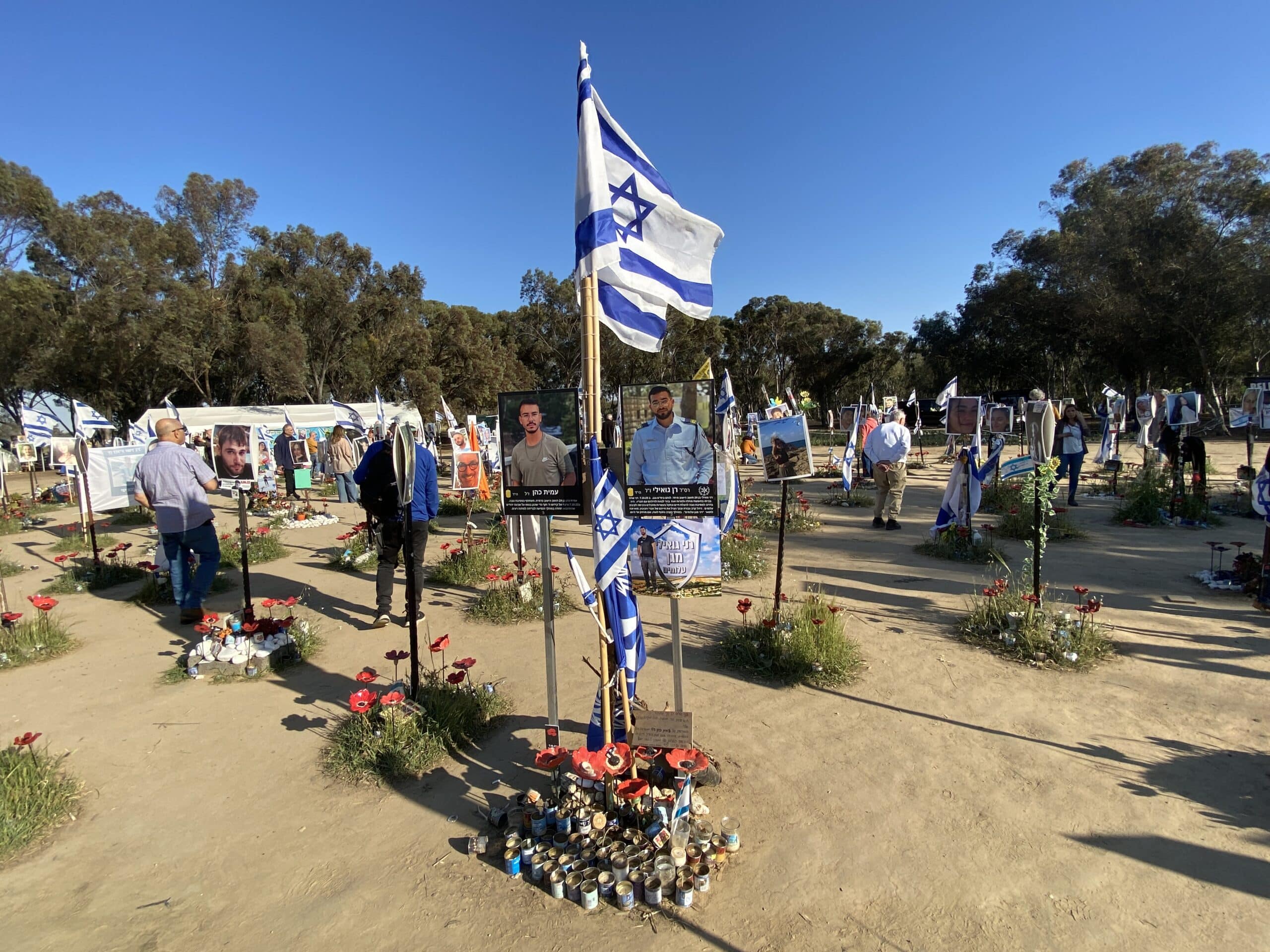
We can see it today even within the communities that experienced the massacre themselves. These days, many communities and kibbutzim are shaping their own memorial ceremonies, and almost inevitably, questions of space and weight arise. How much time will each story receive during the ceremony, who will appear in the video, who will be given more space. There are families who lost those most precious to them, and there are families who sat in the same community, during the same hours and under the very same threat, but ultimately, everyone in their family survived. It is absolutely clear that these experiences are not the same, and that the price they paid is not the same. But within this encounter, you can sometimes hear sentences such as, “I know you suffered too,” and almost feel the invisible
ladder on which we all place ourselves and others.
I encounter that same ladder among people who come to my tours. Sometimes they share with me how difficult things have been for them since October 7, and immediately afterward they qualify what they have said. What right do I even have to find this difficult, they ask, I wasn’t there, I didn’t lose someone close to me, I wasn’t injured. There is always someone who experienced something more terrible, and so it seems to us that our pain needs justification.
It is precisely here that I find myself returning to an idea I learned years ago, from an entirely different field.
In his article on Jewish resistance during the Holocaust, philosopher Roger S. Gottlieb proposed broadening the way we understand resistance. For years, we became accustomed to identifying resistance during the Holocaust primarily with physical fighting, with underground movements, partisans, and uprisings. Gottlieb asked a different question. To understand what resistance is, he argued, we must first understand exactly what the Nazis were trying to oppose, what they were trying to destroy, and how they were trying to do it. If the goal was to erase Judaism and Jewish existence, then the deliberate preservation of Jewish life can be considered an act of resistance. If starvation was one of the tools through which the Nazis sought to break and destroy the Jews, then obtaining food and smuggling it into the ghetto takes on a different meaning as well.
One of the important elements within this perspective is the question of intention. An action is measured not only by the impact it ultimately had, but also by what the person was trying to accomplish through it. A person could have tried to resist, disrupt, preserve, or protect, even if the action did not succeed in changing the Nazi system or even their own fate.
This very gap between intention and impact, between what was intended and the outcome, is an idea that accompanies me closely in my work today. Not because trauma and resistance are the same thing, of course, but because it forces me to ask how often we judge a human experience through our knowledge of its outcome.
One woman from Sderot told me how she sat with her children while convinced that terrorists might enter their home at any moment. She tried to cover them with dolls and other objects so that if the terrorists entered the safe room, perhaps they would not notice them. At the same time, she held knives and prepared to try to defend her children if the door opened.
When she told me about it, she immediately added that, in fact, nothing had happened to her. She did not see terrorists, they did not enter her home, everyone survived. But today she knows that they did not enter. At that moment, she did not know that.
The woman sitting in the safe room during those hours truly believed that she and her children were in mortal danger. Her body, her thoughts, and her actions responded to reality as she understood it at that moment, not to the outcome we know today. The fact that the scenario she feared did not materialize does not change what she believed was about to happen. In a certain sense, it reminds me of a sentence we heard for years, almost casually, on the news, “Rockets were fired, they landed in open areas, and no damage was caused.”
But here too, “no damage was caused” is a description of the outcome. The person who heard the siren did not know at that moment that the rocket would land in an open area. As far as that person knew, it could have fallen on their home, on their children’s school, or right next to them. Their distress occurred before they knew the outcome. Knowing afterward that the rocket landed in an open area does not erase what they experienced during the siren.
And this makes me rethink the way we talk about a hierarchy of trauma.
Sometimes we are so deeply immersed in Israeli reality that we no longer manage to understand just how extraordinary our experiences are. I once told someone who claimed that he had no story to imagine meeting a tourist from abroad who had never lived in a reality of Red Alert sirens, safe rooms, or terrorist infiltrations. That tourist asks him where he was on October 7, and he explains that he sat at home and heard the attack and the terrorists outside. To that person from abroad, this is an unimaginable story. Only here can someone finish a story like that with the words, “But nothing really happened to me.”
We compare because we are surrounded by stories more difficult than our own. The person who was in a safe room knows that someone else fought. The person who fought knows that someone else was injured. The person who was injured knows someone who was killed. And in the face of the immense loss of October 7, it is very easy to conclude that our own
private pain is too small to take up space.
But the circles of trauma extend far beyond the people who were physically present at the scene of the event. Studies conducted following terrorist attacks and disasters have shown that repeated exposure to distressing images and videos through the media can be associated with significant levels of distress and anxiety even among people who were not present at the event itself. In some cases, repeated exposure can deepen the distress, precisely because the person returns again and again to the images and to the sense of threat. (Holman, Garfin & Silver, 2014).
Since October 7, these circles encompass a vast number of us. There are those who survived the massacre, families who lost those most precious to them, families of hostages, the wounded, soldiers, therapists, people who rescued others, families of those who were there, evacuees, residents of the south and the north, and also millions of Israelis and Jews and allies around the world who sat in front of their screens, followed names and faces, waited for news, and were exposed again and again to images that cannot be forgotten.
This does not mean that everyone experienced the same thing. Certainly not. A person who has not lost a child does not know what it means to lose a child. Someone who was not in a kibbutz on October 7 cannot say that they know what it felt like to sit for hours in a safe room while terrorists moved around outside their home. There is also a practical reality that cannot be ignored. Money, therapeutic resources, time, and even space in a memorial ceremony are limited, and therefore states, institutions, and communities are forced to prioritize.
But prioritizing resources does not have to become a hierarchy of the right to feel.
To me, that is the important distinction.
We can recognize that some people paid an immeasurably heavier price than others, while at the same time understanding that someone who did not lose a loved one can still carry a deep wound within them. We can give priority to those who need help most urgently without teaching someone else to tell themselves that they have no right to ask for help. Because the moment we create a hierarchy not only of need but of legitimacy, we risk missing people who do not even dare admit to themselves that they need someone.
Perhaps that is why I prefer to think of our society not as a pyramid, but as a large puzzle. Each of us has a different place within the story of October 7, and each of us has a different story. There are stories of unimaginable loss and stories of heroism, survival, fear, waiting, concern for someone who was there, and there are also stories of people who followed the events from thousands of miles away and felt that their world had changed. They are not the same story, and they do not need to be the same story in order to be part of the same picture.
To me, this is one of the great challenges facing Israeli society today. Since October 7, many of us have been walking around with a wound that has not yet closed, and sometimes we do not even know how to recognize the ways it affects us. That is why we need greater awareness, more patience with one another, and the ability to give one another the benefit of the doubt. We need to be able to listen to another person’s story without immediately measuring it against a more difficult one, and at the same time, to be able to acknowledge our own pain without thinking that it takes something away from someone else’s.
Ultimately, this connects to a deep belief that accompanies me in my work, that our healing as a society will also come through memory and commemoration. Through the ability to give space to the different stories of October 7, to listen to them, document them, and connect them. Not in order to blur the differences between people’s experiences or between the prices they paid, but to allow each person to find their place within our broader story. I believe that it is precisely through this connection, between the stories, between the people, and between the different circles of experience, that our ability to heal can also begin to grow.
When I look at the moments in which our people have managed to stand against what seemed impossible, I cannot separate what took place on the battlefield from what took place within us as a society. Perhaps now, precisely when the wounds are still so close to the surface, we need to remember that we do not need to decide who is allowed to hurt in order to know who needs a hand extended to them.