|
Getting your Trinity Audio player ready...
|
Hatred rarely announces itself all at once. More often, it spreads slowly into public life until people stop reacting.
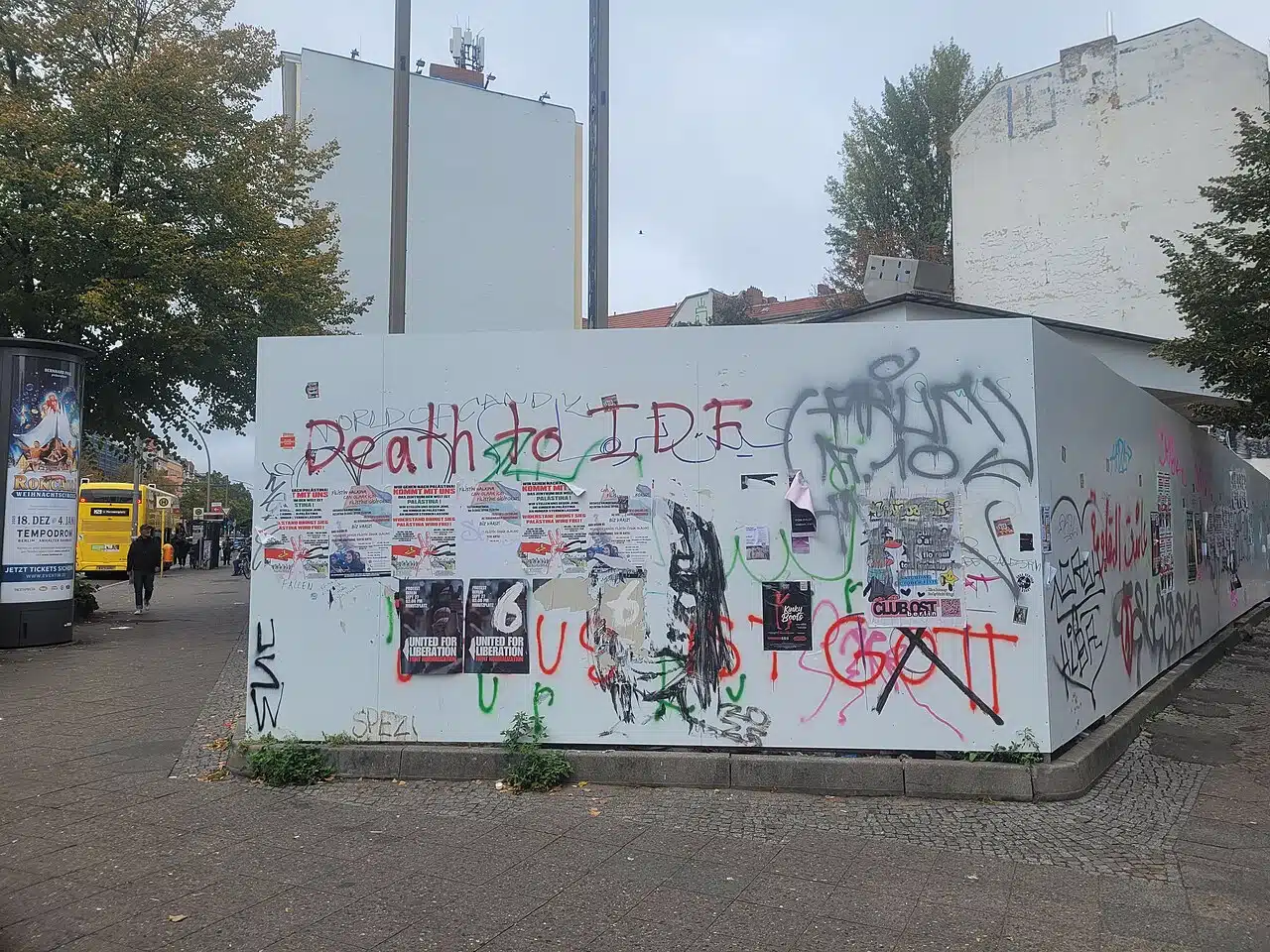
That is what Grace says she has watched happen in parts of the German capital of Berlin since the October 7th attacks in Israel more than two and a half years ago. Near the intersection of Hauptstraße and Grünewaldstraße in Berlin’s Schöneberg neighborhood, the words “Death to the IDF” were sprayed high across the side wall of a building overlooking cafés, sidewalks, and a public park.
“I won’t be able to say later, ‘I didn’t see it happening,’” Grace, who is originally from the United States, told the Combat Antisemitism Movement (CAM).
“In the past 20 years since I moved to Berlin from the U.S., antisemitic graffiti did not seem to be as widespread a phenomenon,” she said. “It increased exponentially after the massacre on October 7, 2023.”
The graffiti, she says, has become larger, more aggressive, and more visible over time. Across Berlin, antisemitic messaging, Palestinian flags, political slogans, and keffiyehs have become an increasingly familiar part of everyday life.
Grace also recalled that candy was distributed at Berlin’s busy Hermannplatz in celebration of the October 7 massacre.
The Cost of Looking Away
Shortly after the attack, Grace received warnings in a parents’ group chat advising people to avoid certain areas because of planned violent anti-Israel demonstrations.
Yet, antisemitic graffiti often remains untouched long after it appears. “I feel like antisemitic graffiti is just sticking around and sticking around,” she said. “That is the main area I see right now in my non-Jewish corner of the world where persistent antisemitism is just not being dealt with.”
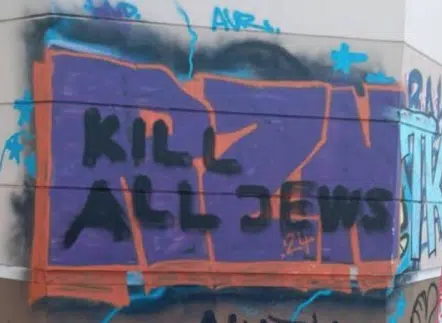
That reality is part of what compelled her to begin reporting incidents when she encounters them. “I now intend to report it wherever I see it,” she said, “so that it doesn’t start to seem normal or even acceptable.”
“It makes me feel very nervous since antisemitism can snowball into full-blown hate that makes both Jewish friends and colleagues and everyone else feel endangered,” Grace added. “I feel scared and sad for all my friends and neighbors who could become front-line targets of violence if such graffiti is allowed to remain on the streets and inspire terrorism.”
“When I read about terror attacks around the world, I realize things can rapidly get much worse if nothing is done,” she said. “I’m feeling these very years just how violence is only held back when someone decides to speak up against hatred on the slippery slope toward radicalization.”
Now, when she encounters antisemitic graffiti, it triggers what she describes as “an inner warning.”
“We cannot say later, ‘I didn’t see that antisemitism was ballooning,’” she said.
“I want to listen to what my Jewish friends and colleagues say they need.”
Grace’s decision to speak publicly underscores something increasingly significant in today’s climate. Confronting antisemitism cannot be left to Jews alone.
In Berlin, a city where the consequences of hatred are etched into its history, her warning carries particular weight. Silence and indifference have consequences, particularly when public hatred stops provoking public alarm.
Take Action
CAM has launched Report It, a secure app to report antisemitic incidents anonymously and in real time. Don’t stay silent. Download it today on the Apple App Store or Google Play. See it. Report it. Stop it.