|
Getting your Trinity Audio player ready...
|
The following analysis was authored by Tablet Magazine columnist and CAM editorial advisor Lee Smith:
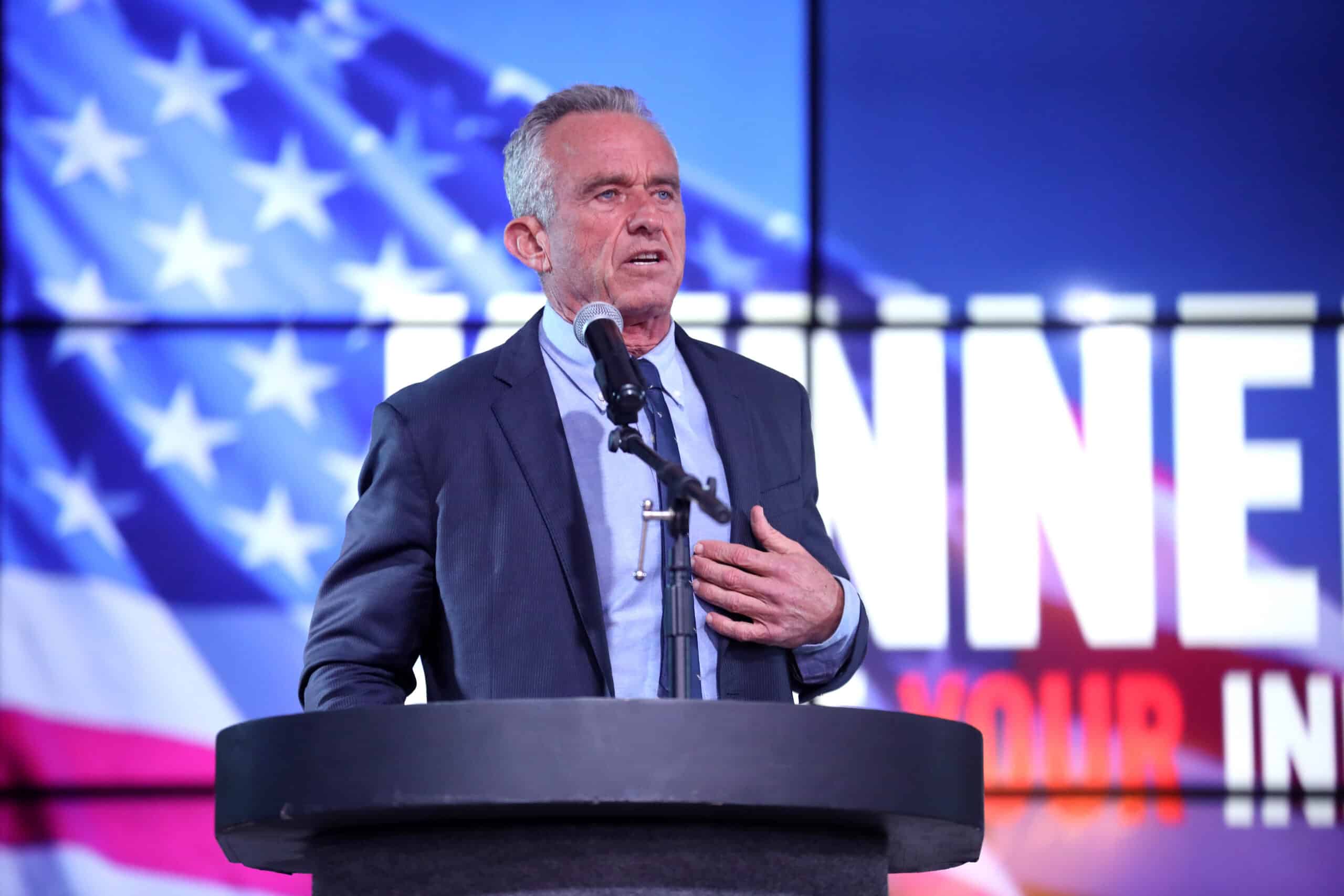
In discussing Michigan Democratic Senate candidate Abdul El-Sayed’s alleged ties to the Muslim Brotherhood this week, Secretary of Health and Human Services Robert F. Kennedy Jr. delivered one of the sharpest assessments any U.S. official has ever given of the organization’s political and cultural influence.
At a campaign event for El-Sayed’s Republican rival Mike Rogers, Kennedy said, “The people who live in the countries that the Muslim Brotherhood has taken over live inside a death cult. They are immersed in an ideology of victimization of murder of genocide. And they are atrophied and stagnant.”
Further, noted Kennedy, the Brotherhood’s ideology was responsible for turning the Middle East into a black hole of scientific and intellectual achievement. After praising past Islamic contributions to the wealth of human knowledge, Kennedy described the current reality. “There’s 500 million Arabs in the world, and yet they don’t produce science, they don’t win the Nobel Prize, they don’t win the Field[s] prize, they don’t win the Wolf Prize, they don’t produce the literature they used to produce.”
Kennedy didn’t say so directly, but the implication of his critique was clear — electing El-Sayed is likely to put America on the path to the obscurantism, ignorance, and political violence that marks the Muslim world.
El-Sayed claims he doesn’t support the Muslim Brotherhood and when he was asked at a town hall earlier this month whether he condemns it, he answered, “Sure, yeah, absolutely.” Nonetheless, Kennedy says that he doesn’t think the candidate is “trustworthy.”
In speaking with the press, the scion of the Democrats’ most famous family dynasty suggested that El-Sayed is using the party as cover to legitimize political goals that are irreconcilable with constitutional government. “If you want Sharia law, it’s completely incompatible with liberalism,” said Kennedy, citing conflicts involving freedom of speech, religious liberty, and women;s rights. “You cannot have a U.S. Constitution and Sharia law in the same place.”
For Kennedy, El-Sayed’s true loyalties are to the Islamists. He pointed to the candidate’s support for Egyptian senior Muslim Brotherhood official Mohamed Morsi, who was elected president in 2012. Months into Morsi’s brief term, El-Sayed signed a petition in support of his “revolutionary decisions” to eliminate judicial review of his presidential decrees and urged him to purge the police and the media, two Egyptian institutions historically opposed to the Muslim Brotherhood.
Recent media coverage of connections between El-Sayed’s family members and the Muslim Brotherhood have further amplified concerns about his agenda. According to a recent report in The Washington Free Beacon, El-Sayed’s half-sister, University of Chicago Professor Eman Abdelhadi, wrote on social media in 2013 that “My family has long been MB,” and referred to relatives jailed for their involvement with the organization.
In another post, Abdelhadi described a conversation with her mother, Fatten Elkomy, about her political sympathies as a student at Alexandria University in Egypt. “Had an amazing talk with my mom about her activism in the Muslim Brotherhood during the early 70s while she was in college,” she wrote.
The 1970s were a decisive period in the history of Egyptian Islamism, anchored by the Muslim Brotherhood, the movement’s leading organization since its 1928 founding. Islamist ideologues attributed Israel’s 1967 victory in the Six-Day War to the fact that Egypt was governed by secularists and argued that only by returning to Islam could Egypt restore its past glory.
University campuses across Egypt, including in Alexandria, became centers of recruitment as Brotherhood activists created student associations, charitable organizations, and professional networks for the purpose of reshaping Egyptian society according to Islamic principles. The Islamic revival also gave rise to militant factions advocating violence against Egypt’s political order, which in their eyes was not only secular but also compromised by its close association with non-Muslim governments, especially America’s.
The violent insurgency that ensued culminated in the 1981 assassination of President Anwar Sadat, a world-transforming terror attack waged by the two most notorious organizations that came out of this period, Gamaa Islamiya and Islamic Jihad. The former took as its spiritual guide Omar Abdul Rahman, who would be convicted in 1996 for his role in a conspiracy to attack New York City landmarks. The latter was led by Ayman al-Zawahiri, who later become Osama Bin Laden’s top deputy.
That is, El-Sayed’s rise is a reminder that America was swept up in the furies of Islamist violence long before he stepped on to the political stage. And thus, according to Kennedy, America’s problem with the Muslim Brotherhood is much bigger that the Michigan election.
“We should fight it in our communities,” Kennedy said of the Brotherhood and its ambitions to compel Western governments to submit to tenets. “We should fight it across the country.”
Unsurprisingly, media reactions to Kennedy’s assessment of the damage the Brotherhood has done to the Arab world were harsh. It’s worth noting however that his criticism is essentially the same made in a two decades-old United Nations report authored by Arab scholars and intellectuals detailing the region’s political and intellectual stagnation
The Arab Human Development Report’s 2003 paper “Building a Knowledge Society” documented Arab countries’ weak scientific research institutions, inadequate investment in technological development, limited production and translation of books, and political restrictions on intellectual freedom. Arab expenditures on research and development amounted to approximately 0.2 percent of gross national product, compared with several percentage points in advanced industrial economies. The region employed substantially fewer scientific researchers per capita than the international average.
And yet it’s true that a handful of Arab scientists and writers have won Nobels and other international honors. But the story of the Arab world’s most famous Nobel Prize winner proves the secretary’s essential point.
Egyptian novelist Naguib Mahfouz won the Nobel Prize in Literature in 1988, even as Islamist clerics accused him of blasphemy. Indeed, during the controversy surrounding Salman Rushdie’s The Satanic Verses, none other than Omar Abdel-Rahman spoke out to threaten both writers. “If we had punished Naguib Mahfouz for what he wrote,” said the terror sheikh, “then Salman Rushdie never would have dared to write that book.”
Five years later, Mahfouz was stabbed in the neck on a Cairo street by an Islamist assailant who said he was motivated by Abdul-Rahman’s charges of blasphemy. The Nobel laureate survived, although his injuries left him with permanent disabilities.
The attempt on Mahfouz’s life illustrated the danger of Islamist ideology and the influence of the organization that’s been promoting it for nearly a century. Without free speech and equal rights under the law, no civilization can sustain a constitutional political order or culture of scientific and literary achievement if its most ambitious members must work under fear of death.
Kennedy is right, the Brotherhood’s agenda and its promoters must be fought in our communities and across America.
Read more:
The Muslim Brotherhood Goes to Washington
What Abdul El-Sayed’s Michigan Victory Means for Democrats and Israel