|
Getting your Trinity Audio player ready...
|
The following analysis was authored by Tablet Magazine columnist and CAM editorial advisor Lee Smith:
For decades, law enforcement officials, counter-terrorism analysts, and Middle East experts have been warning that someday soon, the Muslim Brotherhood would make its move on America.
The concern wasn’t so much that the modern Muslim world’s first Islamic terror group would wage violent attacks on U.S. soil, though it did raise money here for terror groups abroad that targeted US citizens, allies, and interests.
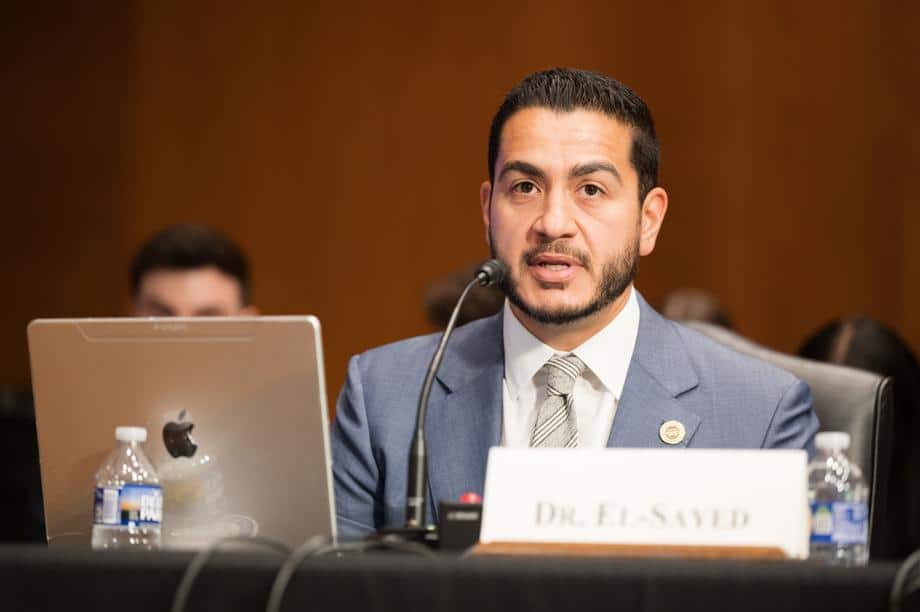
Rather, the worry was that the Brotherhood would make good on its well-documented plans to infiltrate U.S. institutions on the local, state, and federal level to influence policy, domestic and foreign, and shape American society to ultimately transform it. And now, with Michigan Democrat Abdul El-Sayed on the verge of winning a U.S. Senate seat, that day is here.
Sayed is leading his Republican rival Mike Rogers in virtually every poll, by as many as seven points. It’s true that El-Sayed beat primary opponent Haley Stevens only by a narrow margin after his campaign predicted a blowout. But the general election will depend in large part on how voters feel not just about Rogers but also the leader of his party, President Donald Trump.
High gas prices and knock-on effects causing the “affordability crisis” help the opposition party. And the fact that a major cause is a Middle East war that the president has not yet chosen to win decisively can only boost a candidate who not only opposes the war but has identified the culprit who forced us into conflict — the American Israel Public Affairs Committee (AIPAC).
“The reason that we’ve seen this war fought is because of the impact of AIPAC in our politics,” El-Sayed said last month. He’s not blaming Jews, of course. “I will always stand with the Jewish people against any antisemitism,” Sayed declared last month, but “that’s not the same as AIPAC or Israel.”
Not exactly. Since AIPAC is an American organization backed by Jewish Americans who support the U.S.-Israel alliance, for antisemites on the left as well as the right, AIPAC is just code for Jews. El-Sayed doesn’t support America’s crucial ally and wants Washington to cut all military aid to Israel, including defensive systems, such as Iron Dome and David’s Sling.
To show he’s not biased, El-Sayed says he also opposes military aid to the country from where his parents emigrated. “When I’m elected,” he said, “I’m probably going to be the loudest critic of the Egyptian government in the whole U.S. Senate.” But the reason he doesn’t like Egypt’s current government is because in 2013 President Abdel Fattah el-Sisi overthrew and then imprisoned the president Sayed liked, Mohamed Morsi, a senior Muslim Brotherhood official.
Months into Morsi’s brief term, El-Sayed joined 45 other Egyptian Americans in signing a petition in support of his “revolutionary decisions” to eliminate judicial review of his presidential decrees and urged him to purge the police and the media. In El-Sayed’s eyes, funding Cairo means supporting a regime that continues to suppress the Brotherhood after Sisi outlawed it and branded it a terror organization.
Foreign military funding for Egypt also means supporting the 1979 peace deal with Israel. For nearly half a century, the Egyptian military has gotten annual assistance from Washington, now at roughly $1.3 billion, conditioned on keeping the peace. Who wants to break it? The same people who assassinated Anwar Sadat in 1981 for signing it — the Islamist terror organizations that grew out of the Muslim Brotherhood.
The Brotherhood was founded in Egypt in 1928 in opposition to continued British domination of Egypt despite the country’s nominal independence. As Washington replaced London as the West’s dominant power in the post-World War II era, the Brotherhood turned its ire against America, and Israel.
In 1949, Muslim Brotherhood ideologue Sayyid Qutb came to the U.S. for a two-year educational program and left hating America more than when he arrived. He especially despised pop culture and sexual morality — teenagers at a church dance swaying to “Baby, It’s Cold Outside” struck him as the epitome of spiritual decadence. And of course he detested the American heartland’s love of Israel, Christian Zionism.
Nonetheless, Muslim Brotherhood members migrated to the United States, many after President Gamal abd-el Nasser’s purge of the organization after a Brotherhood activist made an attempt on his life in 1954. In the 1960s, according to security analyst Kyle Shideler’s recent U.S. Senate testimony, the “North American Brotherhood structure was developed, centered around the founding of the Muslim Students Association (MSA), which served as a front for Muslim Brotherhood organizing and recruited cadre from which future Brotherhood fronts would be created.”
El-Sayed was vice president of the MSA at the University of Michigan during his senior year, 2007 — which in retrospect was a watershed year for federal law enforcement officials looking to dismantle Islamist infrastructure in the United States in the still dark shadow of September 11.
In 2007, the Justice Department brought terror-financing charges against a pillar of the Muslim Brotherhood’s U.S.-based network, the Holy Land Foundation, for pushing more than $12 million to Hamas. In its ultimately successful prosecution, the government produced evidence showing glimpses of the Brotherhood’s blueprints for America.
A 1991 memorandum written by Muslim Brotherhood operative Mohamed Akram described the organization’s project as a “grand Jihad in eliminating and destroying the Western civilization from within.” In addition to the “Explanatory Memorandum,” the government submitted an FBI wiretap of a 1993 meeting in Philadelphia that caught Hamas supporters discussing how to conceal their connections while continuing fundraising and political activities in America.
What makes those decades-old documents relevant today is El-Sayed’s candidacy. His political opponents cast him as socialist when his biography shows he was raised in a Muslim Brotherhood milieu.
His Egyptian-born father Mohamed was president of the Islamic Center of Columbia, Missouri, an affiliate of the MSA and the Islamic Society of North America (ISNA), which Holy Land prosecutors identified as part of the U.S. Muslim Brotherhood network. Sayed’s father-in-law, Dr. Jukaku Tayeb, is a member of the ISNA Founders Committee. Tayeb, who has contributed $200,000 to El-Sayed’s campaign, was also at one time president of the Michigan chapter of the Council on American Islamic Relations (CAIR) which, according to federal prosecutors, is also part of the Brotherhood’s U.S. infrastructure.
The candidate’s mother, Fatten Fathy Elkomy, was employed by an Islamic charity that the Treasury Department listed as a Specially Designated Global Terrorist in 2004. During her 1999-2004 tenure as a nurse practitioner in the Columbia office of the Islamic American Relief Agency, the organization provided direct financial support to various U.S.-designated terror groups, including Al Qaeda, Hamas, and the Taliban. IARA eventually pleaded guilty to conspiracy to violate American sanctions, conspiracy to commit money laundering, and obstructing the administration of the tax laws.
So what has the government done since 2007 to disrupt the Muslim Brotherhood’s U.S. networks? Not much. For instance, no one really knows how many of the roughly two million Muslims who have obtained green cards in the last two decades support the Brotherhood. State Department consular offices ask visa applicants whether they support terror groups, but not if they’re associated with the Muslim Brotherhood. Recent polling, however, gives us some insight into the scope of the issue.
A May 2026 Pew Research Center survey found that 44 percent of American Muslims hold a favorable view of the Muslim Brotherhood’s Palestinian branch, Hamas. And 21 percent believe the murders, rapes, tortures, and kidnappings of October 7th were acceptable.
Those numbers are bad for the future of America’s domestic peace and interests abroad. So are the numbers that show Michigan’s Muslim residents back El-Sayed en masse. His overwhelming support in Arab and Muslim-dominated Dearborn (78%–20%) and Dearborn Heights (72%–26%) was decisive in his Senate primary win. It’s not long before other candidates around the country recognize there is a big voting bloc that’s easy to woo, so long as you vow to advance the anti-American and antisemitic policies they bring from the old country, amplified here by Muslim Brotherhood networks in the Land of the Free.
The good news is that if he wins, El-Sayed is only one of a hundred elected lawmakers making decisions over American domestic and foreign policy. The bad news is that since law enforcement has done little in the last two decades to dismantle the Muslim Brotherhood’s U.S. networks, he won’t be the last.
Read more:
Analysis: What Abdul El-Sayed’s Michigan Victory Means for Democrats and Israel