|
Getting your Trinity Audio player ready...
|
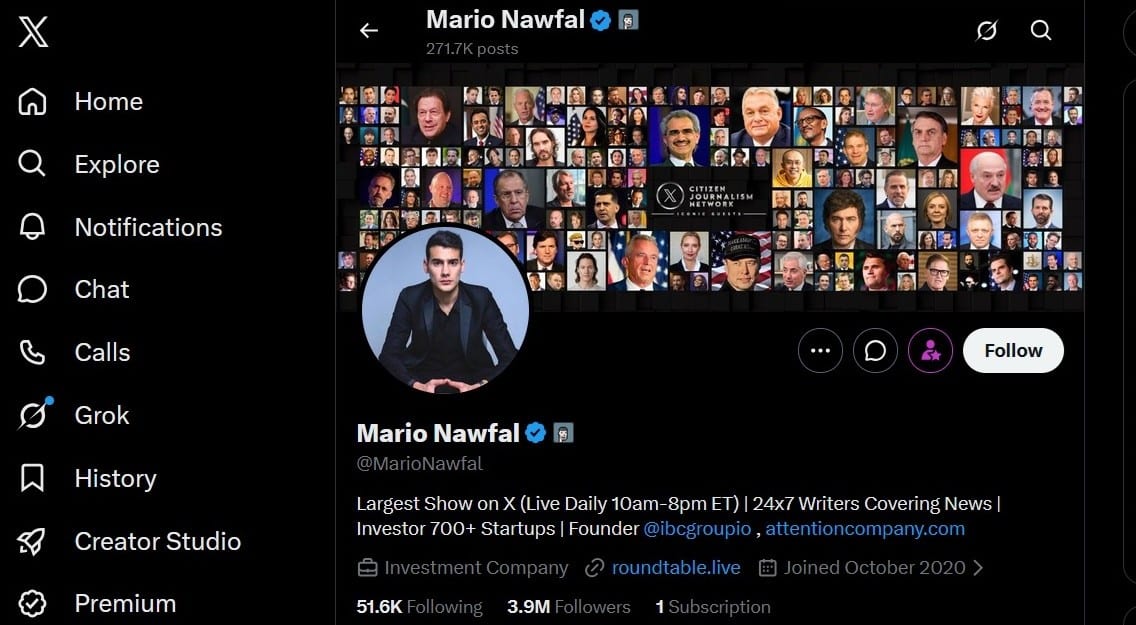
Around two in five accounts engaging with the most widely shared posts by prominent X news aggregator Mario Nawfal (@MarioNawfal) are inauthentic, according to a new study by CAM’s Antisemitism Research Center (ARC).
Over a 45-day tracking period from Aug. 29-Oct. 12, the ARC analyzed 10,015 unique X accounts that amplified 230 of Nawfal’s most-shared posts. After auditing, the ARC’s detection model identified 4,054 of these accounts (40.5%) as likely bots or fake profiles.
Nawfal is a Lebanese-Australian crypto entrepreneur with nearly four million followers on X. His team does not vet posts for accuracy, and in recent years his account has served as an unfiltered channel for state-aligned propaganda, including anti-Israel narratives, originating from countries such as Russia and Qatar.
Bots, fake profiles, and coordinated networks of inauthentic accounts are increasingly being weaponized to spread conspiracy theories, incite hate, and sow discord in democratic societies. Operating under false identities and without transparent affiliations, these networks distort public discourse, manufacture artificial consensus, and erode trust in the information that millions of people consume online every day.
Read the full report, “Bot-Like Amplification on X: Findings from CAM’s Study of the @MarioNawfal Amplifier Network,” HERE.
X’s own rules already prohibit what this study measured. Its authenticity policy states that the platform does not allow “any activity that attempts to manipulate our platform or disrupt our services through inauthentic accounts, behaviors or content.” Its platform manipulation policy names artificial amplification, making an account or idea seem more popular than it is through inauthentic reposts and engagement, as a violation.
Yet 40.5% of the accounts amplifying one of X’s most-boosted news accounts show strong signals of being bots, fake profiles, or inauthentic accounts. The rules exist, but enforcement is not keeping pace.
CAM is calling on X to apply its own platform manipulation policy to the amplifier networks around high-reach accounts, and to give independent researchers the data access needed to verify findings like these.
How CAM’s Bot Score Works
The score comes from CAM’s own model (X model v1.4.0), which detects bots, fake profiles, and inauthentic accounts. It is built on CAM’s framework of key signs that an account may be a bot, with each signal’s weight grounded in published research from DFRLab, Indiana University’s Observatory on Social Media, and the Cresci studies.
Each account is measured against 32 signals — posting rate and bursts, odd-hour activity, duplicate text, account age, default avatars and digit-suffixed handles, follower patterns, and generic or repetitive replies. No single signal counts on its own; only consistent combinations raise an account’s 0 to 100 score.
The model is built to undercount. Post content and ideology are not inputs, so an account is never scored as a bot for what it says. Any one measurable human behavior, such as original varied text, real conversations, or a daily sleep gap, pulls a borderline account out of the bot-like group. The 40.5% figure is what remains after those protections, which makes it a conservative measure rather than an inflated one.
Read more:
Bot-Like Amplification on X: Findings from CAM’s Study of the @MarioNawfal Amplifier Network
33% of Dan Bilzerian’s Congressional Campaign X Posts Are Antisemitic, New CAM Analysis Reveals