
|
Getting your Trinity Audio player ready...
|
A comprehensive new study by CAM’s Antisemitism Research Center (ARC) revealed the extraordinary scale at which antisemitic content is distributed to mass audiences across major social media platforms.
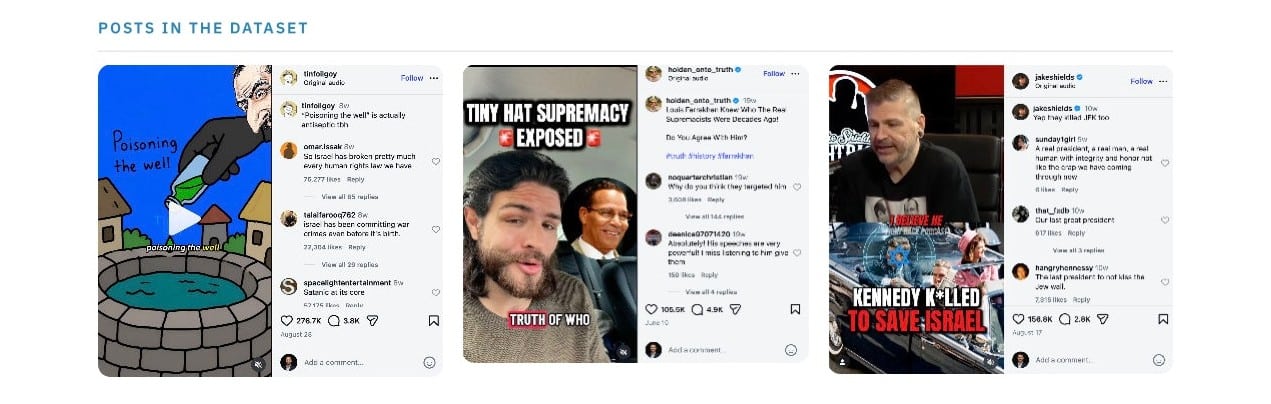
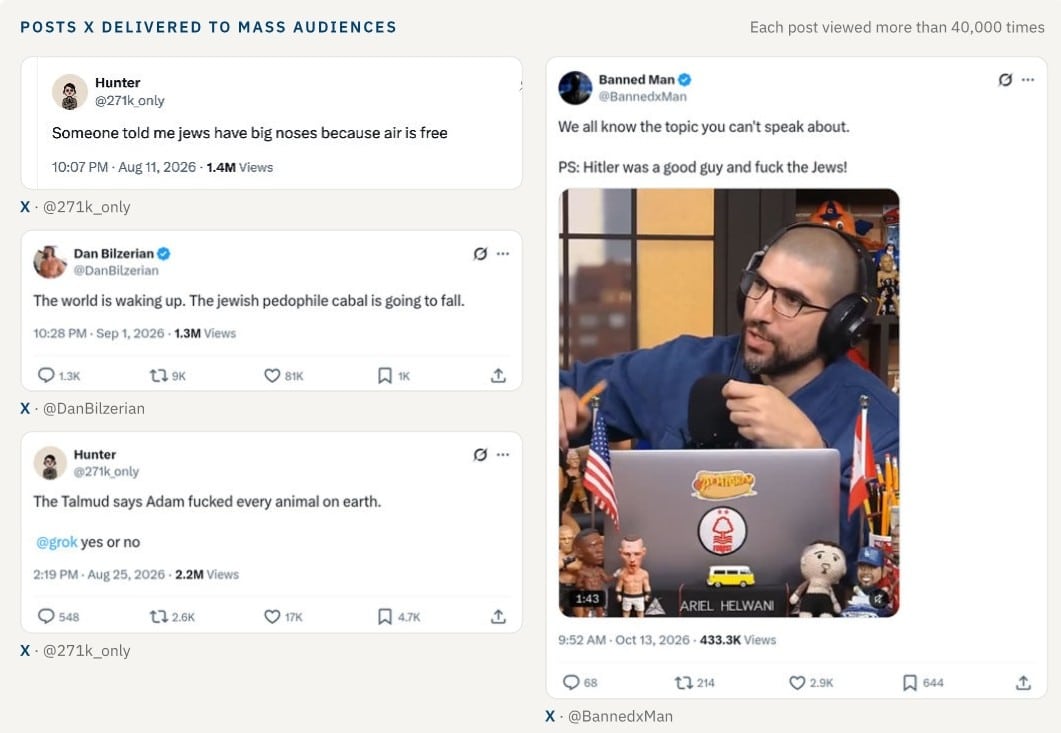
During a 75-day monitoring period from Aug. 1-Oct. 14, ARC researchers identified 683 accounts on X, Instagram, Facebook, and TikTok regularly publishing antisemitic posts. The ARC then filtered the posts down to ones that received viral engagement, drawing 40,000 or more views each.
The 2,806 tracked posts collectively generated 1.18 billion views, underscoring the far-reaching spread of online antisemitism and the urgent need for social media companies to address the role their platforms play in amplifying and normalizing Jew-hatred.
Additional key findings included:
- 98% of views came from X and Instagram: The overwhelming majority of recorded exposure occurred on these two platforms, highlighting their positions as principal vectors for the distribution of antisemitic content.
- Conspiracy theories accounted for 52% of views: Antisemitic conspiracy narratives, including allegations of Jewish control of media, government, and finance, as well as the orchestration of “false flag” incidents to benefit Israel, represented more than half of the total recorded views.
- Exposure was concentrated among a small number of accounts: Just 100 of the 683 accounts were responsible for 64.5% of all recorded views, pointing to the outsized influence of a relatively small group of high-reach accounts.
Based on the study’s findings, CAM is urging social media companies to reassess and revise their distribution algorithms, strengthen and consistently enforce policies against antisemitic content, and take meaningful action to limit the visibility of accounts that repeatedly promote such material, guided by a commitment to the principle of “freedom of speech, not freedom of reach.”
Transparency is equally essential. Platforms must help facilitate independent monitoring by providing clearer information about how antisemitic content is recommended and distributed, how enforcement measures are applied, and whether policy changes are producing measurable reductions in exposure. Furthermore, the countries of origin of accounts, as well as the countries from where posts are published, should be publicly noted, and accounts using location-concealing VPNs flagged.
In recent months, the ARC’s newly-launched Bots Accountability Project has been keeping close tabs on the growing use of bots, inauthentic accounts, and fake profiles to amplify antisemitic narratives, often in patterns mirroring influence operations of hostile anti-Western regimes, including the governments of Russia and Qatar.
“We have been tracking online antisemitism for years, and the connection between virtual hatred and real-world attacks on Jews has become impossible to ignore,” stated CAM CEO Sacha Roytman. “Our research shows that platforms expose their users to antisemitic content every day.”
“Foreign influence campaigns promoting hatred pose a growing threat,” Roytman added. “With AI generating content and large language models powering bots, it has become easier than ever to infiltrate Western societies and sow hatred. It is time to establish digital borders. Just as we protect our physical borders and rely on law enforcement to safeguard the streets of our communities, we must bring the same vigilance and determination to policing the web.”
CAM Tech Engagement and Digital Threats Research Lead Oliver Marks said, “Antisemitism cannot be addressed effectively if we ignore the systems that enable it to proliferate unchecked. Our latest findings paint a stark picture of the environment in which antisemitism thrives online. Social media companies must critically assess the role their platforms play in spreading hate and act where existing policies and enforcement measures fall short.”
“The ARC will continue to vigilantly monitor the prevalence of antisemitic content on social media and the responsiveness of platforms to the concerns raised by this study,” he emphasized.
The full report, “1.18 Billion Views in 75 Days: How Antisemitic Hate and Conspiracy Theories Spread in Blink of Eye,” including its dataset and research methodology, is available at: 1b.combatantisemitism.org
The study built on past ARC research into the amplification of antisemitic content by social media platforms. In March, the ARC documented 100 antisemitic posts that Instagram’s recommendation engine pushed to accounts during a 96-hour monitoring period and drew more than 5.3 million likes and 3.8 million shares.
A separate ARC study in June examined how Instagram’s algorithms steered ordinary users toward antisemitic content.
Read more:
Algorithmic Escalation: From Self-Improvement Content to Antisemitism on Instagram
Instagram’s Algorithm Feeds Antisemitic Content to Millions, New CAM Research Finds