|
Getting your Trinity Audio player ready...
|
Dr. Susannah Heschel is the Eli Black Distinguished Professor of Jewish Studies at Dartmouth College and a leading scholar of modern Jewish history, German-Jewish thought, and antisemitism.
Heschel has spent decades examining how antisemitic hatred operates. In her recent article, Antisemitism as Cultural Sadism: An Erohistorical Approach, she explores the sadistic gratification that antisemitism can produce in those who perpetrate it.
The Combat Antisemitism Movement (CAM) recently spoke with Heschel about growing up as the daughter of Rabbi Abraham Joshua Heschel, the theologian and civil rights activist who famously marched alongside Martin Luther King Jr., why she believes many American Jews have been naive about the persistence of antisemitism, and the pressing need for young Jews to learn about their history.
Growing up as the daughter of Rabbi Abraham Joshua Heschel meant growing up around questions of Jewish identity, ethics, and public responsibility. Looking back, how did that environment shape the path you ultimately took as a scholar?
“My father didn’t talk about Jewish identity,” Heschel says. “Being Jewish was so intrinsic to who he was that it wasn’t something that you hold out at arm’s length to talk about.”
Learning shaped nearly every aspect of life at home. “My father was a very serious scholar,” she said. “He studied all the time. He always had a book with him. And my mother was a pianist, and whenever she had a minute, she was at the piano.”
“That’s how I was raised,” she said. “Books, education, you have to read everything. And it’s the most thrilling thing to do, is to study.”
Even leisure was viewed through that lens. When her parents occasionally set aside their work, they often returned saying, “That was a waste of time.” What they meant, she explained, was that it had been time away from learning.
“So I’m also always studying,” she said. Before her children could read, they would grab books in toy stores and sit on the floor turning pages. “They are voracious readers to this day,” she noted.
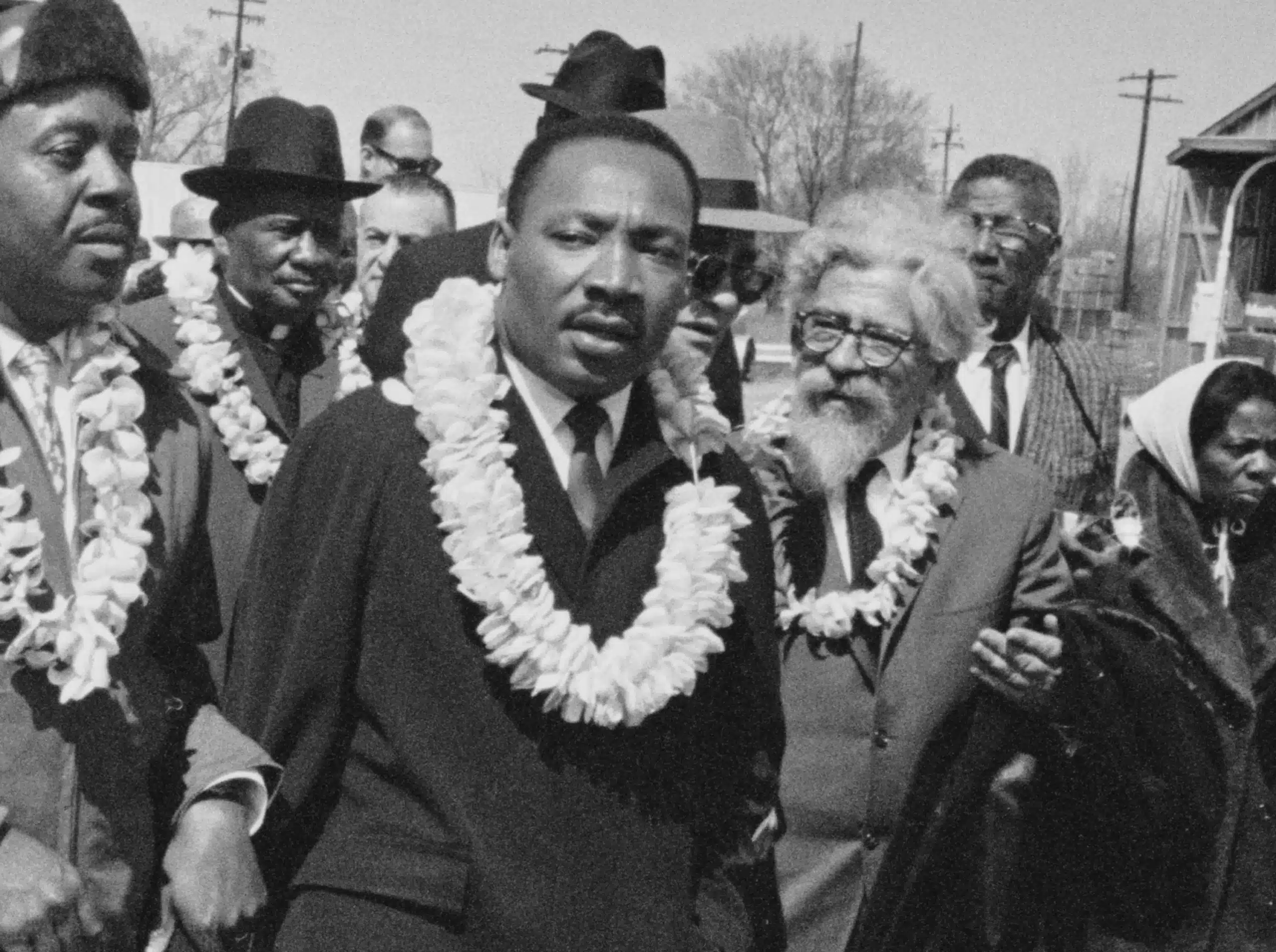
Your father became a prominent Jewish voice in American public life without softening or distancing his Jewish identity. Do you think that kind of public Jewish confidence has become harder to sustain in America today?
“I don’t think so. I don’t feel that way,” she said.
The idea of hiding being Jewish, she pointed out, would be “like thinking about hiding being female.”
She remembered teaching in Dallas and joining a gym, where an aerobics instructor noticed her watching CNN and asked whether she had family in the military. When Heschel mentioned friends and family in Israel, the woman lowered her voice and asked whether she was Jewish.
“I thought that was pretty hilarious,” Heschel said. “I’m so Jewish, everything I do in my life is Jewish. Why would I be embarrassed about it?”
At the same time, she did not take offense. “She was being gracious,” Heschel said. “She didn’t want to make me feel uncomfortable. And I appreciate that.”
The exchange amused her, but it also underscored how Jewish identity can still be treated as something delicate or uncomfortable to discuss openly.
Jewish American Heritage Month (JAHM) celebrates the contributions of Jews to American life. Yet much of your work examines societies that admired Jewish achievement while remaining deeply uncomfortable with Jewish identity.
What do you think the current moment is revealing about the conditions of Jewish acceptance in America?
“I think we all have had a very naive view of America,” Heschel says.
She argued that many American Jews came to see the United States as fundamentally different from Europe and, in doing so, overlooked an important lesson.
“You can’t say we’re free if other people are not free, because the unfreedom, the racism toward one group can so easily expand to include us,” she said.
That lesson came into focus again after the Tree of Life synagogue massacre in Pittsburgh in 2018. Heschel was struck by how shocked many people seemed.
“What are you shocked about?” she recalled thinking. Violence against minority communities had existed for decades. “If in the United States they can lynch Black people, they can lynch Jews. And they did,” she said.
For Heschel, the point is not to compare suffering. “It was not a question of number,” she said. “And it’s not a question of any kind of competition.”
Instead, she returned to a principle she said her father understood well. “Freedom is for everybody or nobody,” she emphasized. “You can never feel 100 percent safe if there are other people who don’t.”
Your recent work explores antisemitism as “cultural sadism” — the gratification people derive from Jewish humiliation or suffering. Do you think that helps explain some of the reactions we’ve seen globally since October 7?
The idea emerged, Heschel says, from her engagement with scholarship on the Black American experience.
“I found they were much more sophisticated in the way they analyzed anti-Black racism,” she said. “And I thought, we in the study of antisemitism have something to learn.”
Her thinking was further shaped by research on sexual violence during the pogroms in Eastern Europe more than a century ago.
One account in particular stayed with her. “A woman reported that during a pogrom, she was raped by a man in her village whom she had taken care of when he was a baby,” Heschel said. “We have to think about what that means. How could he do that? And what kind of horror was that for her?”
“I also started thinking about the sadistic quality of antisemitism,” she added. “There is something sadistic to it. Why does it feel good to them to be sadistic toward Jews? What is the specific relationship?”
For Heschel, the October 7th massacre in Israel reinforced the urgency of those questions. The sexual violence committed that day, she posited, was part of a longer history that scholars have often been reluctant to confront.
“It wasn’t the first instance, as we know,” she said.
As a professor, what has most frustrated you about the way antisemitism on campus has been studied and addressed since October 7th?
Heschel believes much remains unknown about the forces driving antisemitism on campus. “I want to break it down and I haven’t seen anyone do that,” she said.
She wants to know which academic disciplines are most affected, what students are hearing in their classrooms, and how those ideas are shaping campus culture. “What are they hearing? That’s what I want to know,” she continued. “I don’t need a report card. I need to know how to change things.”
What Heschel wants is practical guidance. She asked, “What do I do if I’m sitting in a faculty meeting and someone says X? How should I respond in that moment in a way that will be effective, that won’t alienate me from everybody else, and will get people to agree with me?”
So far, she said, “I don’t get an answer.”
After spending your career studying Jewish history and antisemitism, what concerns you most about how younger American Jews understand Jewish identity today?
Zionism, she said, was built on “a sense of our collective history as Jews, what we share, that brings us together, that we’re all part of a Jewish world.”
“My concern with college students is that they’re not studying Jewish history.” She understands the pull of Shabbat dinners at Hillel and Chabad. “But you need the education part,” she added.
That gap, she believes, has real consequences. “I think it undermines Zionism when we don’t have a sense of our history,” she said. “And I think that contributes to antisemitism.”