|
Getting your Trinity Audio player ready...
|
Europe’s antisemitism crisis continues to escalate, with CAM’s Antisemitism Research Center (ARC) monitoring 2,962 incidents across the continent in 2025, a nearly 50% annual rise.
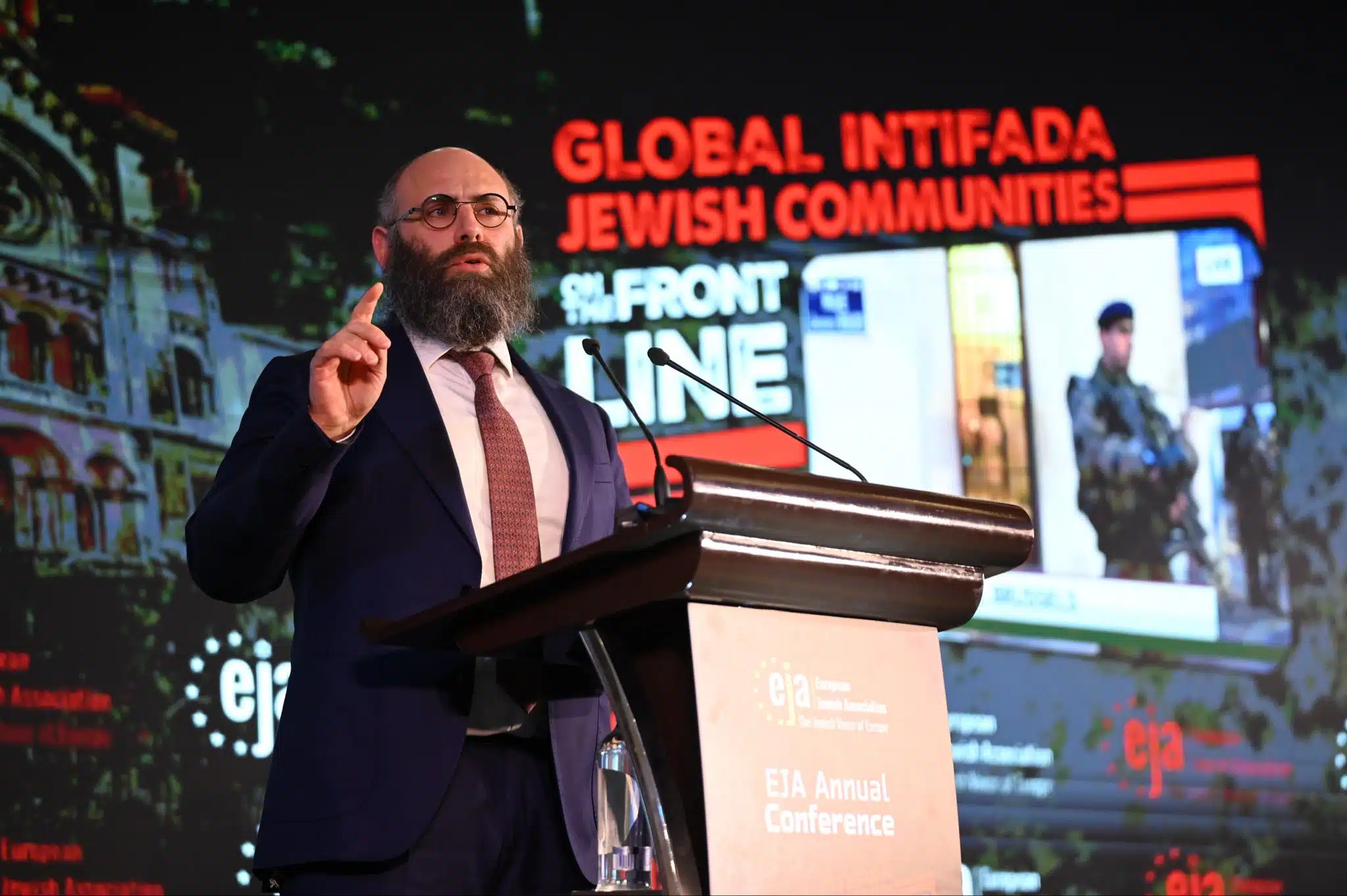
This week, Rabbi Menachem Margolin — chairman and founder of the European Jewish Association — spoke with CAM Director of European Affairs Shannon Seban about his organization’s activities, the situation in Europe, and what must be done to safeguard the future of European Jewish life.
What are EJA’s main priorities today, and what do you see as the most pressing challenges for Jewish communities across Europe?
The EJA is active on a number of fronts, as the fight against antisemitism and its latest incarnation, anti-Zionism, are being felt across multiple political theaters.
Our immediate priority is securing the safety and freedoms of European Jewry. I think we can say with a degree of certainty that all the strategies and statements made by governments, while welcome, have not improved the lived situation for Europe’s Jews.
With our community leaders and with the EU and national governments, we are actively exploring a special protected minority status for Jews in Europe, protected under law, and with a metaphorical fence around our faith and practices, and our buildings, synagogues, and schools. This is a potential game changer for all of us, settling the issue of our rights and freedoms for generations to come and sending the clearest possible message that European Jewry is a cherished part of Europe’s patrimony.
The issues of shechita (kosher slaughter) and brit milah (Jewish ritual circumcision) pop up regularly, so we are also very active on that front. For example, on brit milah we are working with the European Commission on establishing a European center of excellence for the accreditation and ongoing training of mohelim. There’s a tremendous amount of ignorance out there about our faith and practices. We seek to protect them by engaging positively where we can. Where we cannot, we follow legal routes.
Those are two of the most pressing issues, but they are but two of many, with others including governmental, municipal, and institutional adoptions of the IHRA definition, Holocaust awareness, and press and political briefings on Israel, the world’s only Jewish state.
Since October 7th, many European governments have strengthened their rhetoric against antisemitism. Where do you see the greatest disconnect between political statements and concrete action?
On the streets. In public discourse. From the NGOs. How can you say you are committed to fighting antisemitism while simultaneously allowing the false narratives and tropes of “genocidal, child-killing, and apartheid-supporting Jews” to go unchecked and permitted under freedom of expression? It’s oxymoronic.
Europe has invested heavily in Holocaust remembrance and education for decades. Why do you think these efforts have not translated into greater societal resilience against contemporary antisemitism?
When the very subject of what constitutes antisemitism is a matter of political conjecture and debate, rather than in the hands of Jews themselves, when people cannot even agree that the IHRA definition is the definition, and when social media rewards and amplifies hate, it will take more than simply talks in classrooms. This is part of the challenge. We need education at every level, and across multiple platforms.
Antisemitism today often intersects with anti-democratic movements, Islamist extremism, and political polarization. Are European policymakers still approaching these as separate challenges when they should be treated as interconnected threats?
A few are, but on the whole there’s either a fear, at worst, or reluctance, at best, to properly tackle the issue. After all, many of these governments were actively encouraging the intake of millions of migrants from the Middle East, without explaining the ground rules of tolerance and western liberal democratic values to them. Now, I know very few governments would be willing to admit that this process was, in fact, a failure. So it has become a bit like an elephant in the room. It’s there, it habitually wreaks havoc in Europe, makes life next to impossible for Europe’s Jews, but governments on the whole just ignore it, either for reasons of political expediency or for fear of unleashing widespread societal upheaval. Meanwhile, our walls get higher and more police and army are needed to keep us safe. It makes little sense.
Some European municipalities have recently adopted the IHRA Working Definition of Antisemitism. Do you believe local governments have become an underestimated actor in the fight against antisemitism? Where can they make the biggest difference?
It’s hugely important. It has a domino effect, and the fact that an increasing number of municipalities are doing this, notably in Spain where we are very active, puts pressure right at the heart of government. Locally, it sends a clear message too — Jews are welcome here, are a valued part of our communities, and we will protect them. Where municipalities lead, and they are leading, others must follow.
There is growing concern that antisemitism is increasingly tolerated when framed through certain political or ideological narratives. How can democratic societies address this double standard without undermining legitimate freedom of expression?
Once that genie is out of the bottle it is very hard to put it back in. The antisemites and anti-Zionists were quick to start work minutes after October 7th took place, pushing the limits of free speech, testing the borders, and to use the language of that terrible day, breaking the fence completely and running riot with language as a weapon against Jews. We have seen antisemitic discourse and actions last seen in the dark days of the Kristallnacht.
The line should be clear to all. Legitimate criticism of the policies of the government of Israel is entirely normal. Denying the right of an entire state to exist, calling for the eradication of its people “from the river to the sea” and equating Jews with Nazis, the South African apartheid system, and all the other tropes fueling this tidal of wave of hate against Jews is not only not normal, it is abhorrent and must be stopped immediately. Freedom of expression is a just, noble, and fundamental right, but it is being badly abused at present.
Cooperation between organizations, governments, faith leaders, and civil society has never been more important. In your view, what does effective cooperation look like in practice, and where do you see the greatest opportunities for impact?
Effective cooperation means speaking with one voice, unambiguously as defenders and active citizens of the societies we call home. When it comes to freedom of religion issues, this is where impact can be maximized. I think religious leaders can see that secularists are constantly trying to erode this fundamental right, and standing together on these issues, whether they directly impact us or not, shows a much needed unity and strength in numbers, so governments can see that hitting this freedom is not the path of least political resistance.
If you could ask every European policymaker to take one concrete action tomorrow to combat antisemitism, what would it be?
To help us ensure European Jewry is covered under a special protected minority status — to advocate for it, approve it in their parliaments, and make sure every Jew in Europe is protected under this status.
Read more: