|
Getting your Trinity Audio player ready...
|
Just over a month ago, Wisconsin Governor Governor Tony Evers signed into law AB 446, a measure adopting the International Holocaust Remembrance Alliance (IHRA) Working Definition of Antisemitism into state statute for use in evaluating discriminatory intent and enhanced criminal penalties.
The new law, now titled Wisconsin Act 143, defines antisemitism based on the IHRA framework, including its 11 illustrative examples.
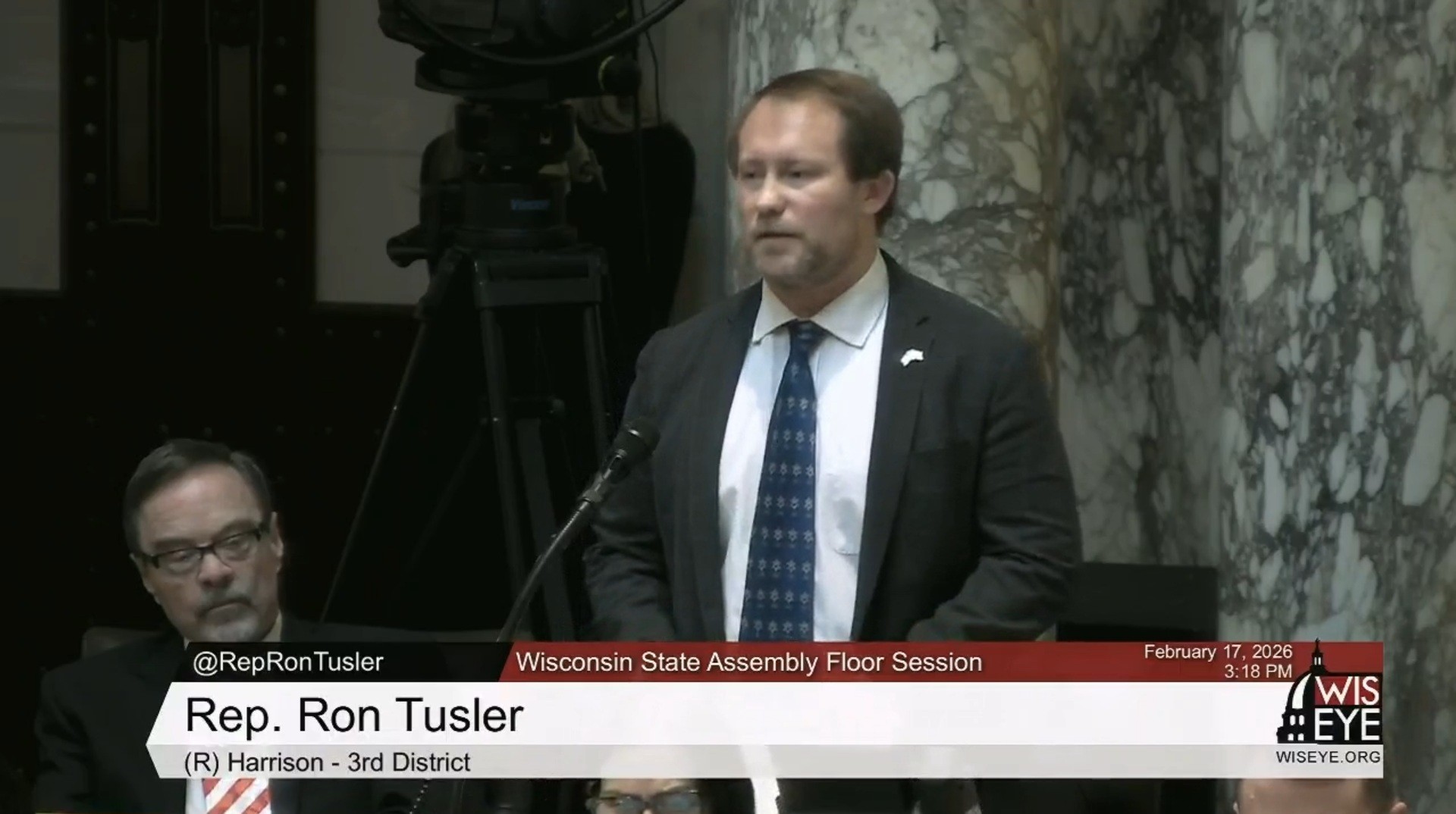
In an interview this week with the Combat Antisemitism Movement (CAM), State Representative Ron Tusler, the lead sponsor of the bill in the Wisconsin Assembly, talked about the legislative process, the law’s expected impact, and what’s next in the fight against antisemitism in his state.
What motivated you to get involved in this specific issue?
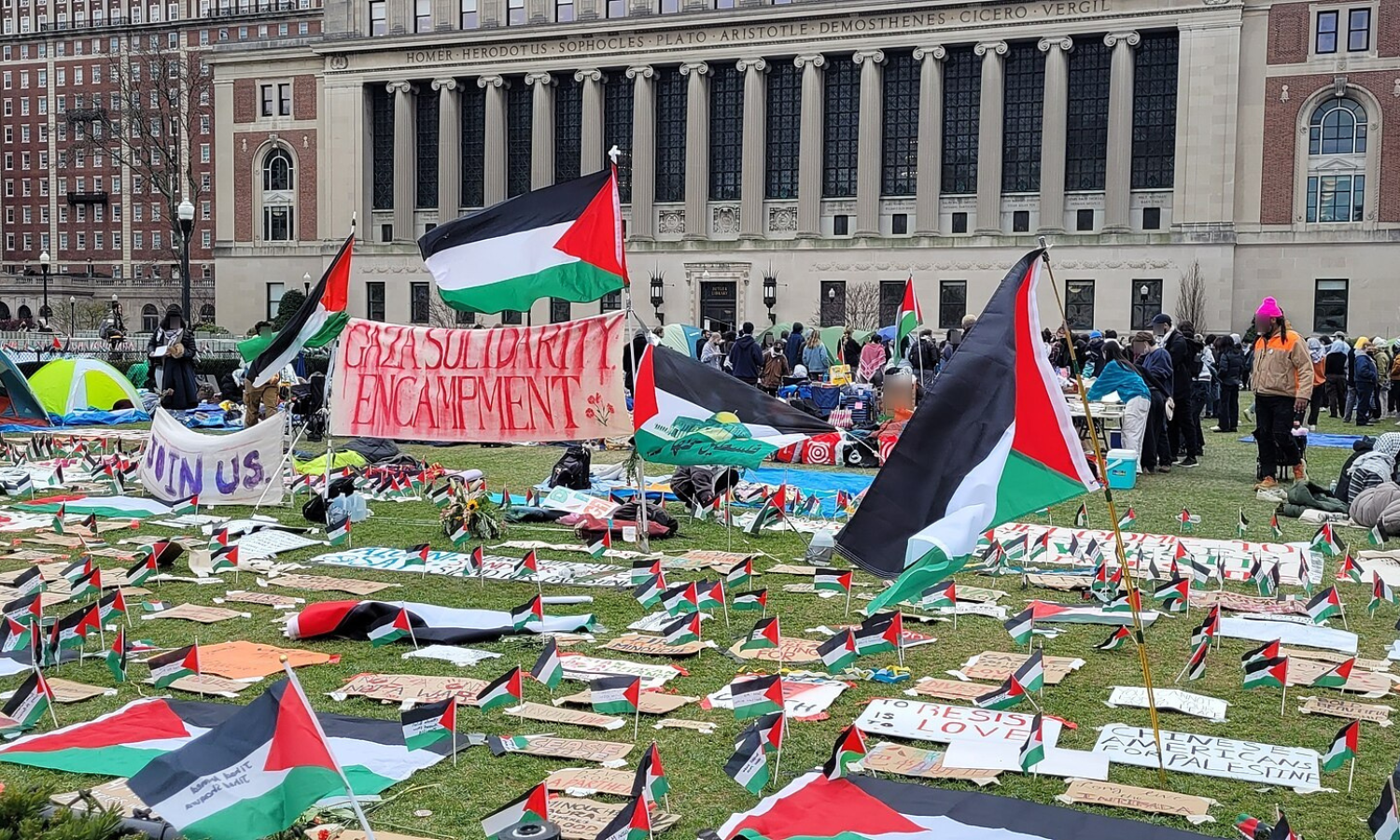
A former professor of mine at the University of Wisconsin-Milwaukee, Shale Horowitz, contacted me. He’s Jewish, and he told me how the pro-Palestinian protests and encampment on campus were affecting him and the Jews who go to UW-Milwaukee and live in the area. The demonstrators were bullying kids walking past the encampment who had yarmulkes on their heads and were clearly Jewish.
Professor Horowitz was very frustrated with the situation. As a Jewish person, he thought the university should be doing something, but they were so scared of the issue that they wouldn’t touch it.
Of course, I cared about this. I felt very bad for him that he had to put up with this. So he and the Jewish community started looking at ways to peacefully and politely, in a very civil way, react to these folks who were being very uncivil. Their ringleader, by the way, is one of my colleagues, Representative Ryan Clancy, who is just a blatant antisemite.
In this context, I must also mention the late Jonathan Brostoff. Jonathan was a former state representative, a hard Democrat who was no friend to me as a Republican. He was a Jewish man, and even though he was very hard to work with, he was very passionate. It was hard not to respect how good he was at his job. It really bothered how some of his longtime friends were now protesting him just for being Jewish. He committed suicide in 2024, and it really kind of shocked everybody. We never thought that all of this could result in something like that. I felt very bad for him and his family. He was a good guy.
With this as the background, I started asking for responsibility and to try to be of assistance. The Jewish Federation Milwaukee and Michael Blumenfeld told us that something clarifying what is or is not acceptable in a context like the UW-Milwaukee’s would be helpful.
As a Christian man, I really wanted to help the Jewish people. I’ve spent a lot of my life learning about Jewish culture and studying the Old Testament and the New Testament. I see these folks as my people, and people I want to help, and people who deserve to be treated fairly.
What kind of opposition did you face to the bill?
It was really wild. I couldn’t believe how much resistance there was about something that seemed so simple and what I feel like in a different context everybody would accept. The IHRA definition was adopted by both President Donald Trump and former President Joe Biden, and 37 other states had it before Wisconsin. More than 45 countries have adopted the definition. There really isn’t any other definition that has gotten any sort of distance like that. It is a pretty well-accepted, pretty well-known, and pretty well-tested definition. This shouldn’t have been difficult at all. If not for Representative Clancy, it probably would have been a bill that was passed and signed totally under the radar.
There were two camps who had a problem with this bill. You had the pro-Palestinian folks with their black-and-white Yasser Arafat keffiyehs they would all wear. They would testify at meetings and say just the most horrible things about me and the bill, claiming we were trying to steal away their First Amendment rights and silence opposition to Israel, and that Israeli Prime Minister Benjamin Netanyahu was somehow funding all of this. Just every nasty thing they could think of.
There was also a small, but very vocal, camp of Jewish people who disagreed with the bill, who were trying to push alternatives, like the Jerusalem Declaration, a far less comprehensive and less tested definition than IHRA that was not acceptable to us.
Now that the bill has become law, what impact will it have?
It will have an impact in multiple different valuable ways. One is that a Wisconsin jury instruction will be drafted. Let’s say, in a hypothetical situation, a pro-Palestinian person decides to punch a Jewish student at UW-Milwaukee just for wearing a yarmulke. You would expect that pro-Palestinian person to be charged with battery, which sometimes they would in Milwaukee, a lot of times they wouldn’t. But now if they were charged, the jury will get to additionally consider whether if antisemitism had a role in the decision to throw the punch. And if it did, there’s not necessarily an additional punishment, it might not affect the way the person’s punished at all. That’s up to the judge. But one would think that if the jury determines that, then the penalty would be greater because it’s a little bit of a greater offense. Same thing on the civil side. If let’s say the victim wanted their medical bills paid for because the punch did a lot of damage or caused a concussions or brain damage or something like that, the jury could decide whether antisemitism was a factor in the assault.
Another thing the law helps with is the policies at our universities. Now that we have one definition in the state of Wisconsin of antisemitism is, no one can hide from determining whether an incident is antisemitic or not. UW-Milwaukee has these pro-Palestinian folks and they’re doing things that I think the average person would agree is antisemitic, but the university would say, ‘Well, we don’t really know exactly if that’s antisemitic or not. We don’t have our own real definition of what it is. So we don’t want to be involved.’ And that’s really what offended Professor Horowitz — that antisemitic things were clearly happening on campus, but UW-Milwaukee just took no action because they didn’t want to. The excuse they used was that they didn’t know what antisemitism was, so how could they punish somebody for something that they didn’t now where the line was.
Are there further state-level steps that you think need to be taken in Wisconsin to address antisemitism?
There are states that have done more than us. So we’re going to look at what those other states have done, and we’re going to see if we think it would be helpful in our context. But as for choosing exactly what the next step is, I would want to defer to organizations like the Combat Antisemitism Movement and the Jewish Federation, and other stakeholders to come to me tell me what they think is most valuable and what’s most useful.
As someone who isn’t Jewish, I want to defer to them and find out what they say. But I think that we’ll do more. But it is a little bit of a question of what that more is.
There are also many states that have done less than Wisconsin. What message do you have for lawmakers considering embarking on the same path you did?
I would encourage them to look at it and do it now, specifically, because why not define these things? Why not, especially when we have such a well-agreed upon definition? Why not do it now before you have a problem? We’re always reacting to things instead of getting proactive about it. To me, I think this whole scenario that happened in Wisconsin would have played out in a much more expected and much more positive way if we would have already had this definition. So instead of regretting that something happened that caused this to be necessary, just get ahead of it. I don’t see any reason that the IHRA definition shouldn’t be passed in all 50 states.