|
Getting your Trinity Audio player ready...
|
The following analysis was authored by Zoef Menovsky, Arabic-language research associate for CAM’s Antisemitism Research Center (ARC):
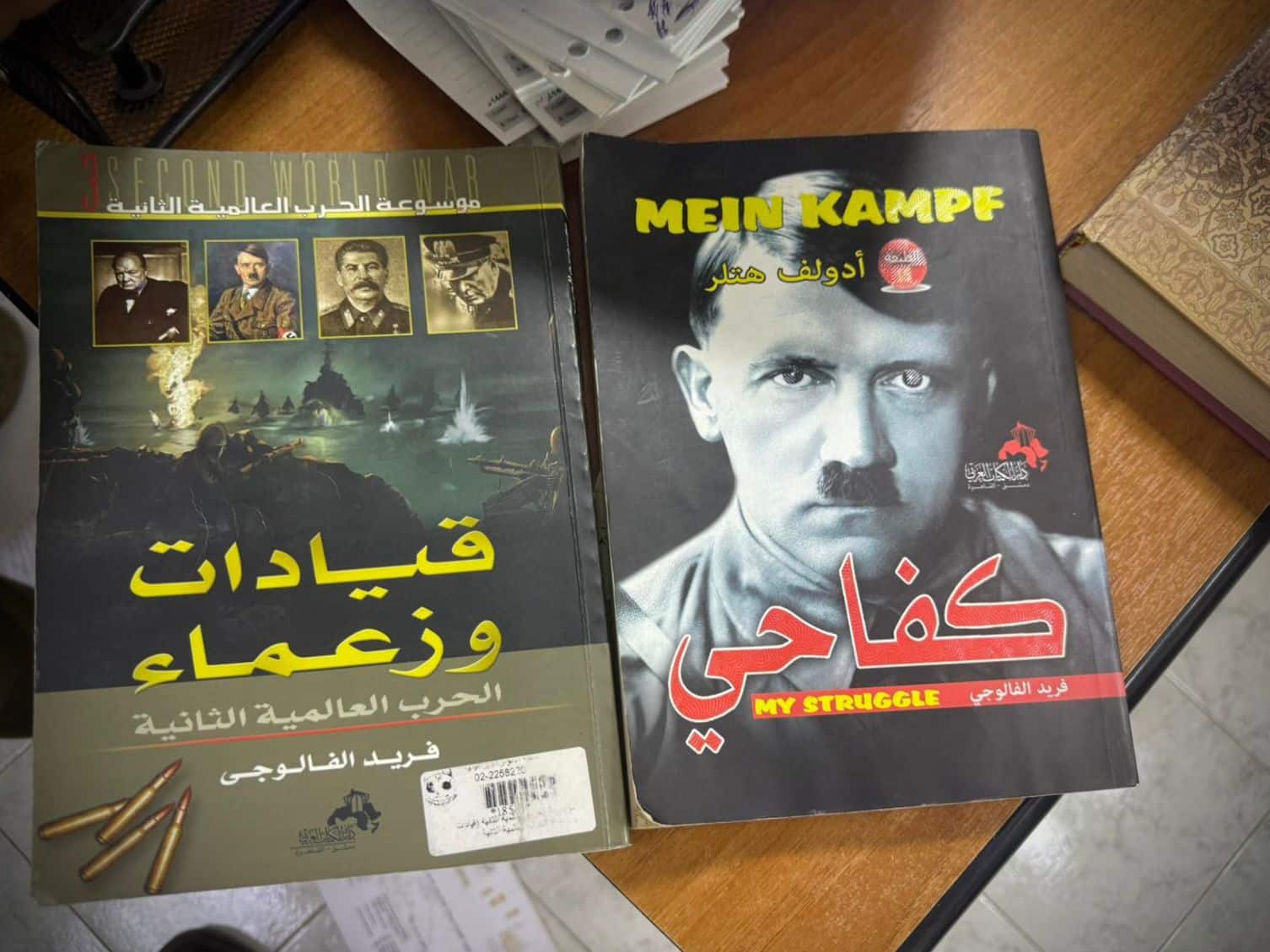
Walk into a bookshop in Cairo and there is a fair chance you will find an Arabic edition of Mein Kampf (Kifāḥī in Arabic) on display. Visit the state-run Cairo International Book Fair, the largest in the Arab world, and the odds rise further.
The same admiration for Adolf Hitler is also present on Egyptian social media. In a post on October 29, 2023, Alaa Mubarak, son of late former Egyptian President Hosni Mubarak, posted a picture of Hitler during an exchange about the Gaza war, accompanied by the words: “خلونا نحب الراجل ده ونقول ولا يوم من أيامك يا هتلر” (“Let’s love this man and say, ‘Not a day like your days, Hitler.'”).
None of this means Egypt harbors a mass neo-Nazi movement. Nor are antisemitism, anti-Zionism, and Hitler glorification always interchangeable. But the persistence of Hitler as a cultural and political symbol points to an enduring phenomenon — the repurposing of Hitler’s image response to contemporary conflicts, first with with the United Kingdom and later with the State of Israel.
The historical record suggests that public expressions of support for Hitler in Egypt become particularly pronounced during periods of intensified hostility toward Israel.
The Enemy of My Enemy: 1928-1945
Nazism took root in Egypt not simply as an imported racial ideology, but amid the struggle to end British colonial control. Germany and Italy, Britain’s rivals, attracted some Egyptian nationalists. Historian Łukasz Hirszowicz argued that hopes of escaping British influence led many Arabs to look favorably on the Axis powers. Nazi persecution of Jews also appealed to some pro-Palestinian nationalists who viewed Zionism as a threat.
Two movements reflected this climate. Young Egypt, founded in 1933, adopted green-shirt uniforms and borrowed openly from European fascism. The Muslim Brotherhood, founded by Hassan al-Banna in 1928, was a religious movement, not a fascist one, but embraced fierce anti-Jewish rhetoric during the 1936–39 Arab Revolt in British Mandatory Palestine. The extent of its ties to Nazi Germany remains disputed. Matthias Küntzel posits that the Brotherhood received German funding and that Arabic editions of Mein Kampf and The Protocols of the Elders of Zion circulated at a 1938 Cairo conference. Other historians acknowledge contacts, but question their ideological significance.
Nazi propaganda nevertheless circulated widely in Arabic. In the 1930s, Iraqi nationalist Yunis al-Sab’awi translated passages of Mein Kampf in Baghdad, while German radio broadcast antisemitic messages across the region. Pro-German sentiment became more visible in 1942, when German General Erwin Rommel’s Afrika Korps advanced toward El Alamein, threatening Cairo. That year, Anwar Sadat was arrested for contacts with German agents. In his 1957 memoir, Asrar al-Thawra al-Misriyya, published in English as Revolt on the Nile, Sadat recalled Egyptian Nazi sympathizers preparing to welcome Rommel and Nazi swastikas appearing in public.
After 1945: A Changing Symbol
Germany’s defeat in World War II did not erase Nazi ideas from Egypt. They survived through former Nazis, propaganda, and print.
In 1946, King Farouk granted asylum to Haj Amin al-Husseini, the former Mufti of Jerusalem, who had spent the war in Berlin broadcasting Nazi propaganda. In the 1950s, Egypt became home to several former Nazis, including Johann von Leers, a former associate of Joseph Goebbels who converted to Islam, took the name Omar Amin, and worked on anti-Zionist campaigns in Cairo. Aribert Heim, the concentration camp doctor known as “Dr. Death,” also lived in the Egyptian capital under an alias until his death in 1992. President Gamal Abdel Nasser, who ruled Egypt from 1954-1970, drew on their expertise to aid his efforts to confront Israel.
Anti-Jewish rhetoric predated Israel’s creation in 1948, but the Arab defeat in the war that ensued gave it a new political focus. Hitler could be recast not just as Britain’s wartime enemy but also a persecutor of the Jews. In 1953, Sadat published an open letter to Hitler in Al-Musawwar. Arabic editions of Mein Kampf and The Protocols of the Elders of Zion also remained in circulation.
The wars of 1956, 1967 and 1973 further entrenched animus toward Israel and Jews as a core element of Egypt’s political culture.
The Pattern Becomes Visible
After Egypt signed a peace treaty with Israel in 1979, the relationship between the two countries changed fundamentally. Anti-Israel sentiments, however, remained popular among the Egyptian public.
The Second Intifada brought a renewed wave of Hitler references. In April 2001, the government-backed daily Al-Akhbar published a column thanking Hitler for taking revenge on Jews for the Palestinians and regretting that he had not gone further. A year later, Egyptian television aired Horseman Without a Horse, a Ramadan drama based on The Protocols of the Elders of Zion, despite international protests.
After Mubarak’s regime fell in 2011, a self-declared Nazi party briefly emerged, with its founders appearing on television to discuss the “positive aspects” of Nazism.
Since October 7, 2023, the Gaza war has again fueled extreme anti-Israel rhetoric. Mein Kampf has continued to appear at the Cairo book fair, while a 2025 Jewish People Policy Institute (JPPI) study found antisemitic content in nearly three in ten articles mentioning Jews in the Egyptian newspapers it examined.
The proliferation of antisemitic conspiracy theories and the conflation of the terms “Jew” and “Zionist” have created an environment in Egypt where expressing support for Hitler has become a common and legitimized form of political rage.
Why the Conditions Remain Favorable
Several factors help explain why Hitler remains a potent political symbol in Egypt.
First, anti-Zionist rhetoric often overlaps with antisemitism. The JPPI study of Al-Ahram and Al-Gomhuria, two leading state-aligned newspapers, found that 70 percent of opinion articles about Israel were negative. More tellingly, some invoked conspiracy theories resembling The Protocols of the Elders of Zion, alleging Jewish plots to dominate the region or the world. When “Jew” and “Zionist” become interchangeable, the line between political criticism and antisemitism blurs.
Second, Nazi texts remain on sale at the government-run Cairo International Book Fair. The Anti-Defamation League (ADL) and Simon Wiesenthal Center have repeatedly reported finding Mein Kampf and The Protocols there. The U.S. embassy closed its stand in protest in 2019. Four years later, the Wiesenthal Center reported finding Mein Kampf at roughly a dozen stalls. Allowing these texts to circulate at a state-sponsored event lends them a degree of legitimacy.
Third, the Gaza war has intensified public anger toward Israel, which is likely to outlast the fighting and can be revived during future confrontations.
Social media amplifies these trends. Where newspapers, books and television once shaped public debate, Hitler memes and Nazi references now spread instantly to millions, largely beyond traditional editorial control. Their reach makes this resurgence harder to track.
Hitler also sometimes serves as a symbol of strongman rule. Actress Soheir al-Babli once said Egyptians needed a leader as ruthless as Hitler to discipline them. But evidence for how widespread this sentiment remains limited.
A Recurring Symbol, Not Egyptian Nazism
Hitler imagery is not unique to Egypt, and enmity toward Israel does not amount to support for Nazism. Egypt has maintained peaceful relations with Israel since 1979, and its government has strategic reasons to contain political extremism.
The history is not one of continuous loyalty to Nazi ideology, but of a symbol repeatedly adapted to political circumstances. In the 1930s and early 1940s, Hitler represented a potential ally against Britain. After 1948, his antisemitic ideology became more central to his appeal. During later Arab-Israeli conflicts, Hitler’s image resurfaced as an expression of anti-Israel and antisemitic feelings.
Several conditions sustaining that symbolism remain — the aftermath of the Gaza war, antisemitic narratives in parts of the media, Nazi texts at a state-run book fair, and social media that spreads such imagery far beyond traditional outlets.
The danger is not necessarily a mass Nazi movement, but Hitler’s continued use as a recognizable symbol of hatred when political circumstances make him useful. Egyptian authorities cannot erase this history, but they can choose whether to reinforce it through what they publish, broadcast, and permit at state-sponsored events — or make invoking Hitler less acceptable.
Read more:
‘A Curse Upon the Jews’: In Houthi-Run Yemen, Antisemitism Is a Way of Life
CAM Expands Antisemitism Research Center (ARC) With Dedicated Arabic-Language Monitoring Capacity