

|
Getting your Trinity Audio player ready...
|
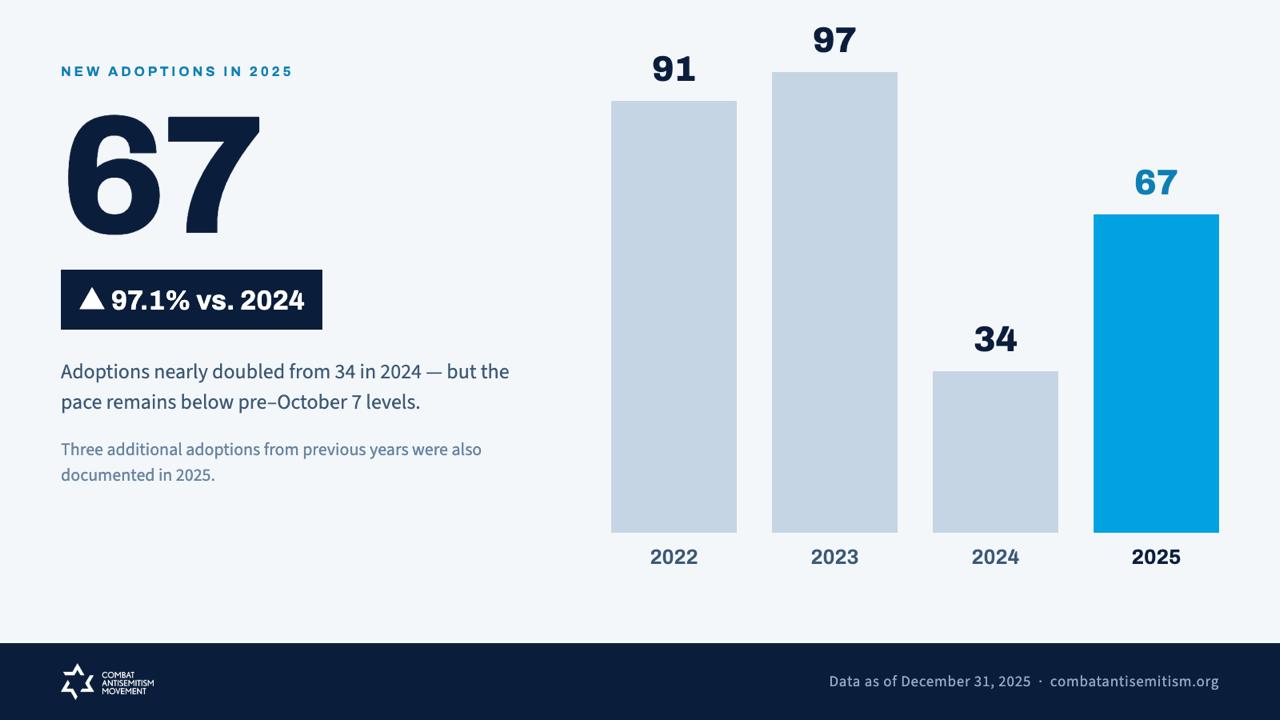
A total of 67 new entities adopted the International Holocaust Remembrance Alliance (IHRA) Working Definition of Antisemitism last year, and three previous IHRA adoptions were added, bringing the all-time number of global adoptions to 1,334 as of the end of 2025, according to data compiled by CAM’s Antisemitism Research Center (ARC).
The 67 new adoptions in 2025 marked a 97.1% increase from 34 the prior year. Despite this upward trend, the pace of adoptions was still lower than pre-October 7, 2023 — 97 adoptions were documented in 2023 and 91 in 2022.
Read the ARC’s IHRA definition adoptions data in full HERE.
Key Statistics:
— Total All-Time IHRA Adoptions (as of December 31, 2025): 1,334

— New Adoptions in 2025: 67
— Adoptions Added in 2025 from Previous Years: 3
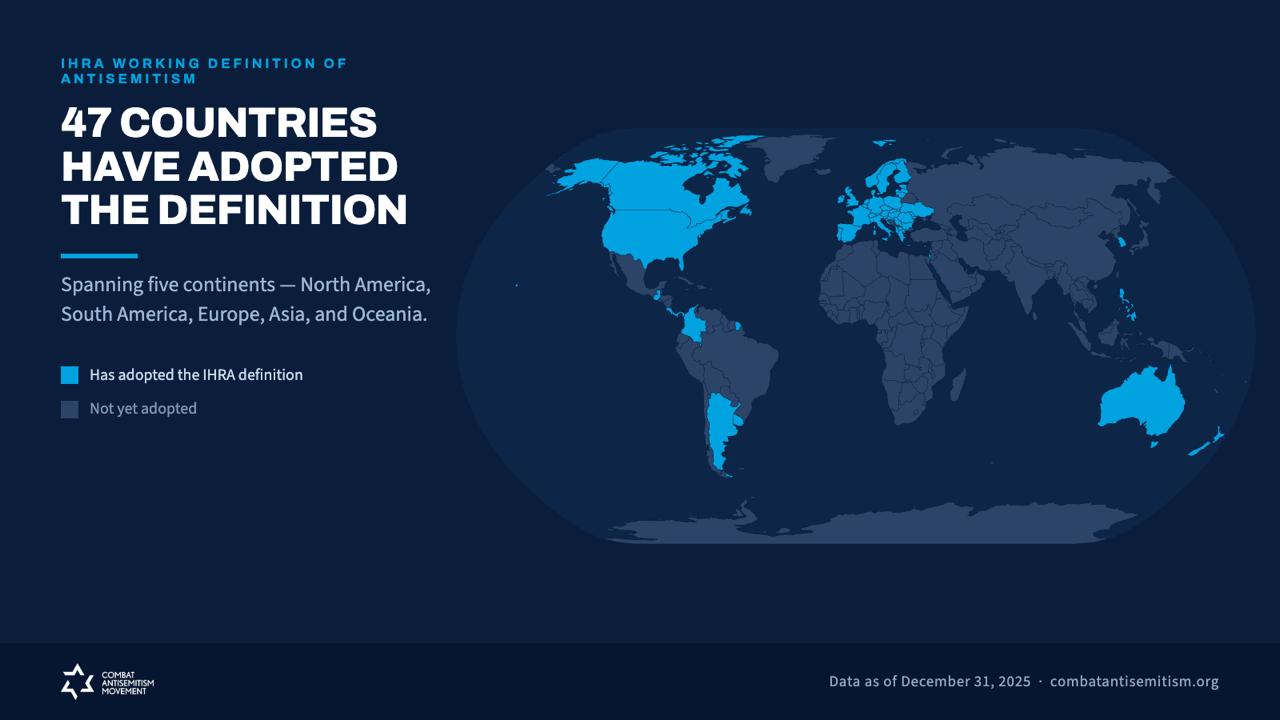
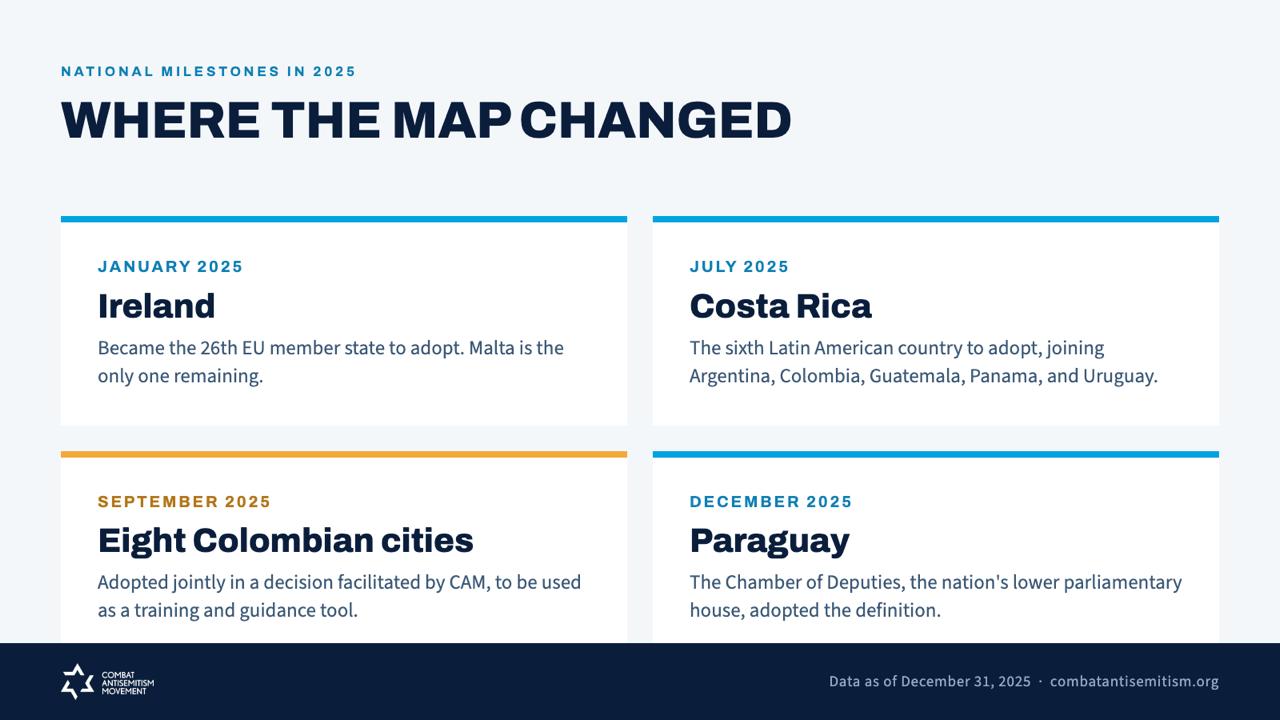
— Total National IHRA Adoptions: 47
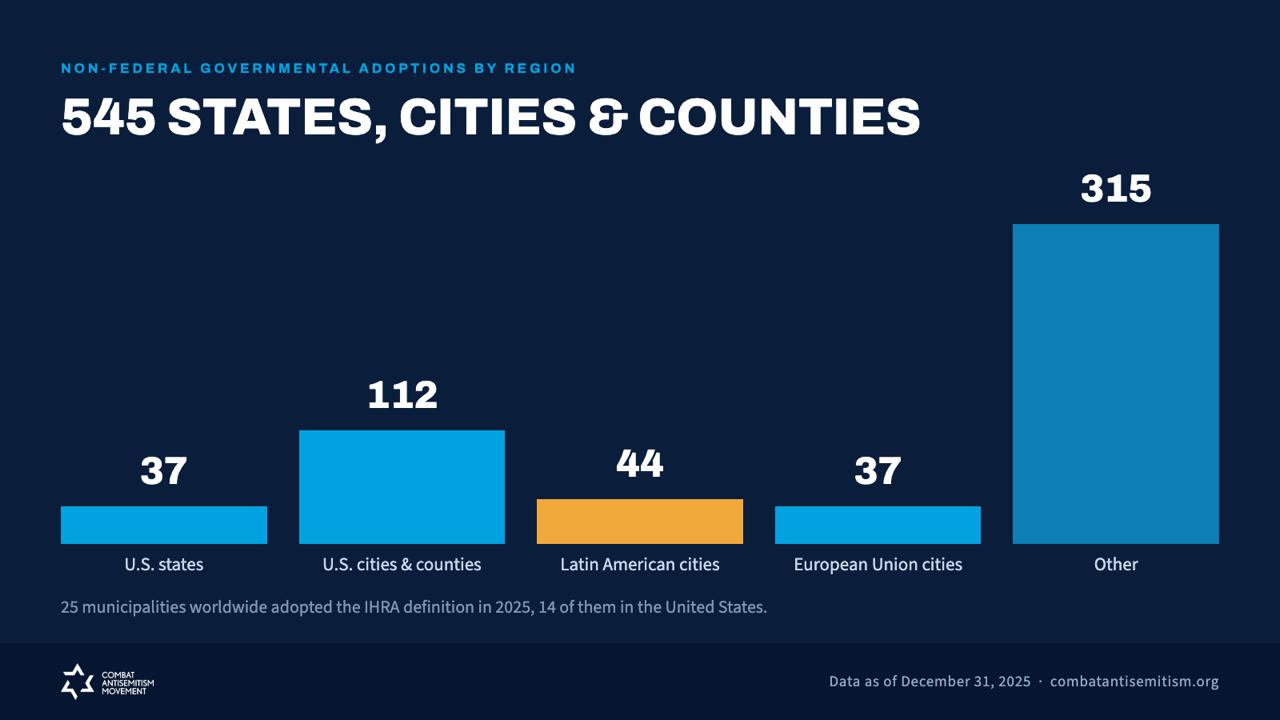
— Total U.S. State IHRA Adoptions: 37
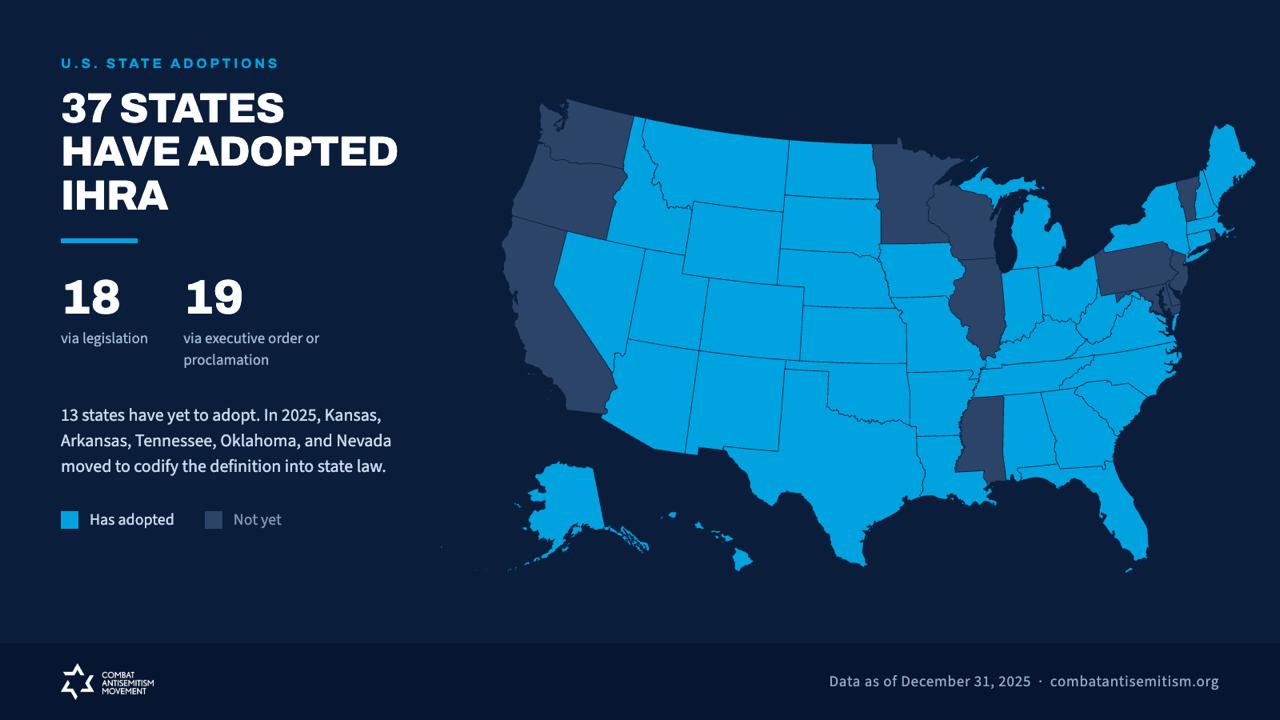
— U.S. State IHRA Adoptions via Legislation: 18
— U.S. State IHRA Adoptions via Executive Orders/Proclamations: 19
— Total Non-Federal Governmental IHRA Adoptions: 545
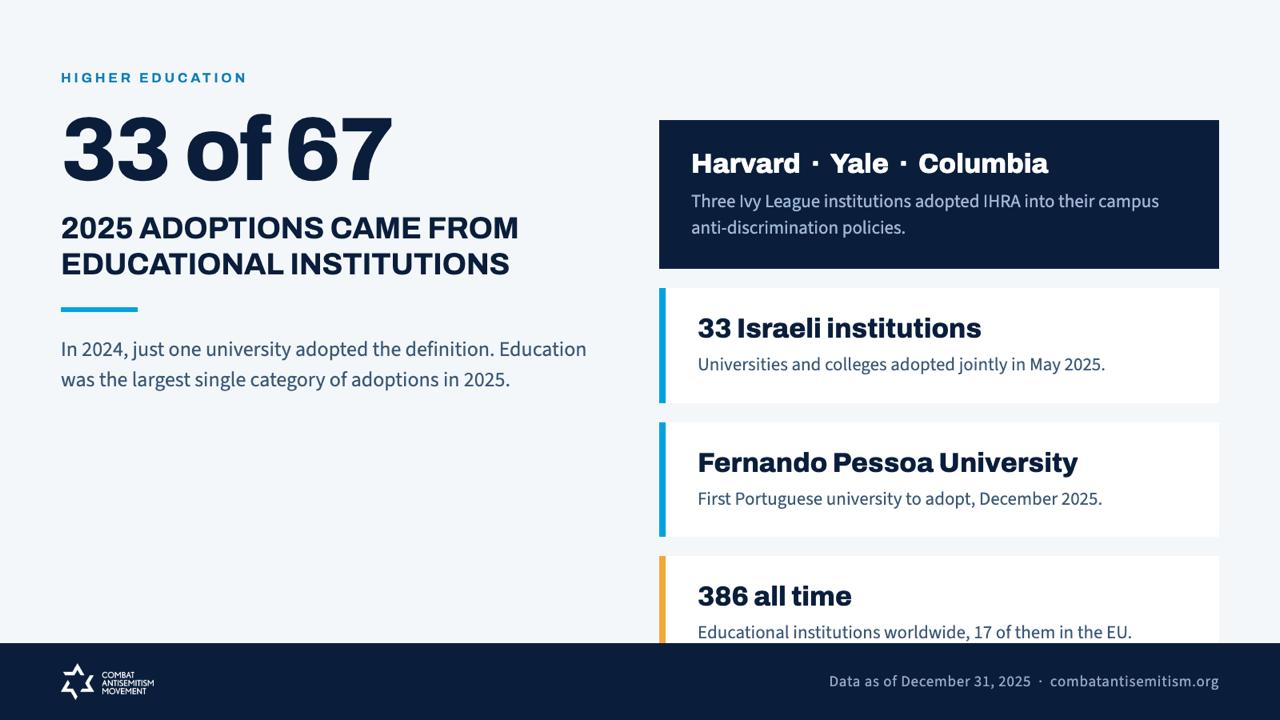
— Total Educational Institution Adoptions: 386
— Total Public Organization and Entity IHRA Adoptions: 261
— Total Private Organization and Entity IHRA Adoptions: 58
CAM’s Strategic Recommendations for Promoting IHRA Definition:
— From Adoption to Implementation: Prioritize codifying the IHRA Working Definition of Antisemitism. Governments and institutions that have already symbolically adopted IHRA should ensure its integration into hate crime investigations, civil rights enforcement at K-20 schools, and law enforcement training.
— Close Remaining U.S. State Gaps: Focus legislative advocacy on the 18 U.S. states that have not yet adopted the IHRA definition, and continue to strengthen and expand implementation in states that have already taken symbolic or statutory action.
— Institutionalize IHRA on Campuses: Build on the significant increase in university adoptions in 2025 by ensuring the IHRA definition is embedded in student conduct codes, faculty policies, Title VI compliance, and campus disciplinary processes, with mandatory training for students and staff.
— Strengthen Municipal and Regional Leadership: Expand outreach to cities and regional authorities as frontline actors in combating antisemitism, promoting the adoption and implementation of the IHRA definition in policing, public safety, and community engagement activities.
— Defend IHRA’s Integrity and Expand Cross-Sector Engagement: Vigorously counter efforts to politicize or misrepresent the IHRA definition, while mobilizing civil society, interfaith partners, and the private sector to adopt and implement the definition.
Text of IHRA Working Definition of Antisemitism
Antisemitism is a certain perception of Jews, which may be expressed as hatred toward Jews. Rhetorical and physical manifestations of antisemitism are directed toward Jewish or non-Jewish individuals and/or their property, toward Jewish community institutions and religious facilities.
Manifestations might include the targeting of the State of Israel, conceived as a Jewish collectivity. However, criticism of Israel similar to that leveled against any other country cannot be regarded as antisemitic. Antisemitism frequently charges Jews with conspiring to harm humanity, and it is often used to blame Jews for “why things go wrong.” It is expressed in speech, writing, visual forms and action, and employs sinister stereotypes and negative character traits.
Contemporary examples of antisemitism in public life, the media, schools, the workplace, and in the religious sphere could, taking into account the overall context, include, but are not limited to:
— Calling for, aiding, or justifying the killing or harming of Jews in the name of a radical ideology or an extremist view of religion.
— Making mendacious, dehumanizing, demonizing, or stereotypical allegations about Jews as such or the power of Jews as collective — such as, especially but not exclusively, the myth about a world Jewish conspiracy or of Jews controlling the media, economy, government or other societal institutions.
— Accusing Jews as a people of being responsible for real or imagined wrongdoing committed by a single Jewish person or group, or even for acts committed by non-Jews.
— Denying the fact, scope, mechanisms (e.g. gas chambers) or intentionality of the genocide of the Jewish people at the hands of National Socialist Germany and its supporters and accomplices during World War II (the Holocaust).
— Accusing the Jews as a people, or Israel as a state, of inventing or exaggerating the Holocaust.
— Accusing Jewish citizens of being more loyal to Israel, or to the alleged priorities of Jews worldwide, than to the interests of their own nations.
— Denying the Jewish people their right to self-determination, e.g., by claiming that the existence of a State of Israel is a racist endeavor.
— Applying double standards by requiring of it a behavior not expected or demanded of any other democratic nation.
— Using the symbols and images associated with classic antisemitism (e.g., claims of Jews killing Jesus or blood libel) to characterize Israel or Israelis.
— Drawing comparisons of contemporary Israeli policy to that of the Nazis.
— Holding Jews collectively responsible for actions of the State of Israel.
For more information on the IHRA definition, please visit:
Antisemitism Definition and Meaning — A Clear Guide From Ancient Hatred to Its Modern-Day Disguises