
|
Getting your Trinity Audio player ready...
|
Following the European Parliament’s adoption earlier this month of a resolution calling for a coordinated EU strategy to “counter Islamist entryism and the influence of the Muslim Brotherhood,” the debate over extremist networks, public accountability, and the protection of democratic institutions has taken on renewed urgency.
The resolution’s leading proponent, French MEP Céline Imart (European People’s Party), spoke with Combat Antisemitism Movement (CAM) Executive Director of European Affairs Shannon Seban about the motivations behind the initiative, concerns about Muslim Brotherhood activities across Europe, and the links between Islamist ideologies and antisemitism.
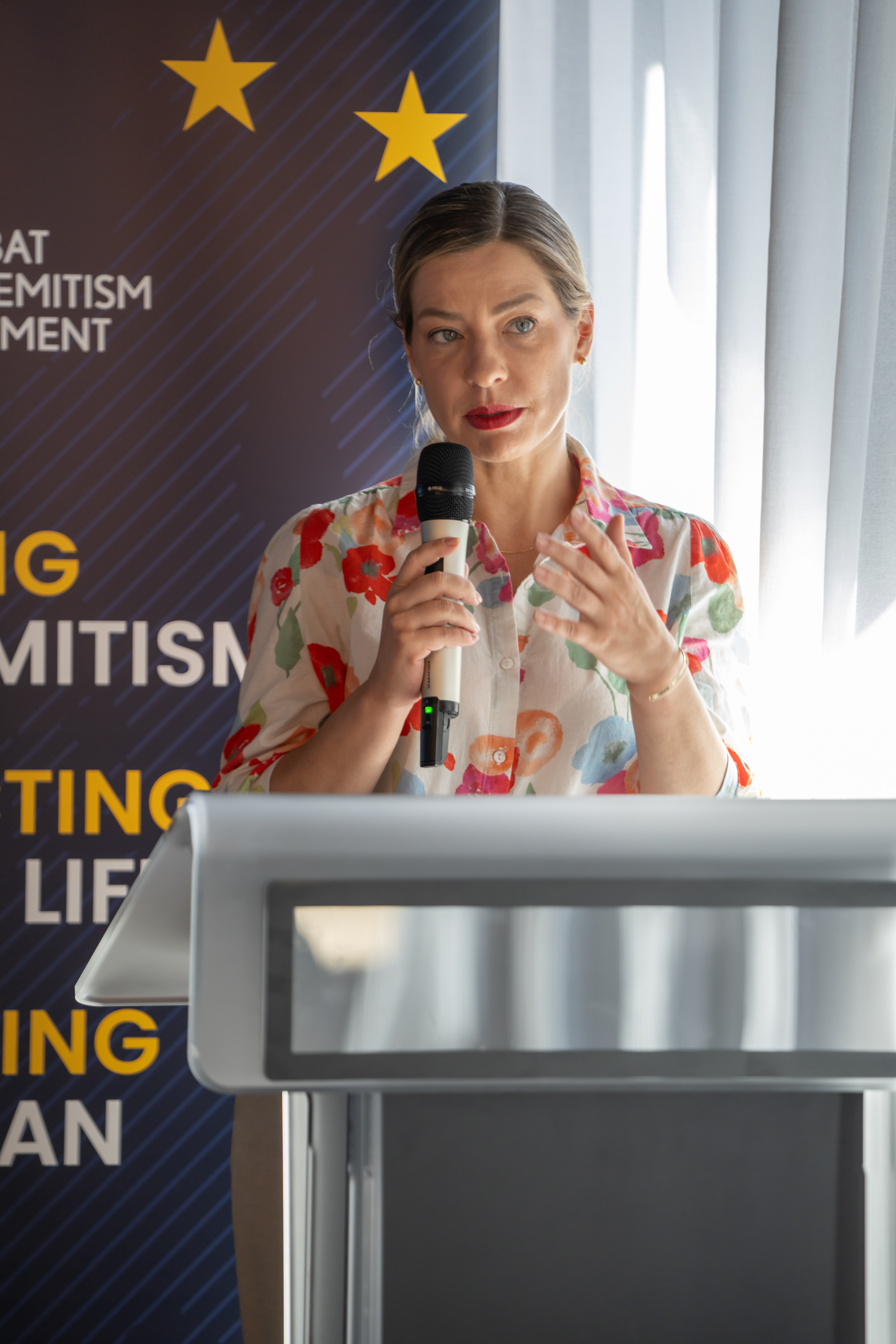
You have been personally committed to addressing the influence of the Muslim Brotherhood in Europe. What first prompted you to take on this issue, and why did you decide to bring this resolution before the European Parliament?
The real turning point for me was the French government report on the Muslim Brotherhood and political Islamism, published in May 2025. It showed that we were not simply dealing with a handful of isolated organizations, but with sophisticated and coordinated strategies of influence operating through civil society, education, sport, and even public institutions.
When I came to Brussels, I was struck by a particular contradiction. We impose extremely demanding requirements on certain recipients of EU funding, even when they directly contribute to our competitiveness, sovereignty, and international standing. I am thinking, of course, of farmers, who were constantly being asked to provide documentation, meet performance indicators, and undergo inspections, sometimes to the point of absurdity. Yet, at the same time, other beneficiaries can much more easily slip through the cracks when it comes to financial transparency and accountability.
We cannot focus the full weight of European scrutiny on law-abiding people simply because they are the easiest to monitor.
Through the initiatives I have championed, particularly on simplification, we are reducing the burden on those who produce, invest and play by the rules. But I have never lost sight of the other side of the equation — we must demand far greater accountability from those who exploit loopholes, opaque funding arrangements, and weaknesses in our oversight mechanisms.
That is also what led me to focus on Islamist entryism. Because this is precisely how entryism works — where violent extremism seeks to break down the door, entryism seeks to persuade us to open it.
I wanted the European Parliament to stop treating each case as an isolated incident and finally start examining the networks, funding streams, and strategies of influence as part of a broader picture. That is precisely what this resolution is about.
On October 8, the European Parliament adopted your resolution on Islamist entryism and the influence of the Muslim Brotherhood network. What does this vote represent for you personally, and why is it significant for Europe?
On a personal level, it is obviously a tremendous source of satisfaction. I championed this resolution from the outset, on an issue that many still considered too sensitive or too divisive to address. It took persuasion, negotiation and the building of a majority without watering down the substance of the text.
And the result speaks for itself: the resolution was adopted by an absolute majority of the European Parliament. For the first time in the history of European integration, the European Parliament has formally taken a position on Islamist entryism and the influence of Muslim Brotherhood networks. This is a historic moment.
This vote breaks down the first barrier — the barrier of avoidance. It will no longer be possible to argue that the phenomenon is too vague to be named or too sensitive to be addressed.
It also sends a clear message to those outside the European Union who seek to use religious or civil society networks as instruments of influence. Our democracies are open, but that openness must never become a vulnerability that others can exploit.
But I do not see the adoption of this resolution as the finish line. On October 8, we opened a political door. My job now is to make sure it stays open.
The Muslim Brotherhood has developed networks and organisations across Europe over several decades. How does its strategy of entryism work in practice, and which European institutions or sectors are particularly vulnerable to its influence?
Entryism is effective precisely because it rarely operates in plain sight. We are not dealing with a single organization with a clearly identifiable hierarchy, but rather a constellation of associations, including FEMYSO and ENAR, NGOs, and educational, sporting, and youth organizations, as well as intermediaries and networks of influence.
Taken individually, each of these organization may appear entirely legitimate. It is only when you examine their leadership, partnerships, funding sources, and affiliations that the broader ecosystem begins to emerge.
The objective is often to gradually gain access, funding, and legitimacy. The most vulnerable sectors are therefore those where institutions work closely with civil society — youth, education, sport, voluntary organizations, and EU programs, but also our own institutions.
Being invited to the European Parliament or associated with an EU-funded program can subsequently be used as a badge of legitimacy and respectability.
For years, the influence of the Muslim Brotherhood has been a controversial and often overlooked issue in European politics. Why do you believe European institutions have been reluctant to address it, and what needs to change?
First, there has been a form of intellectual paralysis, driven by the fear that criticizing Islamism would automatically be portrayed as an attack on Islam or Muslims.
Yet this distinction is fundamental. Islam is a religion protected by freedom of conscience. Islamism is a political project and, as such, must be open to democratic debate and scrutiny.
I also believe that our administrations are better equipped to scrutinize individual organizations than to understand an entire ecosystem. Information is scattered across institutions and Member States, funding can pass through multiple intermediaries, and each authority may see only a small part of the bigger picture.
What needs to change is therefore both political and administrative — greater courage to name these phenomena, but also stronger coordination, better information sharing, and a more comprehensive analysis of the networks involved.
Your resolution raises concerns about the potential use of European public funding by organizations linked to Islamist networks. What concrete measures should the EU adopt to ensure that public funds do not support organizations promoting extremism or undermining democratic values?
The first principle is very simple — whenever the European Union spends a euro, it must know exactly who ultimately receives it.
That means ensuring full traceability, including when funding passes through intermediaries, subgrants, partners, contractors, or final beneficiaries. Today, fragmented databases and overlapping responsibilities still make it far too easy to lose track of where public money ends up.
Secondly, we need to carry out checks before the money is disbursed, rather than uncovering problems after the grant has already been spent.
That means strengthening due diligence, risk assessments, and the cross-checking of available information.
Above all, we must make full use of the tools that already exist, particularly the Early Detection and Exclusion System, or EDES, which allows individuals or entities to be excluded from EU funding when the relevant legal criteria are met.
Our resolution specifically calls on the European Commission to make effective use of this mechanism and strengthen its ability to prevent organizations from circumventing the rules.
We do not need an exclusion mechanism that exists only on paper.
When there are serious warning signs of radicalization, antisemitism, terrorist financing, or activities that run counter to our values, the European Union must be able to identify them, investigate them and, where appropriate, cut off funding.
European taxpayers have every right to expect at least that.
The Combat Antisemitism Movement’s Antisemitism Research Center (ARC) regularly documents antisemitic incidents worldwide, including incidents classified as Islamist-inspired. How do you assess the relationship between Islamist ideologies, the influence of Muslim Brotherhood-linked networks, and antisemitism in Europe?
Antisemitism is not a peripheral issue in this debate. In our resolution, we explicitly identify antisemitism, hatred of Israel, and conspiracy narratives as warning signs that may point to ideological radicalization or Islamist influence.
But what matters most is understanding how these ideas spread.
Networks linked to or inspired by the Muslim Brotherhood do not rely solely on religious organizations. They may also operate through civil society associations, youth organizations, activist networks, and ideological platforms, as well as media and digital ecosystems.
Certain third countries may also use religious or civil society organizations, diaspora communities, or media networks as instruments of influence in European public debate.
It is this transnational structure that we need to be able to examine as a whole.
The Israeli-Palestinian conflict can then become a powerful catalyst.
Of course, this is not about preventing debate or criticism of Israeli government policy. The problem begins when the conflict is politically exploited to spread antisemitic narratives in Europe, legitimize terrorist organizations, perpetuate narratives of victimhood, or deepen divisions within our societies.
Since the October 7, 2023 Hamas attacks, European Jewish communities have faced heightened concerns about antisemitism, including expressions of support for Hamas at public demonstrations. Do you believe European policymakers have sufficiently addressed the ideological dimensions of this antisemitism, and what more should be done to protect Jewish communities?
I believe that part of the left, and particularly the far left, bears political responsibility for this growing confusion.
Since October 7, we have too often witnessed an instinct to contextualize before condemning, to draw equivalences before calling things by their name, and above all, a refusal to confront antisemitism when it comes from radical Islamism.
There is another deeply dangerous confusion — treating European Jews as though they should somehow be held accountable for the debate surrounding Israel.
We saw yet another illustration of this in the European Parliament just days before our vote. Rima Hassan acknowledged removing the Israeli flag from an exhibition commemorating the victims of October 7. The President of the European Parliament announced that she was examining what action should be taken in response to the incident.
When even the commemoration of the victims of a terrorist massacre becomes a battleground for political confrontation, we have to ask ourselves how far we have allowed our moral and political compass to become distorted.
This is precisely where political leaders must step up — end the ambiguity, reject double standards, and make it absolutely clear that no political cause, including the Palestinian cause, can ever serve as a free pass for antisemitism or tolerance of terrorism.
Your resolution raises the possibility of examining whether certain entities or individuals linked to the Muslim Brotherhood meet the criteria for inclusion on the EU terrorist list. What would be required to move forward with such a designation, and what obstacles do you anticipate?
Our objective is not to place the Muslim Brotherhood, as an abstract whole, on the EU terrorist list.
At the European level, the Muslim Brotherhood does not constitute a single, clearly registered, and legally identifiable entity that can simply be added to a list.
We are dealing with a diffuse movement, structured around intermediaries, affiliated organizations, financial networks, ideological platforms, and individuals.
The legal process must then take its course.
For an entity or individual to be included on the EU terrorist list, there must be sufficiently robust evidence, including a prior decision by a competent authority concerning an investigation, prosecution or conviction relating to terrorist acts, and participation in such acts or their facilitation.
It is then for the Council to proceed with the listing.
The main obstacle, therefore, is not so much a lack of legal tools as the fragmentation of information and, at times, a lack of political will to act on the evidence.
That is why we are calling on Member States to share and cross-reference the concrete, recent and specific intelligence and evidence available to their authorities.
We need to be able to examine leadership figures, affiliated structures, front organizations, financial and logistical networks, and entities that re-emerge when an organization has been dissolved or placed under scrutiny.
The Council also strengthened the EU’s criteria in 2026 to make it easier to target individuals and entities associated with terrorist actors, particularly through financing, recruitment, or training.
Now that the European Parliament has adopted your resolution, what concrete steps do you expect from the European Commission and Member States? How can you ensure that this vote translates into meaningful policy changes?
The Commission must now respond and act.
Under the new Framework Agreement, it is required to inform Parliament in writing, within three months, of the follow-up given to each of our requests.
I therefore expect a detailed response setting out concrete measures, clear responsibilities and a timetable for implementation.
My priorities are measures addressing access to EU institutions, foreign funding and influence, and improved information sharing between Member States and with Europol and Eurojust.
Member States must also provide the relevant information held by their national authorities whenever it can help identify the networks or individuals concerned.
And on my side, this vote marks the beginning of more in-depth parliamentary work at committee level to ensure that the resolution is properly followed up.
Finally, what message would you like to send to Jewish communities across Europe, and how can organizations such as the Combat Antisemitism Movement contribute to the next steps in tackling antisemitism and Islamist extremism?
First and foremost, I want Jewish communities across Europe to know that they must never feel alone in the face of rising antisemitism.
Being able to live openly and freely as a Jew, to practice one’s religion and celebrate one’s culture without fear or intimidation, is not a privilege granted by our democracies. It is a fundamental right that they have a duty to protect.
I also want to pay tribute to the work of organizations such as the Combat Antisemitism Movement.
Their role is essential because they document incidents, raise the alarm, connect the dots, and shine a light on trends that institutions do not always recognize quickly enough.
This work on the ground directly strengthens policymakers’ ability to respond with greater precision and effectiveness.
The next steps must therefore be taken together, bringing institutions, researchers, civil society and affected communities around the same table.
Our responsibility is to ensure that these warnings do not remain mere observations, but lead to concrete decisions, effective prevention, and real protection.
Read more:
Op-Ed: A Lesson From the UAE on Why West Must Take Action Against Muslim Brotherhood
On Ottawa Visit, CAM Official Urges Canada to Ban Muslim Brotherhood as Terrorist Group