|
Getting your Trinity Audio player ready...
|
This article is part of the Combat Antisemitism Movement’s series examining the genocide allegation against Israel. For the complete legal, historical, and factual analysis, see Is Israel Committing Genocide? What the Law Actually Says.
One of the foundational principles of international law is that the same legal standard must apply to everyone. When it does not, law becomes a political instrument. By that measure, the genocide allegation against Israel raises a threshold question that has nothing to do with the underlying evidence. International institutions do not apply the same legal standards to Israel that they apply elsewhere. This double standard against Israel is the pattern that defines how the accusation operates.
International Law Requires Consistent Application
The Genocide Convention has one definition. Genocide requires proof of specific intent to destroy a protected group as such. That standard cannot expand or contract depending on who is accused. Consistent application is what separates a legal determination from a political verdict.
That same inconsistency appears in the way international institutions evaluate allegations against Israel. Governments, international tribunals, and UN investigative bodies have formally alleged genocide or documented evidence of genocidal intent in other conflicts. Yet the scrutiny directed at Israel differs markedly from the scrutiny directed at those conflicts. The pattern is persistent, measurable, and legally significant because consistency is indispensable to the rule of law.
The United Nations and the Double Standard Against Israel
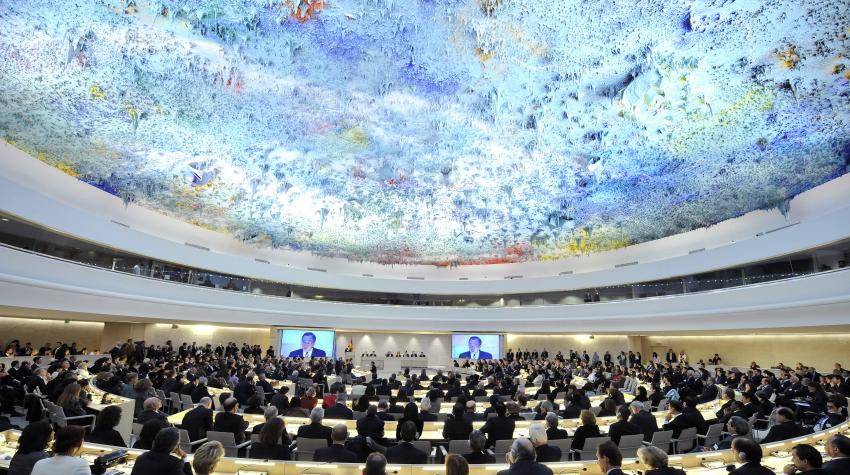
The clearest measure of institutional inconsistency is the voting record of the bodies that claim to uphold international human rights. Since its creation in 2006, the UN Human Rights Council has adopted more resolutions condemning Israel than all other nations in the world combined. By contrast, conflicts in which governments, international tribunals, or UN investigators have documented evidence of genocidal intent have received only a fraction of that scrutiny.
In 2024, the UNGA adopted 17 resolutions targeting Israel and only a handful addressing the entire rest of the world. A single democratic state defended itself against the terrorist organization that committed the deadliest massacre of Jews since the Holocaust. Yet it drew more formal condemnation than every dictatorship, ongoing atrocity, and civil war on the planet combined. That outcome is difficult to reconcile with a consistent application of universal legal standards.
The composition of these bodies compounds the problem. States with documented records of severe repression have often held seats on the Human Rights Council and have sat in judgment of Israel while remaining largely shielded from comparable scrutiny.
Where the Evidence Is Stronger, the Response Is Weaker
In China, the United States formally determined that the treatment of the Uyghurs constituted genocide and crimes against humanity. Yet China continued serving on the Human Rights Council while that determination stood.
In Sudan, Darfur has produced two U.S. genocide determinations a generation apart. The United States issued a formal genocide determination against the Rapid Support Forces. UN-linked investigators documented intentional, ethnically targeted killings and concluded that the evidence was consistent with genocidal acts and intent. This catastrophic displacement of people generated a small fraction of the institutional energy that is routinely directed at Israel.
The Pattern Is Global
In Myanmar, a documented campaign of ethnic cleansing drove more than 700,000 Rohingya across the border into Bangladesh, accompanied by mass killing and sexual violence. The UN’s own fact-finding mission found reasonable grounds to conclude that Myanmar’s military had committed genocide. It called for authorities to investigate and prosecute its generals. Despite the gravity of those findings, the international institutions created to respond to such atrocities failed to devote the level of attention to Myanmar that they later directed toward Israel.
These are not marginal examples. Authoritative bodies have formally alleged genocide or issued genocide determinations in these conflicts. Yet none generated the prolonged institutional focus directed at Israel despite the absence of evidence demonstrating genocidal intent in Israel’s case. That disparity does not resolve the legal question. It does demonstrate that the accusation is not advanced with equal consistency across cases.
When One State Is Held to Legal Standards Applied to No Other
The inconsistency is not limited to which conflicts draw institutional attention. It also extends to the legal reasoning advanced in Israel’s case.
Much of the public argument that Israel is committing genocide centers on the claim that intent can be inferred from the scale of civilian casualties and the extent of destruction. Taken to its logical conclusion, that theory would make destruction itself evidence of genocidal intent. Apply that theory consistently and it would implicate nearly every major urban military campaign of the past three decades. The United States in Iraq and Afghanistan, Russia in Syria and Ukraine, the Saudi-led coalition in Yemen — each produced large-scale civilian casualties. In none of these cases did the international system characterize these circumstances as genocide.
Public advocates have nevertheless advanced this theory with unusual prominence in Israel’s case. Yet the ICJ has repeatedly held that genocidal intent may be inferred from circumstantial evidence only when it is the only reasonable inference available. It cannot reasonably be argued that the destruction resulted solely from anything other than legitimate military objectives recognized under international law.
When a Double Standard Reflects an Ancient Pattern
Applying standards to Israel that are not applied to any other democratic state is one of the defining features of contemporary antisemitism. Applied to the Jewish state, with this consistency and in this form, it reflects the pattern explicitly identified in the International Holocaust Remembrance Alliance’s Working Definition of Antisemitism: applying double standards by requiring of Israel behavior not expected or demanded of any other democratic nation.
This mechanism targeting the Jewish state mirrors one long used against Jews. It casts Israel as uniquely evil and reverses the burden of proof, requiring Israel to prove its innocence rather than requiring its accusers to establish guilt. It also treats exculpatory evidence as insufficient to displace the accusation. Only the vocabulary has changed. The underlying pattern has not.
Any assessment of the genocide allegation must confront one unavoidable question. Why is this accusation advanced so readily against Israel, yet with nowhere near the same institutional focus in conflicts where governments, international tribunals, and UN investigators have documented evidence of genocidal intent? The answer matters. A legal standard applied selectively is no longer functioning as law. It has become a political instrument — and Israel is its principal target.
Continue Reading
- Why the Genocide Convention Sets an Intentionally High Bar — How the intent requirement became central to the Genocide Convention, and why it remains the legal standard today.
- Genocidal Intent: The One Question Every Genocide Case Must Answer — Why specific intent is the defining legal requirement for genocide, how courts determine it, and what the evidence in this war reveals.
- The ICJ Genocide Case Against Israel: Separating Legal Fact from Fiction — What the Court has and has not decided, why many have misunderstood “plausible genocide,” and what former ICJ President Joan Donoghue clarified.
- UN Reports Are Not Court Judgments. Neither Are NGO Findings. — Why only courts can make binding genocide determinations under international law.
- October 7 and Gaza: The Hamas Massacre the Genocide Allegation Intentionally Erases — Why every legal analysis must begin where the war began: October 7, 2023.
- Genocide Is Not a Catch-All Term — Three distinct international crimes, three distinct legal standards, and why conflating them distorts international law.
- Why the Consequences of War Do Not Establish Genocide — Why casualties, proportionality, humanitarian conditions, and urban warfare do not establish genocidal intent.
- A Military Pursuing Genocide Does Not Warn Its Targets to Flee — Why the IDF’s unprecedented civilian-protection measures are direct evidence against genocidal intent.
- The Blood Libel and the Genocide Allegation: A Pattern Centuries in the Making — How the modern genocide allegation repackages one of history’s oldest antisemitic narratives in the language of international law.