|
Getting your Trinity Audio player ready...
|
The following is an analysis authored by Combat Antisemitism Movement (CAM) CEO Sacha Roytman.
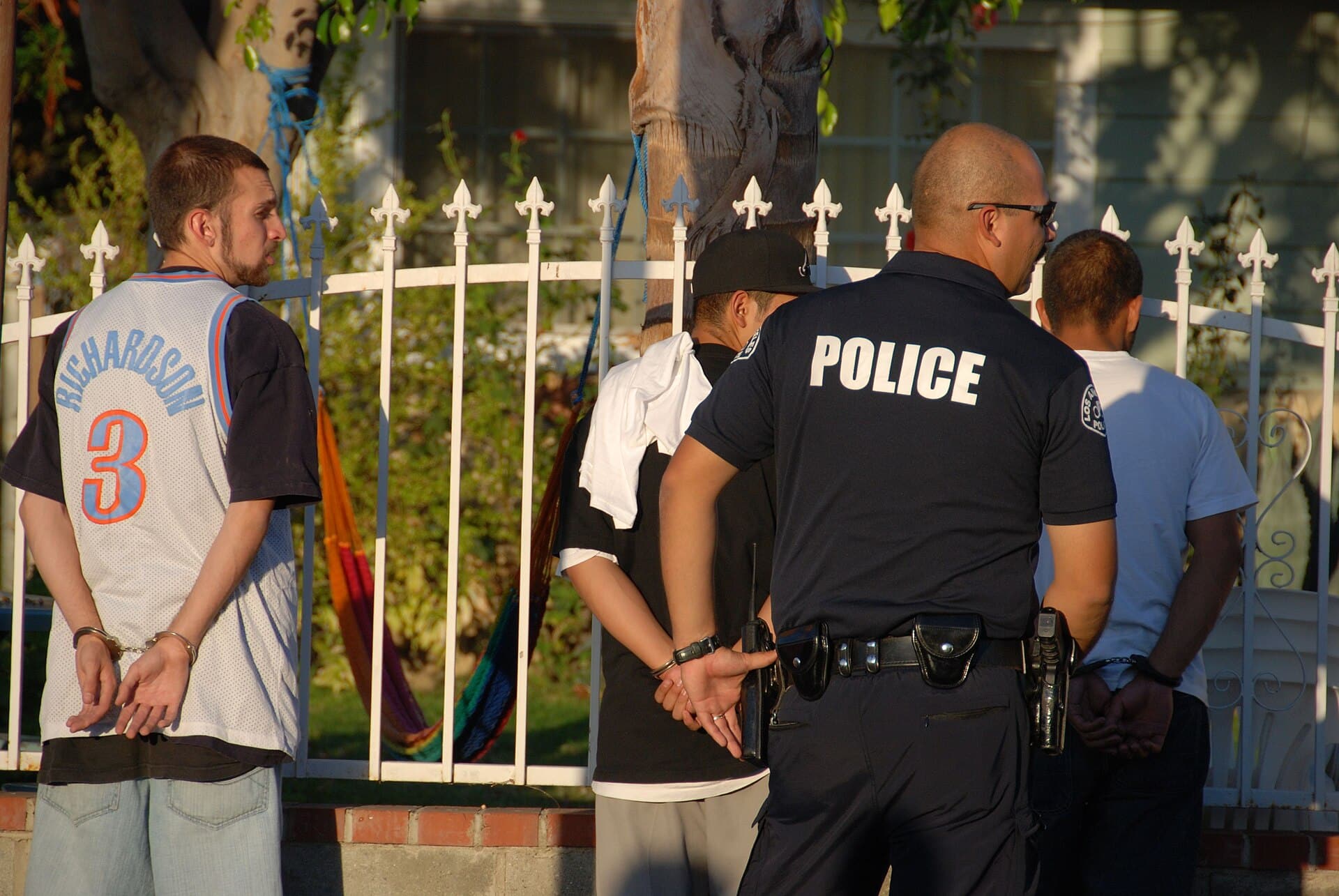
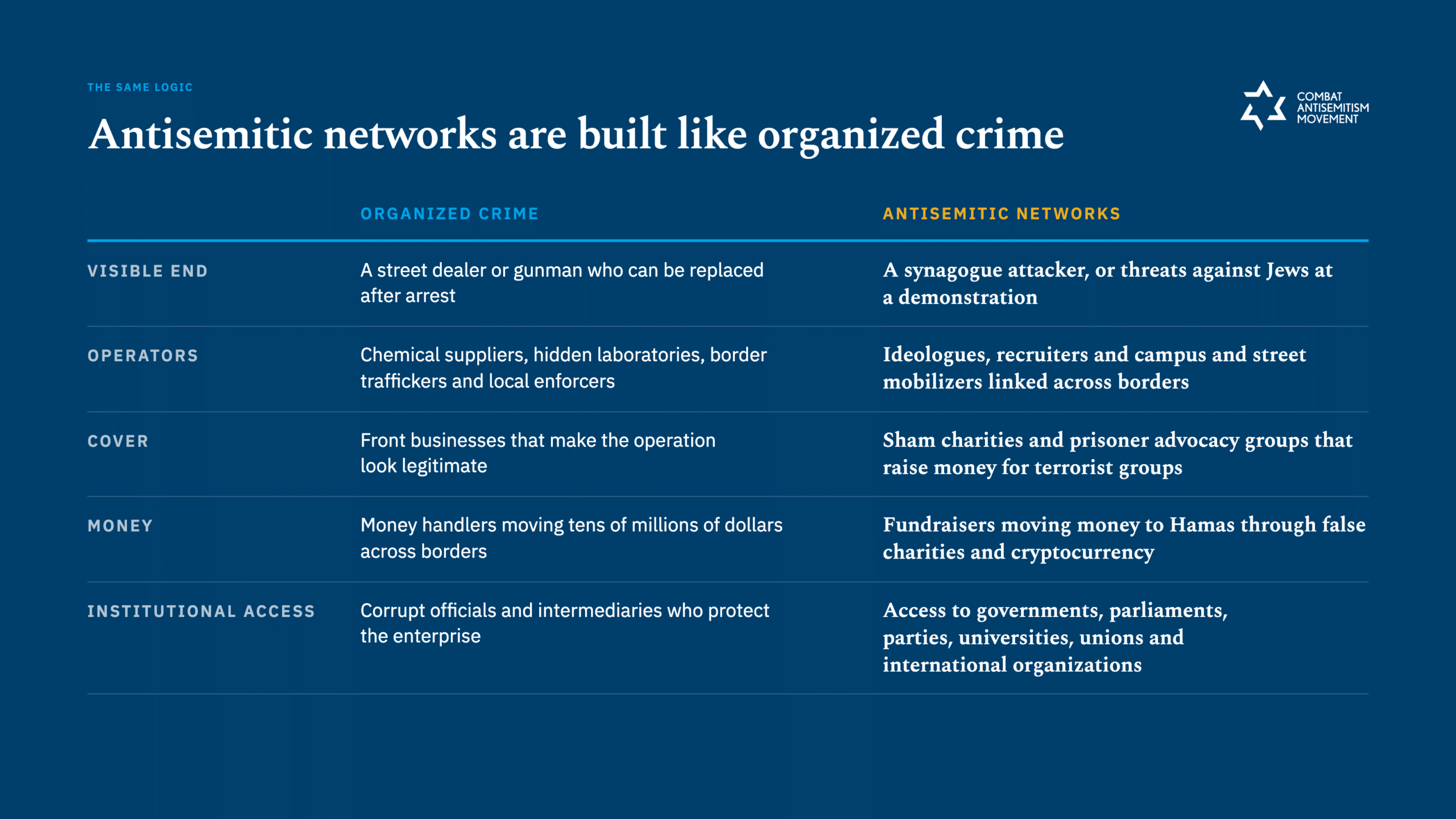
Nobody seriously believes that organized crime consists only of the man who pulls the trigger or sells the drugs. Behind him stand the planners, financiers, recruiters, smugglers, corrupt facilitators, and front businesses that allow a criminal organization to operate. Arrest the gunman and the organization can replace him. Follow the money, identify the leadership, expose the fronts and connect the crimes across borders, and the entire enterprise becomes vulnerable.
Think of the Sinaloa Cartel. A drug dealer on an American street is the most visible end of an operation that can involve overseas chemical suppliers, hidden laboratories, border traffickers, local enforcers, corrupt intermediaries, and money handlers. In March 2025, the U.S. Treasury sanctioned six individuals and seven entities involved in a money laundering network supporting Sinaloa. The investigation drew on agencies in both the United States and Mexico and identified operators who had moved tens of millions of dollars. The aim was not simply to arrest one dealer. It was to expose the people and structures that allowed the enterprise to keep operating.
The Italian Mafia, Colombian cartels, and Mexican criminal organizations do not share one rigid model. Some are tightly controlled hierarchies; others are loose networks of specialists. Europol found that 86% of the most threatening criminal networks it studied abused legitimate business structures. No investigator assumes that every crime in a city was ordered by one boss. But investigators know that apparently separate crimes may lead back to common financiers, organizers, or facilitators. That is why they map the enterprise rather than stop at its most visible member.
Why, then, do we so often treat antisemitism as a collection of isolated incidents instead of investigating the organized networks behind it?
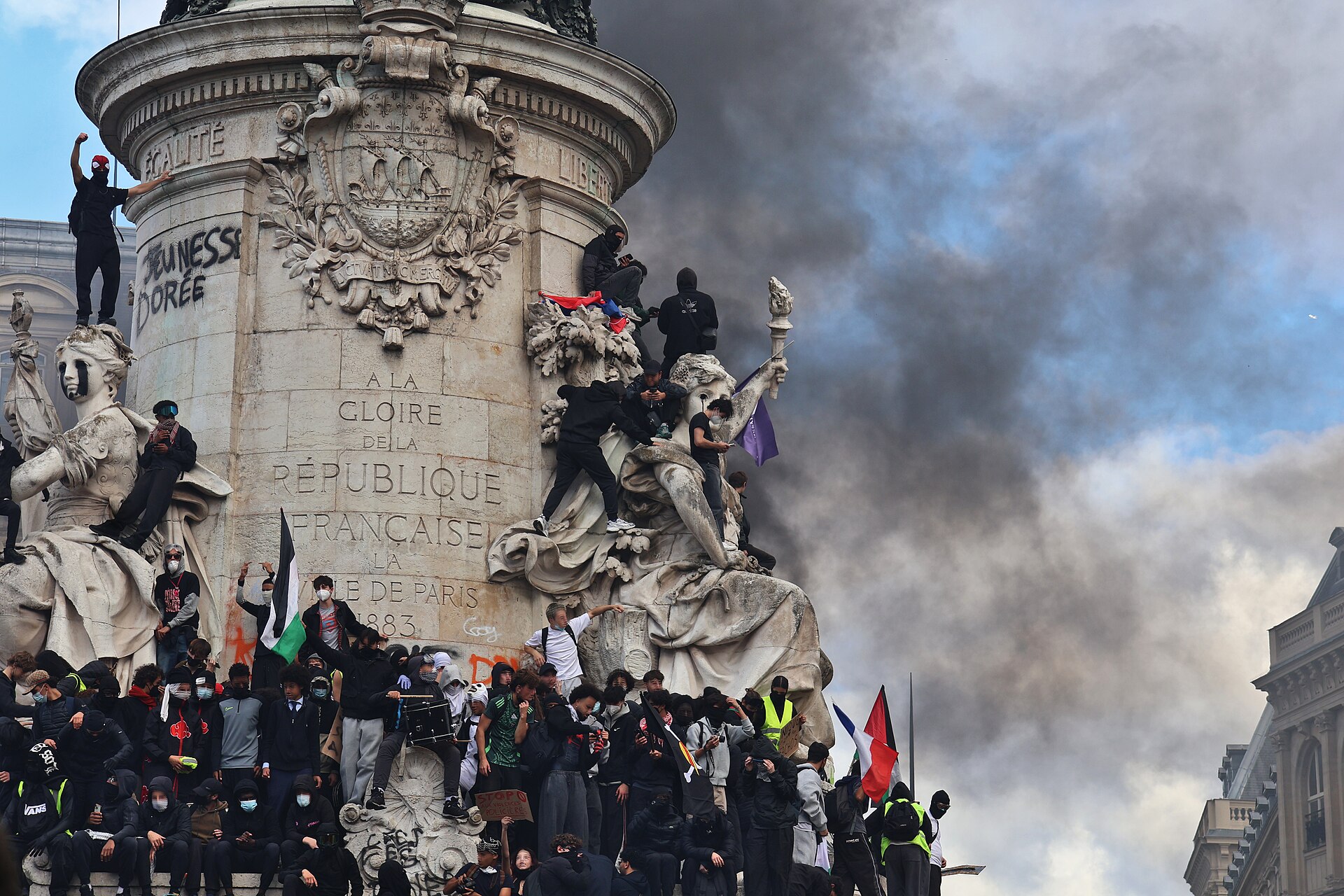
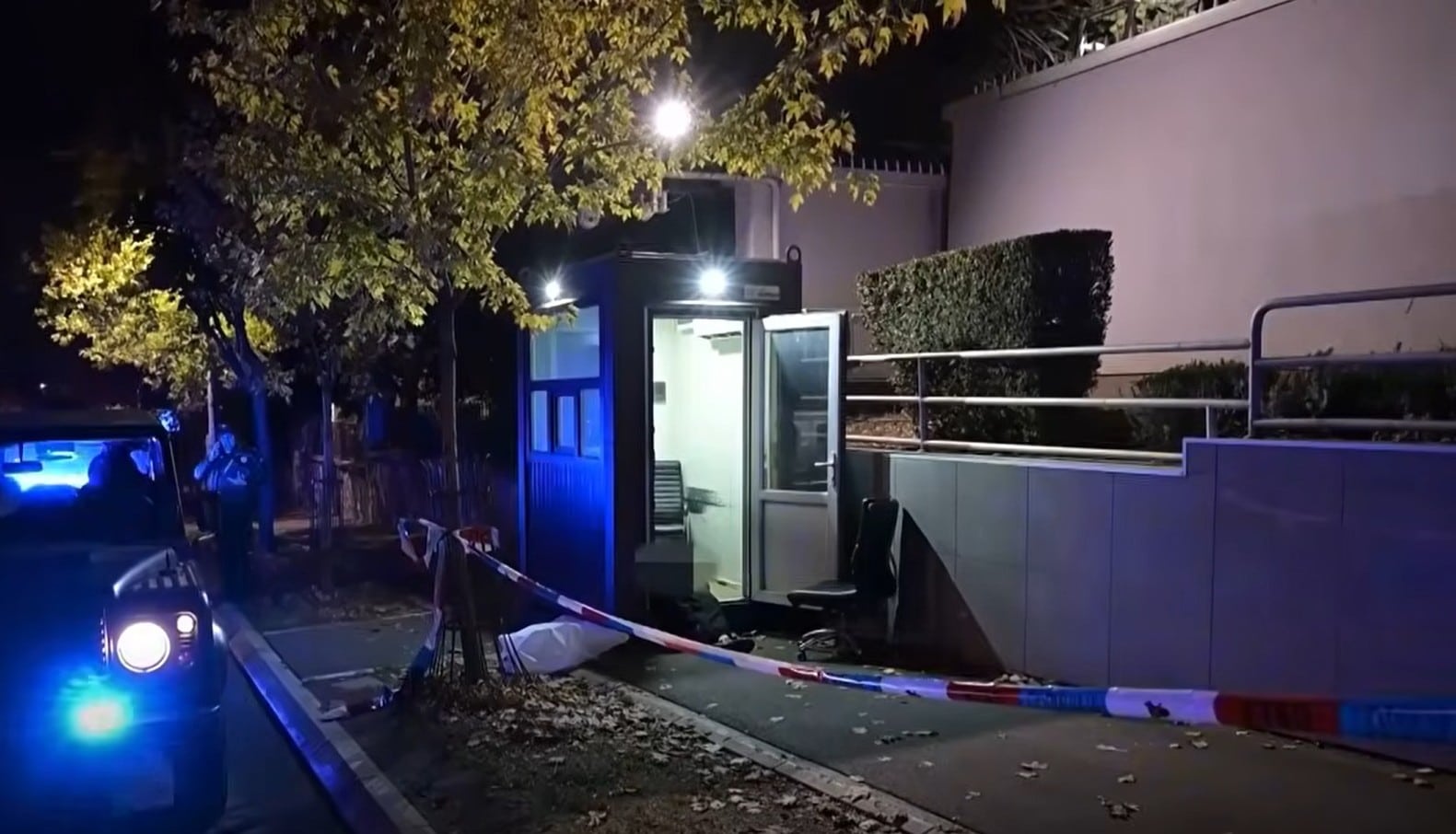
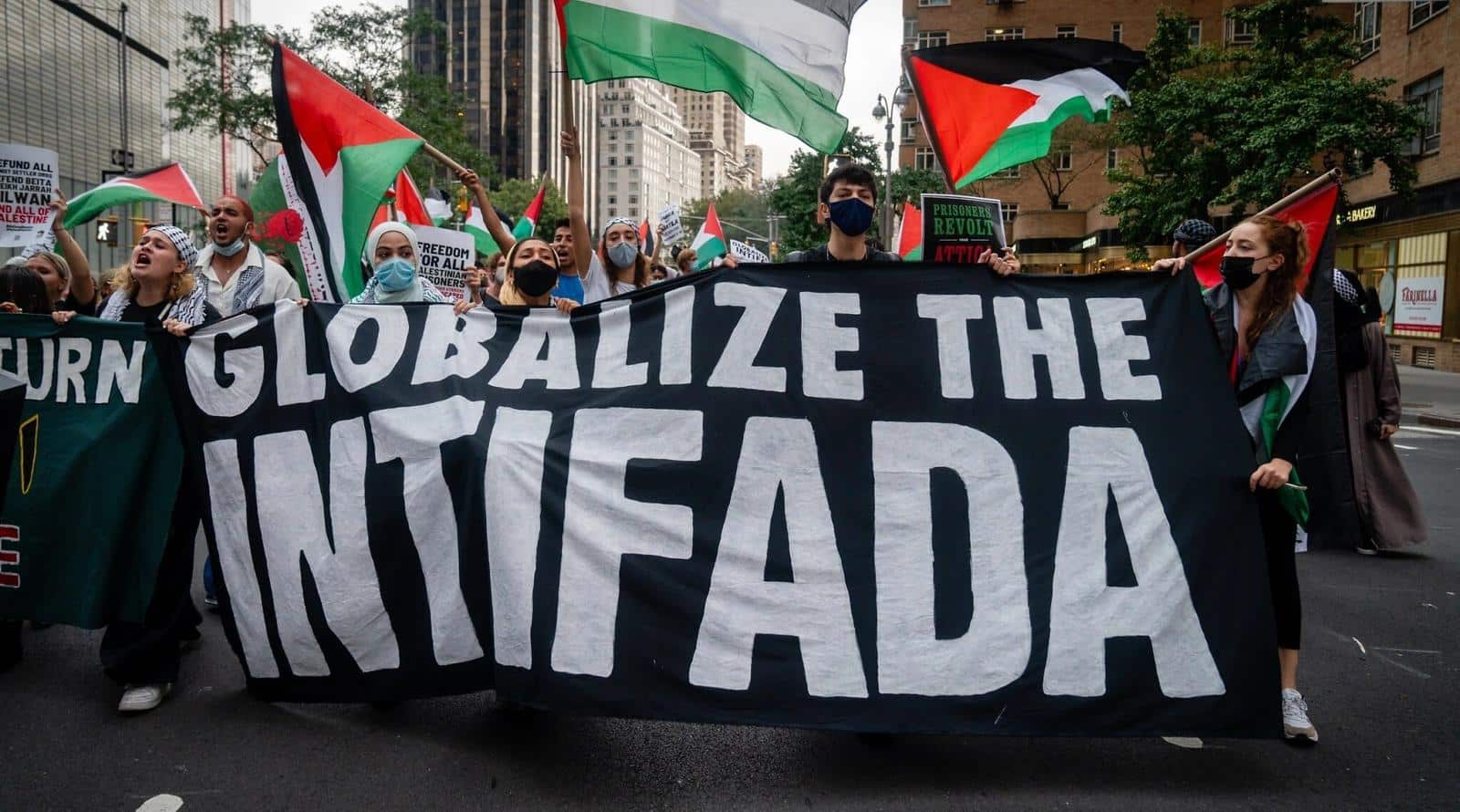
Look at what the public sees. A synagogue is attacked. A demonstration in a Western city turns into threats against Jews. Jewish students are pushed out of parts of a university campus. A supposed humanitarian charity raises money in the name of Gaza. A pro-Palestinian social media campaign repeats old conspiracies about Jews to a global audience. Anonymous accounts spread cyber harassment and intimidation. These events are handled in different places by different people: police, universities, charity regulators, intelligence agencies, and technology companies. The danger is that each sees only one piece of the picture.
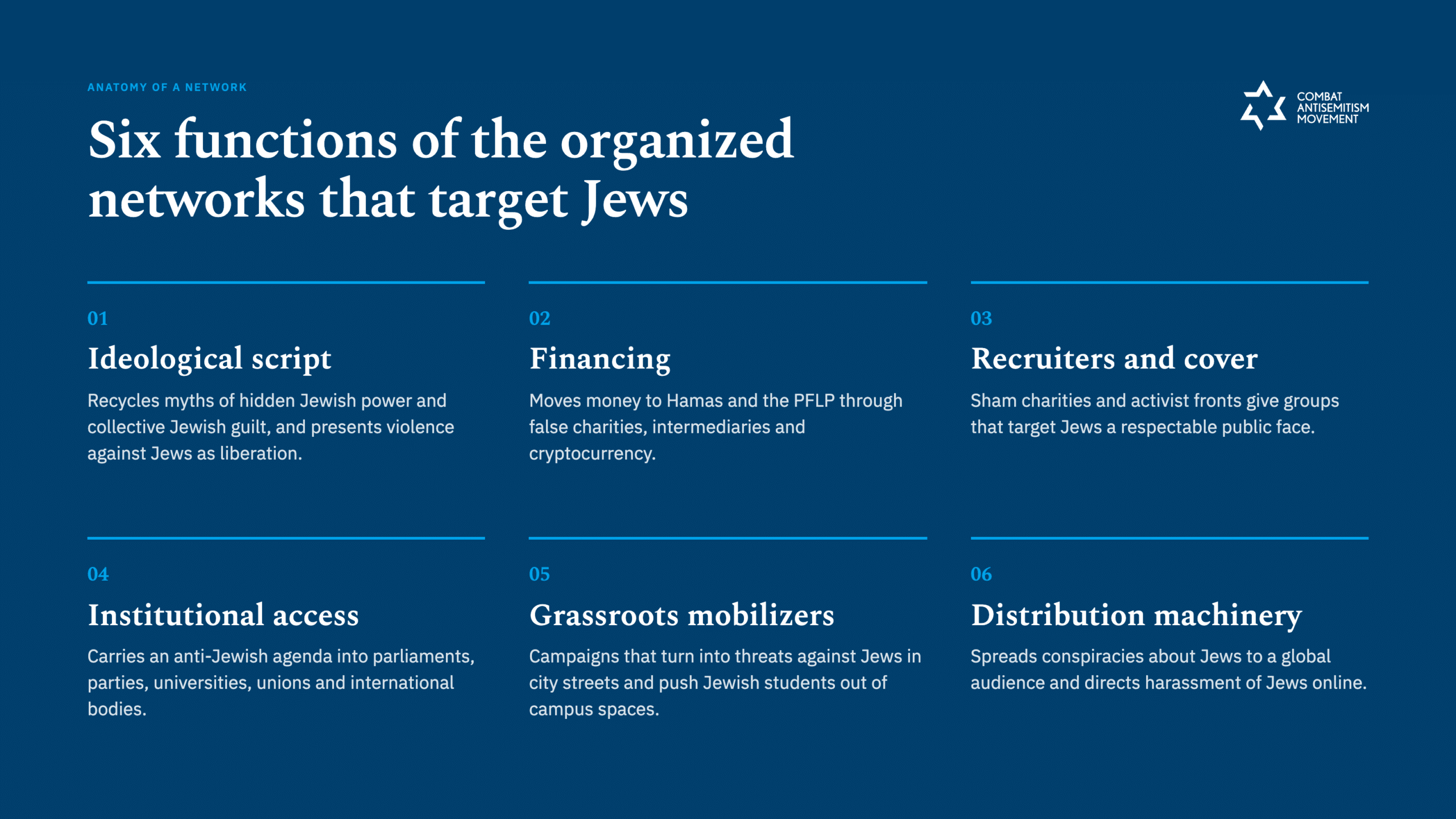
To reconstruct a transnational antisemitic operation, we need to examine six functions:
- Ideological script
- Financing
- Recruiters and organizational cover
- Institutional access
- Grassroots mobilizers
- Distribution machinery
It doesn’t need to resemble a pyramid with one boss. Like a cartel, it can consist of interconnected groups whose relationships cross borders and change over time. The task is to identify who links these functions and which links enable criminal conduct.
The first function is ideological direction. Antisemitism long predates the Soviet Union, but Moscow deliberately turned anti-Jewish ideas into instruments of state policy and international propaganda. The Soviet Union helped advance the 1975 United Nations resolution that equated Zionism with racism, a determination the General Assembly revoked in 1991. In 1983, Soviet Communist Party authorities approved a KGB proposal for an Anti-Zionist Committee, placing Jewish public figures at its head to help deflect accusations of antisemitism. The U.S. State Department documented this history and the Kremlin’s more recent exploitation of antisemitic myths in a 2024 report.
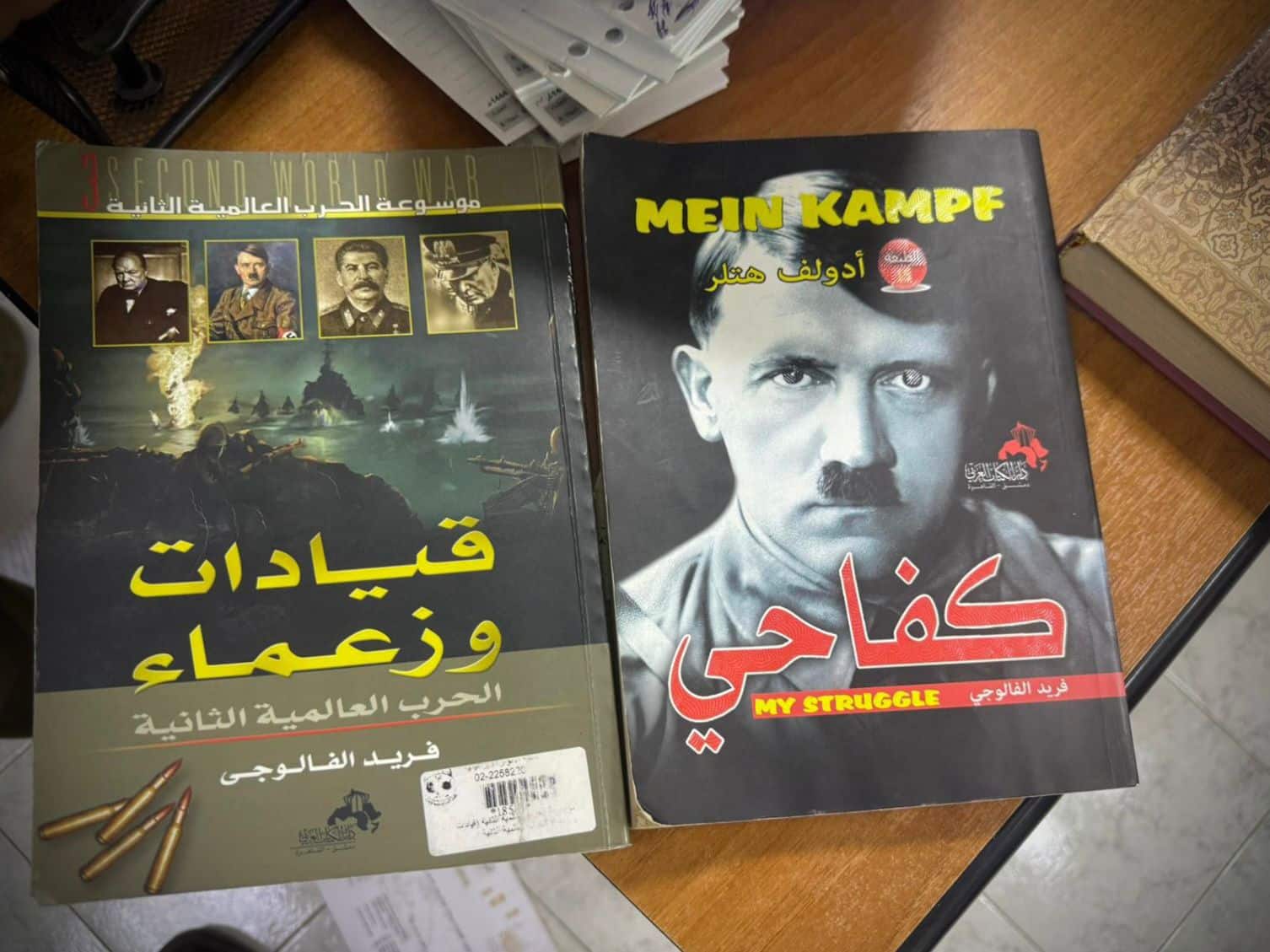
Different ideological movements now recycle overlapping themes. Neo-Nazis, Islamist extremists, and revolutionary movements can all invoke myths of hidden Jewish power, collective Jewish guilt, and violence presented as liberation. For organized networks, ideology does practical work. It identifies the enemy, gives recruits a cause, and creates messages that travel between countries and movements. Investigators should ask who manufactures those messages, which organizations translate them into campaigns, and who is deliberately distributing them today.
The second function is financing. In 2023, the U.S. Treasury sanctioned a Hamas operative based in Qatar whom it said had transferred tens of millions of dollars to Hamas, including its military wing. Money keeps an organization alive. It pays for operations, communications, movement, and recruitment, while financial intermediaries make it harder to identify the beneficiaries. As with any cartel, the trail must lead from individual donors and bank accounts through the handlers to the people who control the operation.
The evidence of international terrorist fundraising networks is substantial. In June 2025, the U.S. Treasury sanctioned people and purported charities in Türkiye, Algeria, the Netherlands, and Italy for supporting Hamas and the Popular Front for the Liberation of Palestine (PFLP). In October 2026, it exposed a network involving fundraisers in France that it said had transferred more than $2 million to Hamas through false charitable fronts and cryptocurrency. The money, the accounts, and the intermediaries can be traced across borders. They are the financial infrastructure of violence.
Some illicit financial channels connect actors who otherwise appear to operate in different worlds. Last month, the U.S. Treasury designated the Russia-linked A7 network as a significant transnational criminal organization and said its shadow banking structures had supported Iran’s Islamic Revolutionary Guard Corps (IRGC) and Tehran regime proxies, including Hamas. A network built to hide sanctioned payments can serve several actors at once. That is exactly why tracing money across national borders can reveal relationships that public speeches, demonstrations and organizational names conceal.
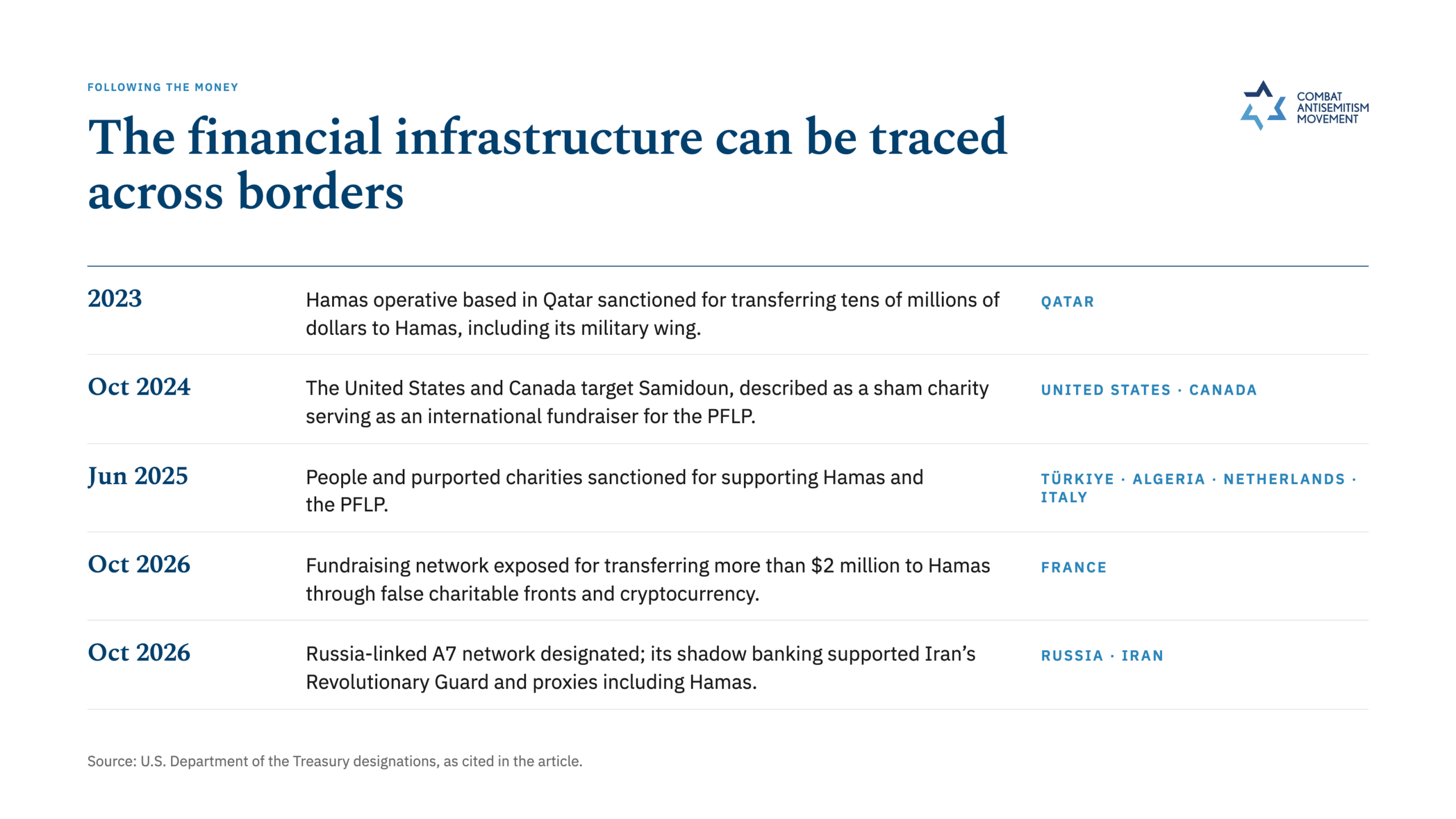
The third function is recruitment and organizational cover. Cartels use legitimate-looking businesses; extremist organizations can exploit charitable or activist identities. In October 2024, the United States and Canada targeted Samidoun, describing it as a sham charity that served as an international fundraiser for the PFLP. The U.S. Treasury later identified links among Samidoun, the PFLP, and another prisoner support organization. The appearance of a humanitarian or prisoner advocacy mission can open doors that a designated terrorist organization could not enter openly.
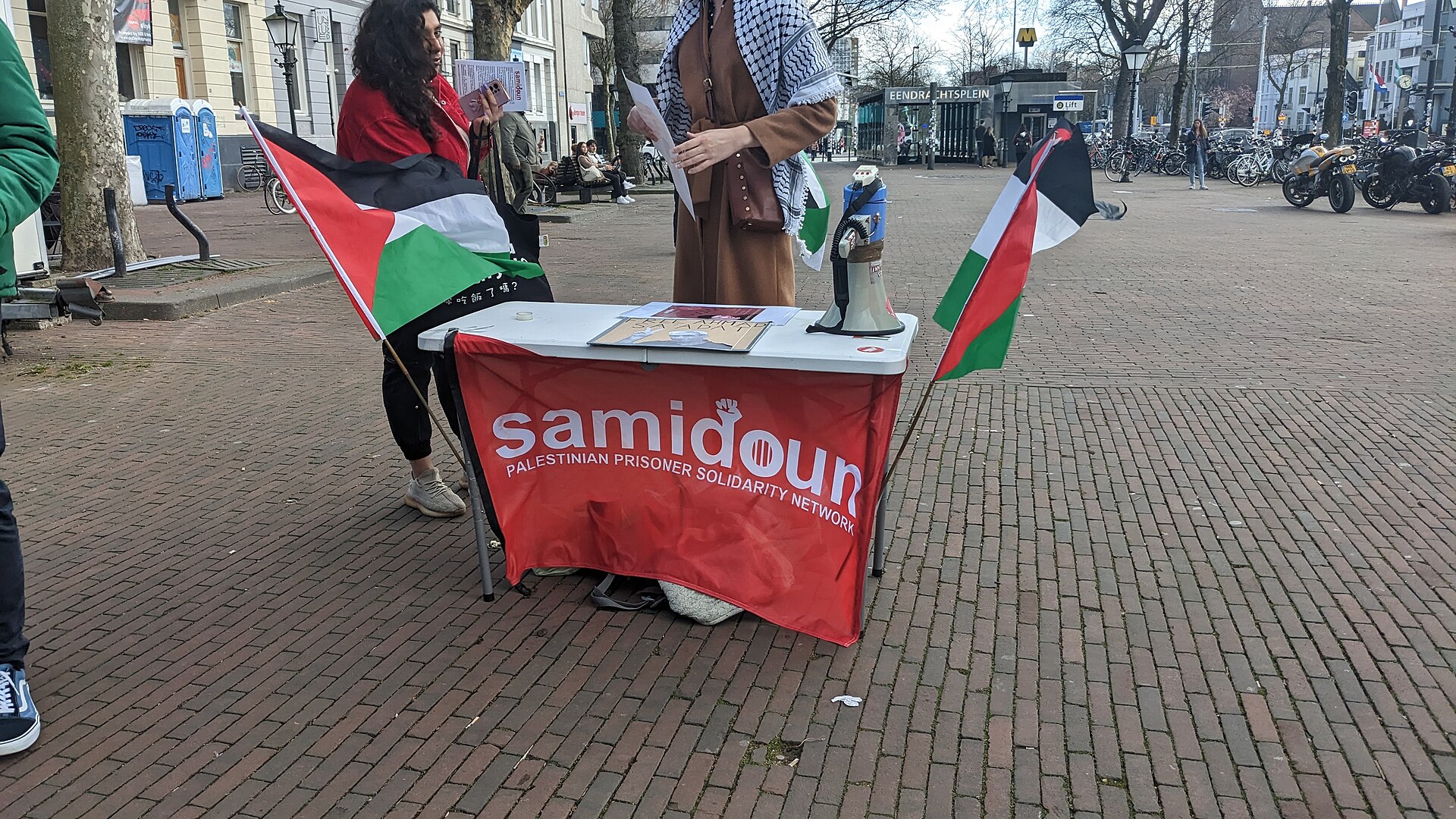
Once a front has earned public credibility, it can attract donors, find local allies, and enter spaces where an openly designated terrorist organization would face scrutiny. The investigative questions are concrete. Who selected the leadership? Who directs the fundraising? Where does the money end up? Which organizers connect the public campaign to a clandestine network? A cartel investigator follows the front company until the people behind it are exposed. Terrorist fronts deserve the same treatment.
The fourth function is institutional access. Organized networks understand that influence does not stop in the streets. Real power comes from gaining access to governments, parliaments, political parties, universities, labor unions, and international organizations. Qatar offers a striking example of how a foreign state cultivates influence through extensive lobbying in Washington, relationships with influential political figures and billions of dollars in university funding.
Political movements provide another route. In the United States, the Democratic Socialists of America (DSA) has made support for the boycott, divestment and sanctions (BDS) movement against Israel a requirement for nationally-endorsed candidates, translating its ideological agenda into electoral influence. In Britain, the Palestine Solidarity Campaign coordinates parliamentary lobbying through its network of activists and trade unions.

More alarming are instances where organizations connected to designated terrorist groups gain institutional access. In 2019, Khaled Barakat and representatives of Samidoun were welcomed into the European Parliament by a Spanish member. Five years later, the U.S. Treasury sanctioned Barakat and Samidoun for their roles in supporting the PFLP. This is why institutional access matters: it allows networks to move from public agitation into the institutions that make laws, distribute funding, shape public policy, and confer political legitimacy.
The fifth function is grassroots mobilization. The BDS movement provides an international campaign framework, while organizations such as Students for Justice in Palestine (SJP), American Muslims for Palestine (AMP), and the Palestinian Youth Movement (PYM) mobilize supporters across university campuses, communities, and city streets. Each plays a distinct organizing role. National SJP has announced university divestment campaigns. AMP says it supports SJP campus activism and promotes BDS initiatives. PYM describes itself as an international grassroots movement organizing Palestinian and Arab youth. The result is an infrastructure that can move messages, people, and political pressure across borders.
The question for investigators is what happens when such campaigns intersect with antisemitic intimidation, threats, exclusion, or violence. Who organizes the demonstrations? Who provides the funding, messaging and logistical support? Who connects local chapters to wider campaigns? When similar unlawful tactics appear in different cities, are they independent incidents or evidence of coordination? Those connections must be proved through specific conduct, communications, and financial records. A serious investigation does not stop with the person at the scene.
The sixth function is distribution, now driven by social media and cyber intimidation. In 75 days during 2026, CAM’s Antisemitism Research Center (ARC) documented 1.18 billion views of 2,806 widely viewed antisemitic posts from 683 accounts. Just 100 accounts generated 64.5 percent of those views. The concentration matters: a relatively small set of accounts can spread conspiracy narratives to a vast audience, while algorithms and automated activity can accelerate their reach.
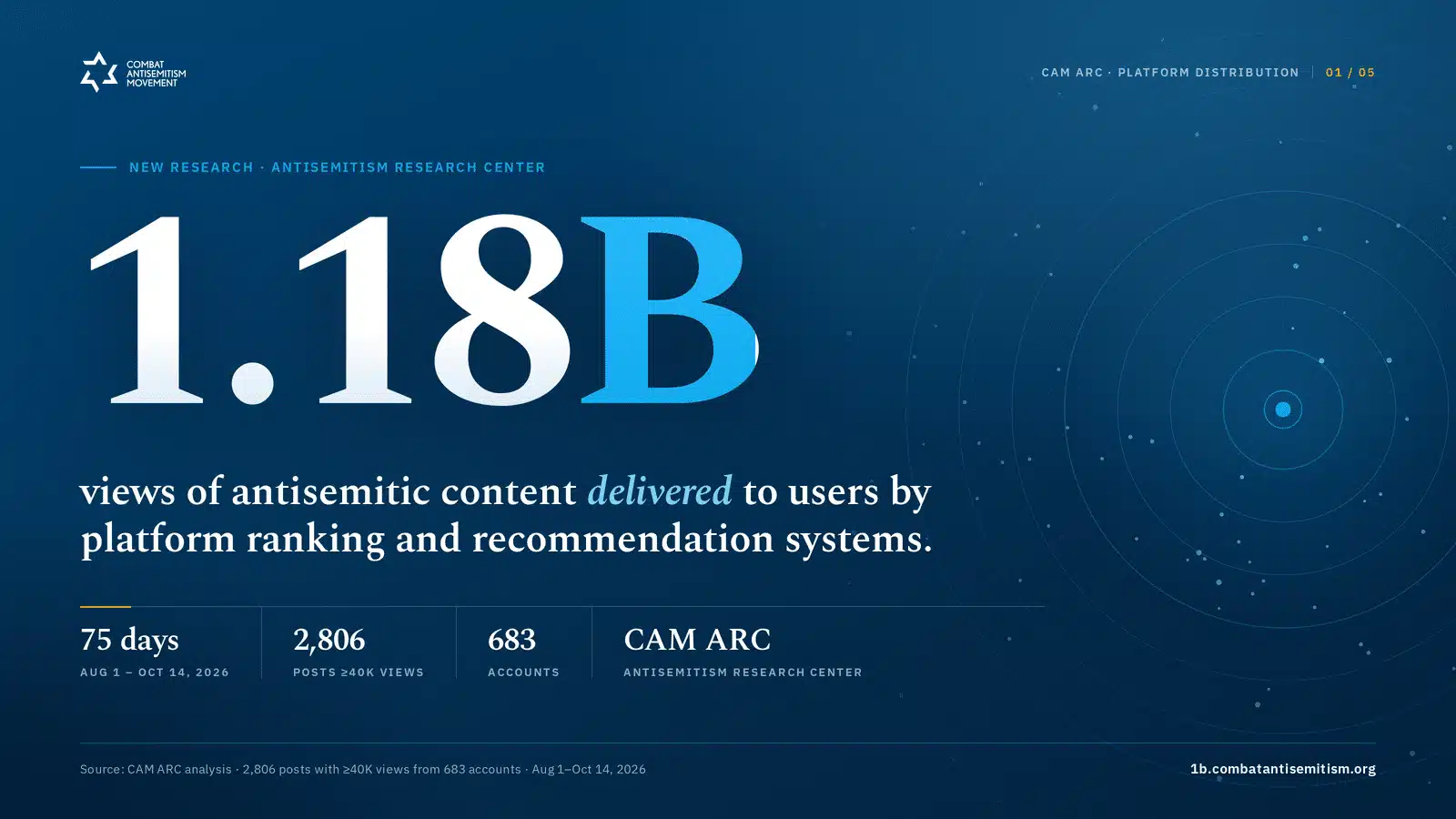
Digital networks can carry propaganda, recruit supporters, direct harassment, and identify targets across continents at extraordinary speed. Bots, fake identities and anonymous accounts can obscure the people operating behind the screen. Investigators should examine the location and ownership of influential accounts, coordinated posting patterns, financial relationships and the movement from online threats to physical attacks. The digital network is now part of the operational infrastructure, and it must be mapped with the same determination as a cartel’s bank accounts and transport routes.
Distribution also includes newspapers, television networks, and other major media outlets, which can lend legitimacy to extremist figures by presenting them as human rights advocates, peaceful activists, or community representatives without investigating their affiliations, financing, or activities. A spokesperson associated with intimidation becomes a respected commentator. An organization with extremist connections becomes a credible source of information. Repeated interviews, favorable coverage, and invitations to public debates gradually transform radical actors into accepted political voices. This legitimacy opens doors to universities, donors, political leaders, and international institutions. What begins as media recognition becomes institutional influence. The objective is simple: make the organization appear respectable while concealing the network behind it.
The response to antisemitism should follow the logic already used against organized crime. U.S. racketeering law looks for patterns of unlawful conduct within an enterprise. INTERPOL connects police across borders; Europol and Eurojust support joint investigations; and financial intelligence units help trace illicit funding, while the Financial Action Task Force sets international standards for combating money laundering and terrorist financing. The mechanisms differ, but the working questions are familiar. Who directed the activity? What money moved? Which organizations provided cover? Which individuals acted together? What admissible evidence connects them?
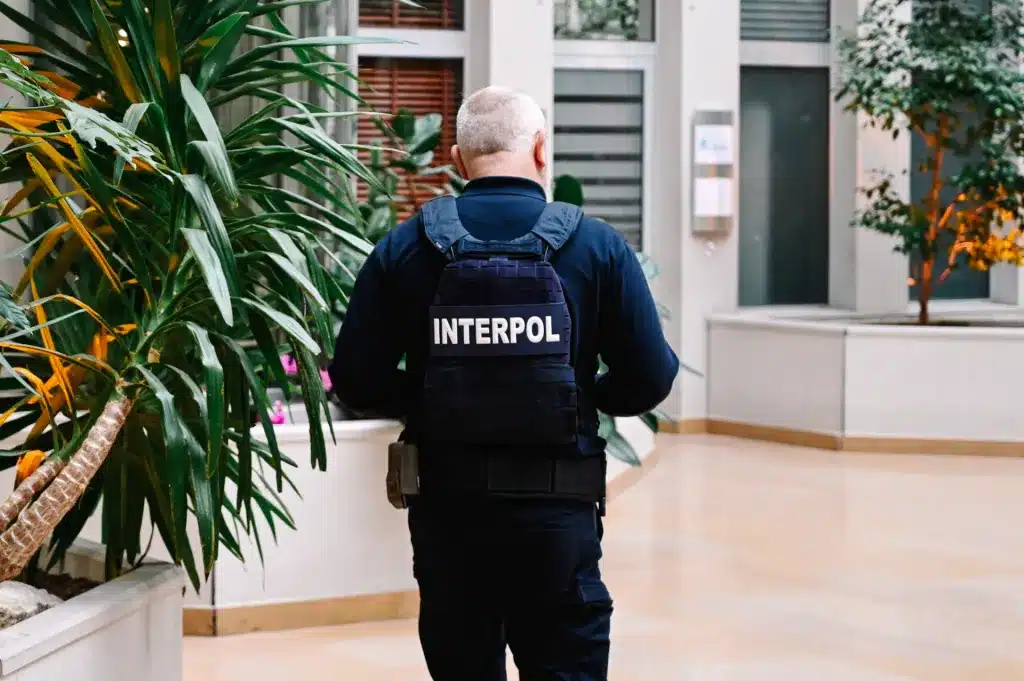
We need a permanent international effort dedicated to those questions in cases of antisemitic violence, terrorist financing, threats and unlawful discrimination. It should bring police, prosecutors, financial intelligence units, security services, civil rights authorities, researchers, and technology platforms into a shared investigative framework. When a synagogue is attacked, authorities should test whether the perpetrator was financed, recruited, or directed from elsewhere. When a charity is sanctioned, partners should examine its linked entities and payment networks. When cyber threats or coordinated harassment emerge, platforms should preserve evidence and help investigators lawfully identify the operators.
That effort should build on existing international bodies, with common standards for intelligence sharing, financial investigation, and joint cases. Platforms should disclose more about account origins, recommendation systems and coordinated inauthentic activity. Governments should connect sanctions, financial seizures, and prosecutions so a network disrupted in one country cannot simply reopen through a different front in another. Success must be measured by funds frozen, recruiters stopped, attacks prevented, and organizations broken up, rather than by how many incidents are recorded after the damage is done.
We would never tell a family devastated by cartel violence that justice ended with the arrest of the person who delivered the drugs or fired the gun. Jews deserve the same committment. A synagogue attacker is the visible point of impact. The investigation must determine who recruited or radicalized him, whether anyone financed or directed him, and which networks glorified or facilitated the attack. Where the evidence exposes an organization, dismantle it.
We will never defeat organized antisemitic crime by treating every offense as a disconnected incident. A global crime demands a global response.