|
Getting your Trinity Audio player ready...
|
This article is part of the Combat Antisemitism Movement’s series on “Globalize the Intifada.” For the full analysis of the slogan’s origins, ideology, and real-world consequences, see the pillar page.
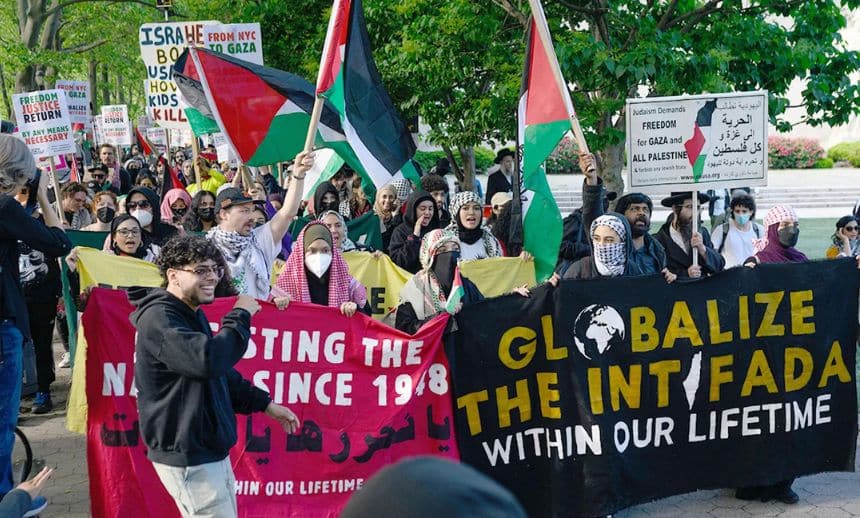
“Globalize the Intifada” emerged in the United States in 2021 through a coordinated activist campaign centered in New York-based networks. Within Our Lifetime (WOL), its primary architect, launched the campaign as a formal effort to export the model of the intifadas into American streets and institutions. Its founder, Nerdeen Kiswani, has stated that “abolishing Israel is the key to peace” and dismissed Israel as “a Zionist settler entity masquerading as a country.” At the campaign’s inaugural rally, she told the crowd: “I hope that a ‘pop-pop’ is the last noise that some Zionists hear in their lifetime.”
Groups including Samidoun and Decolonize This Place (DTP) played a central role in spreading the slogan across protests, social media, and organizing materials. A wider ecosystem of organizations, including Students for Justice in Palestine (SJP), Jewish Voice for Peace (JVP), CODEPINK, the Palestinian Youth Movement (PYM), The People’s Forum, Al-Awda, and the ANSWER Coalition, helped amplify the message and mobilize supporters, embedding the slogan across campus, cultural, and activist spaces.
Jewish Voice for Peace played a distinctive role within this landscape. By presenting itself as a Jewish organization, it helped normalize and legitimize rhetoric widely recognized as antisemitic, granting the campaign a veneer of moral authority it could not have achieved on its own.
Early Coordination and Public Launch
One of the earliest documented uses of the slogan appeared on June 11, 2021, during a demonstration outside the Museum of Modern Art (MoMA) in New York City. Promotional materials labeled the site “Occupied Manhattan,” with “Strike MoMA” slashed in red. This imagery sent a deliberate signal. The “decolonization” framework previously applied to Israel was now being transferred onto the United States itself. The protest was co-hosted by WOL and DTP, marking an early convergence of activist networks that would later popularize the slogan.
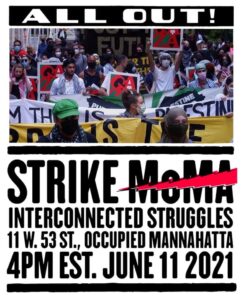
During the demonstration, protesters chanted, “From New York to Gaza! Globalize the Intifada!” This marked one of the earliest instances of the phrase entering U.S. activist spaces. Organizers framed MoMA not as a neutral cultural institution, but as a legitimate site of confrontation within a global struggle. Protest literature accused the museum’s leadership of “settler colonialism,” “apartheid,” and “imperialism.” It argued that cultural institutions function as ideological battlegrounds rather than civic spaces. In this framing, museums, universities, and art institutions were folded into the same worldview applied to Israel, redefining civilian spaces as legitimate sites of confrontation.
From a Single Protest to a Coordinated Campaign
Later that summer, WOL escalated its efforts from episodic protest to formal campaign. On July 30, 2021, the group released an online manifesto announcing “Globalize the Intifada.” The following day, it held a rally in Brooklyn to launch the campaign publicly. Samidoun, a network tied to the Popular Front for the Liberation of Palestine (PFLP), promoted the rally in advance. This signaled early coordination with extremist-aligned actors abroad.
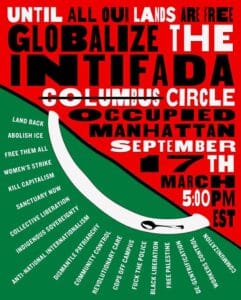
That fall, organizers expanded the campaign’s scope and ambition. On September 17, 2021, WOL organized a march at Columbus Circle. Promotional materials again labeled the site “Occupied Manhattan,” this time striking through “Columbus” and leaving only “Circle.” In doing so, organizers were explicitly recasting U.S. civic space as legitimate terrain for confrontation. The repetition underscored that the framing was deliberate and strategic. The “decolonization” narrative was no longer confined to Israel. Organizers now applied it to American cities, institutions, and public spaces.
Grand Central Terminal, March 2022
On March 30, 2022, several hundred protesters gathered outside Grand Central Terminal in Manhattan before marching through Midtown. Demonstrators chanted “From New York to Gaza, globalize the intifada” and “There is only one solution — intifada revolution.” Signs read “Intifada until victory.”
The demonstration pushed intifada rhetoric into one of the busiest civilian transit hubs in the United States. Language rooted in mass-casualty terror was no longer confined to activist spaces. It entered an everyday public setting used by commuters, tourists, and families — reframing rhetoric tied to violent uprisings as acceptable street protest at the center of American civic life.
Remember how we told you what “globalize the intifada” meant? Now NYC is starting to experience it. Hamas supporters in NYC have surrounded Grand Central Station and are attempting to breach the outer doors to reach police officers sheltering inside…because “Palestine.”… pic.twitter.com/HK4lhspjYy
— Emily Schrader – אמילי שריידר امیلی شریدر (@emilykschrader) November 11, 2023
The WOL Manifesto: A Blueprint to Target the United States
The manifesto established that “Globalize the Intifada” was not a slogan confined to Israel, but a transferable strategy intended for use against U.S. institutions and civic life. It cast the United States as “the belly of the beast,” portraying American institutions as enablers of “genocide” and “ethnic cleansing.” The document asserted that Palestinians and their supporters had the right to pursue “liberation by any means necessary” and urged activists to carry the ethos of the intifadas into their own neighborhoods.
It described the campaign as “an ongoing strike at the heart of empire.” Accompanying materials outlined a broader ideological program calling for “land back,” “kill capitalism,” “f*** the police,” “abolish ICE,” “cops off campus,” and “collective liberation.” New York City was framed as a “theater of operations,” positioning U.S. institutions as part of the same “colonial” structure the campaign claimed to oppose.
The manifesto also presented the campaign as explicitly transnational. It cited affiliated groups in Colombia, Mexico, Puerto Rico, the Dominican Republic, Bangladesh, the Philippines, and cities across the United States. “Mutual liberation” was framed as a shared global project. The core message was unambiguous: the intifada was a model of confrontation to be reproduced in American streets and against American institutions.
“Globalize the Intifada” was no longer an isolated chant. It became a portable strategy. By redefining U.S. cities, institutions, and cultural spaces as “occupied territory,” the campaign established a framework in which confrontation with Jews and Jewish-associated spaces was ideological, intentional, and justified.
Operationalizing Incitement: How ‘Globalize the Intifada’ Was Turned Into Action
After launching the campaign, WOL moved quickly to turn its rhetoric into action. The group released a rally toolkit designed to convert slogans into a reproducible protest infrastructure. It standardized chants, visuals, and protest conduct.
Activist networks across the country circulated the toolkit, pushing its most aggressive messaging into campuses, protest circles, and student environments far beyond New York. As a result, chants calling for Israel’s destruction and openly endorsing violence moved from fringe protests into mainstream activist spaces.
Core Messaging: Fixed Chants With a Clear Agenda
The toolkit centered on a set of approved chants designed to shape both the ideological direction and tone of each event. Collectively, they denied Israel’s right to exist, cast the United States as an imperial aggressor, and framed violent confrontation as legitimate and necessary.
The chants included:
- “From New York to Gaza, globalize the intifada.”
- “There is only one solution! Intifada revolution.”
- “1,2,3,4 occupation no more! 5,6,7,8 smash the settler Zionist state!”
- “Hey hey, ho ho! Zionism has got to go! Hey hey, ho ho! Israel has got to go!”
- “It is right to rebel — Israel go to hell.”
- “Israel bombs, USA pays. How many kids did you kill today?”
- “NYPD, KKK, IDF — they’re all the same.”
- “Not another nickel, not another dime. No more money for Israel’s crimes.”
- “Israel, you can’t hide. You’re committing genocide.”
The chants denied Israel’s existence, sanctified violence, and reduced “Zionists” to legitimate targets.
Security Guidance: Hiding Identities and Avoiding Law Enforcement
The toolkit also included explicit security instructions. Activists were directed to conceal their identities and avoid all contact with law enforcement. One instruction read, “Cover your face if you do not want to be identified.” Another warned participants: “Do not speak to the police” and “Do not record, post, or talk freely about anything that could get anyone in legal trouble.”
These directives reflected a clear awareness of legal risk. Anonymity and non-cooperation were treated not as optional precautions, but as integral to participation.
By standardizing language, visuals, behavior, and security practices, WOL made its ideology portable. The toolkit provided a template that could be replicated at demonstrations on campuses, in U.S. streets, and across aligned networks abroad.
How WOL Framed the October 7th Massacre
On October 7, 2023, Hamas murdered over 1,200 Israelis and abducted more than 250 others. Before the bodies had been counted, WOL declared: “We must defend the Palestinian right to resist zionist settler violence and support Palestinian resistance in all its forms. By any means necessary. With no exceptions and no fine print.”
The following day, thousands gathered in Times Square. Multiple news outlets confirmed that WOL played a central and highly visible role in organizing, promoting, and leading the protest.
Organizers described Hamas’s massacre as “an unprecedented liberation struggle.” They framed the attacks as an effort to “break out of their concentration camp,” presenting the slaughter of civilians as justified resistance. The joint statement asserted a “fundamental right to resist… by any means necessary.” It urged supporters to confront Zionism not only abroad, but inside the United States. One line captured the worldview clearly: “We mobilize in the belly of the beast because we understand that we have a unique role to play in combating material support for Zionism and weakening the handmaiden of U.S. global imperialism.”
Demonstrators chanted “Intifada, intifada” and “Intifada revolution,” turning a day of mass murder into a rallying point for escalation and confrontation. October 7 was not condemned as an atrocity. It was elevated as a model to celebrate, defend, and expand.
In the weeks that followed, WOL escalated further. The group published a map identifying dozens of Jewish and pro-Israel organizations across New York City. It labeled them as having “blood on their hands” and urged supporters to “KNOW YOUR ENEMY.” Many of the listed institutions had no connection to Israeli policy. WOL then released a second map naming Israeli and American companies, along with transit hubs, as “offices of an enemy” — sites for “popular mobilization,” shifting from rhetoric to targeting.
October 7, 2025: The Anniversary as a Rallying Cry
On the second anniversary of Hamas’s massacre, WOL held a rally in New York City.
Speakers declared:
- “We did not act enough.”
- “We must show up stronger than we did the first October 7th.”
- “Louder than the first October 7th.”
Continue Reading:
- The Intifadas: The Terror Campaigns Behind ‘Globalize the Intifada’
- The Terror Network Behind ‘Globalize the Intifada’
- ‘Globalize the Intifada’ on Campus: How the Slogan Became a Weapon Against Jewish Students
- Synagogues Under Siege: ‘Globalize the Intifada’ at Synagogue Doors
- Zohran Mamdani: When ‘Globalize the Intifada’ Reaches Elected Office
- The Bondi Beach Hanukkah Massacre: When ‘Globalize the Intifada’ Became Reality
- Cultural Incitement: How ‘Globalize the Intifada’ Entered Music, Fashion, and Art