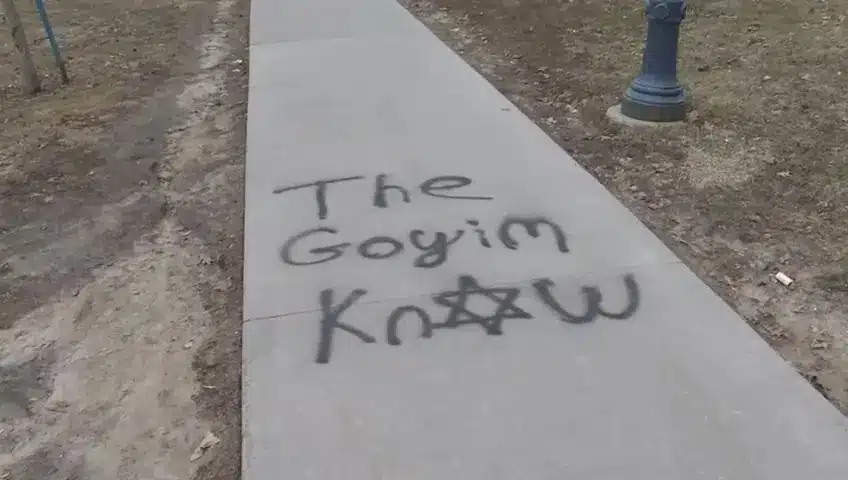
Three words are all it takes to accuse an entire people of secretly manipulating governments, economies, and the media.
“The goyim know” packages one of antisemitism’s oldest conspiracy theories into a phrase built for the internet age.
That conspiracy ran through Robert Bowers’s online posts before he walked into the Tree of Life synagogue in Pittsburgh and murdered eleven Jews at Sabbath prayer in October 2018. At his trial, an FBI analyst told jurors that Bowers used the word “oven” 21 times, a slur for Jews 87 times, and the word “Jews” 152 times across the Gab posts and reposts presented by prosecutors.
The phrase has surfaced at a major white supremacist rally, and the conspiracy behind it has appeared in organized harassment campaigns targeting Jews. By 2026, less overt versions of the same conspiracy had begun entering mainstream online discourse, repackaging the accusation in language that could more easily pass as ordinary slang. This article explains what “The goyim know” means, how it spread, and how that conspiracy has surfaced in both online rhetoric and real-world violence.
What does “The goyim know” mean?
“The goyim know” is an antisemitic meme built around an imagined moment of discovery. The “goyim,” the Hebrew and Yiddish term for non-Jews, have caught a Jewish speaker in the act. The phrase typically appears alongside an offensive caricature of a Jewish man, often shown talking on a phone or looking shocked, and is sometimes extended to “The goyim know, shut it down,” casting the speaker as a conspirator scrambling to conceal a plot that has been exposed.
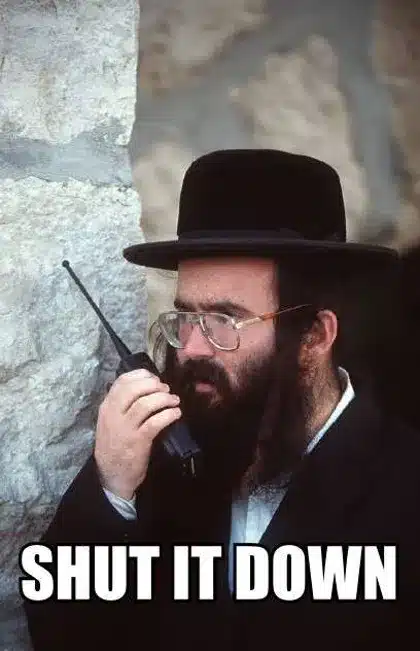
The scene describes no real event. It follows a familiar conspiratorial script in which only Jewish concealment keeps “the goyim” from the truth. By implying the accusation rather than stating it outright, the phrase functions as an effective dog whistle in far-right spaces.
If “goyim” is a normal Hebrew word, why is “the goyim know” antisemitic?
The antisemitism lies in the conspiracy built around the word. “Goy” and its plural “goyim” are ordinary Hebrew and Yiddish terms for a non-Jew or non-Jews, descriptive rather than derogatory. White supremacists have weaponized the word by speaking in an imagined Jewish voice, turning the conspiracy theory into a supposed Jewish admission.
How did “The goyim know” spread?
The phrase gained traction on message boards such as 4chan and 8kun, formerly known as 8chan, and circulated more broadly online. It also crossed into other forms of extremist culture, including an antisemitic song parody bearing the same name.
At the August 2017 “Unite the Right” rally in Charlottesville, Virginia, attendees carried signs reading “The goyim know.” The meme had moved from online spaces into public view at what ProPublica described as the largest public gathering of white supremacists in a generation. The rally culminated in a man driving his car into a crowd of counter-protesters, killing Heather Heyer.
What conspiracy theory is behind “The goyim know”?
“The goyim know” did not invent the myth of a secret Jewish cabal. It recycles the central claim of one of the most notorious antisemitic forgeries in modern history, The Protocols of the Elders of Zion.
The Protocols first appeared in the Russian Empire in 1903 and purported to document secret meetings in which Jewish leaders conspired to control world politics, finance, and the media. Those meetings never took place. By the early 1920s, the text had been exposed as a fraud, with much of it traced to an 1864 French political satire that never mentions Jews. The Nazis circulated the forgery anyway.
Joseph Goebbels, who would go on to run Nazi propaganda, wrote in his 1924 diary that the Protocols were a forgery but that he believed in their “intrinsic but not the factual truth.” Knowing it was false did not stop him from believing the conspiracy behind it. The Nazi regime went on to promote the Protocols as part of the antisemitic propaganda that accompanied the persecution and murder of Europe’s Jews. The forgery has outlived its exposure. Brandeis historian Stephen Whitfield has written that “no outright forgery in modern history has ever proved itself more durable,” and it still circulates on the political right’s fringe.
“The goyim know” compresses that conspiracy into three words for a social media era, stripped of its footnotes but not its central lie.
Has this conspiracy remained online, or has it surfaced in real-world violence?
It has not stayed online. Twice in six months, versions of it turned up in the writings of men who went on to attack synagogues.
In the weeks before October 27, 2018, Robert Bowers filled his Gab account with antisemitic conspiracy theories. In one post, he wrote, “The goyim know. This is becoming increasingly obvious. Eventually it will not be safe here for you and you will be unable to leave.” His profile called Jews “the children of Satan,” and he posted an image of a body burning in a Holocaust crematorium, captioned “Make Ovens 1488°F Again.” He accused Jews of orchestrating immigration into the United States, echoing the “Great Replacement” theory. Two hours before the massacre, he wrote that the Jewish refugee-aid nonprofit HIAS “likes to bring invaders in that kill our people. I can’t sit by and watch my people get slaughtered. Screw your optics, I’m going in.”
Bowers went on to attack the Tree of Life synagogue, killing eleven worshipers. According to the federal criminal complaint, he told a law enforcement officer, in substance, “They’re committing genocide to my people. I just want to kill Jews.”
Six months later, John Earnest opened fire at the Chabad of Poway synagogue near San Diego, killing Lori Gilbert-Kaye and wounding three others. Shortly before the attack, an open letter posted online under his name had cited Bowers, along with the Christchurch mosque shooter, as inspiration. In a 911 call played in court, Earnest said he was “defending my nation against the Jewish people, who are trying to destroy all white people,” a version of the conspiracy Bowers had promoted. By citing Bowers as an inspiration, Earnest showed how an antisemitic worldview could pass from one attacker to the next.
How is this conspiracy being used by extremists today?
The clearest example is the Goyim Defense League (GDL), a neo-Nazi network that has taken the word “goyim” into the streets. Its propaganda promotes an accusation of outsized Jewish power over the media and the economy. Its leader, Jon Minadeo II, also operates GoyimTV, a streaming site where, as “Handsome Truth,” he hosts live shows with other neo-Nazis. GDL members distribute antisemitic flyers, hang banners from highway overpasses, disrupt city council meetings, and livestream stunts that include harassing Jews.
GDL’s 2024 “Name the Nose Tour” in Nashville ended in criminal cases. Police arrested member Ryan McCann and charged him with felony aggravated assault for striking a downtown bartender with a flagpole. Months later, a Davidson County grand jury indicted him over a previously unreported attack the night before, in which he kicked a 20-year-old Jewish man in a parking lot. A jury convicted McCann of civil rights intimidation and assault in that case, and the presiding judge, Steve Dozier, said in court that the trial was believed to be the first of its kind in Tennessee. Dozier sentenced McCann to three years in prison for the civil rights intimidation. McCann separately pleaded guilty to misdemeanor assault in the bartender case and received a nine-month sentence, for a combined three years and nine months.
Others linked to GDL have faced prosecutions of their own. One was convicted by a federal jury of communicating an interstate threat to kill Nashville’s district attorney. Another entered a Nashville Jewish community center disguised as an Orthodox Jewish man for a livestreamed stunt and was indicted on civil rights intimidation charges. In Canada, a man identified by intelligence officials as a participant in a GDL-linked Telegram channel pleaded guilty to hate speech and to manufacturing 3D-printed firearms.
Flyers tied to GDL have been found at homes from Northern California to Long Island, New York. In one Long Island case, the Jewish War Veterans reported, a flyer singled out current and former Jewish members of Congress. The record reaches well beyond online trolling.
Does using the phrase as a joke make it any less antisemitic?
No. The “just a joke” defense deserves a direct answer, because irony is what gives this rhetoric its plausible deniability.
Users insist the phrase is “just a joke,” “just irony,” or “just a word,” while those familiar with the code know exactly what it communicates. The accusation is the same whether delivered as a punchline or a sincere claim, and humor makes it easier to repeat and harder to challenge. Repetition, in turn, can make a claim feel familiar before anyone has stopped to examine it.
Bowers’s posts show how thin the defense is. He wrote “The goyim know” in earnest, before his attack. A phrase that reads as a joke on one screen and a threat on another has stopped being just a joke.
How is this conspiracy evolving today?
It is evolving toward softer language. According to The Forward, “the goyim are waking up,” a phrase that echoes the older meme, entered mainstream online discourse in 2026. It keeps the accusation, that people are finally uncovering something sinister about Jewish influence, and drops the overt hostility.
A related coinage, “goyslop,” pairs “goy” with “slop” and casts junk food as something Jews supposedly promote to make non-Jews unhealthy. Apparently originating on 4chan in 2016, it has since spread into online slang, and a high school student writing on Substack says “goy” and “goyslop” have become everyday vocabulary among young American men, many of whom have no idea what the words mean.
The risk lies in how ordinary these forms sound. “Goyslop” is now repeated by people who think they are joking about junk food, not invoking an antisemitic conspiracy tied to real-world violence.
The words will keep changing. The lie behind them is more than a century old, was exposed as a fabrication generations ago, and has still surfaced in the writings of men who went on to murder Jews at prayer. Every softened variant that slips past a reader’s guard carries that lie forward, finding a new way in.