|
Getting your Trinity Audio player ready...
|
This article is part of the Combat Antisemitism Movement’s series on “Globalize the Intifada.” For the full analysis of the slogan’s origins, ideology, and real-world consequences, see the pillar page.
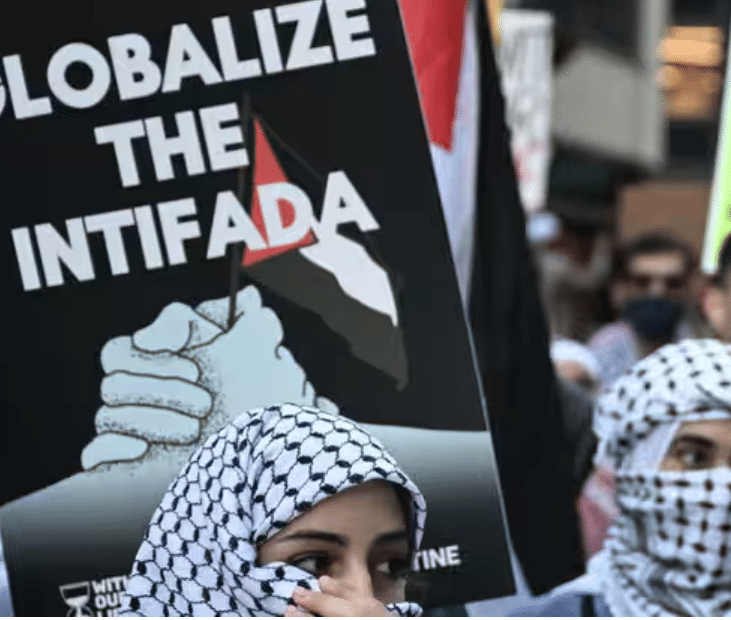
By late 2023, “Globalize the Intifada” had become a fixture of campus activism in the United States, Canada, the United Kingdom, and Australia. What began as a fringe chant in street protests migrated into the center of student life, appearing at marches, in encampments, at student assembly meetings, and in organized demonstrations that Jewish students consistently described as threatening, exclusionary, and in multiple cases physically intimidating.
Campus Incidents: ‘Intifada’ as Intimidation
United States
New York University — October 2023
At a large demonstration near Washington Square Park, protesters displayed openly antisemitic imagery. One sign depicted a Star of David thrown into a trash can with the words “Please keep the world clean.” Video from the protest also captured chants of “globalize the intifada.”
Cooper Union — October 2023
Later that same day, protesters entered a Cooper Union academic building and pounded on the glass walls of the library while chanting “Globalize the Intifada.” Jewish students sheltered inside as staff locked the doors to prevent the crowd from forcing entry.
Jewish students at the Cooper Union college in NYC were locked inside a school library on Wednesday for their own safety as a pro-Palestinian rally moved through the building.
Protestors were seen banging on the doors while chanting "free, free Palestine."
These students… pic.twitter.com/Rd8SyjRBJN
— Combat Antisemitism Movement (@CombatASemitism) October 26, 2023
Rutgers University — April 2024
A Rutgers Student Assembly town hall descended into chaos when hundreds of protesters flooded the room and chanted “There is only one solution — intifada revolution,” “Long live the intifada,” and “Globalize the intifada.” Campus police escorted Jewish students and the university president out for safety. SJP also staged a separate protest directly outside the campus Chabad House, again chanting “Globalize the Intifada.” These incidents became the subject of federal civil rights litigation.
University of Pennsylvania — Late 2023 to Spring 2024
Protesters chanted “There is only one solution, intifada revolution” and “Long live the intifada,” vandalized campus buildings with intifada graffiti, praised Hamas, and circulated calls for a “global intifada.” Congressional testimony and university reports later documented more than one hundred related antisemitic incidents.
Columbia University — 2023 to 2024 Academic Year
By early 2024, “Globalize the Intifada” signs and chants appeared at most demonstrations. A Columbia University Senate report cited the slogan’s “divisive and threatening impact.”
Harvard University — November to December 2023
During a coordinated series of campus protests, demonstrators marched through Harvard University while chanting “Long live the Intifada” and “Globalize the Intifada,” carrying the slogans into academic spaces. Congressional hearings in December 2023 brought Harvard’s then-President Claudine Gay before the House Committee on Education and the Workforce to answer questions about campus antisemitism. She resigned in January 2024 amid the fallout.
Canada
McMaster University — May 2024
At a campus encampment, Ontario Member of Provincial Parliament Sarah Jama publicly shouted “Globalize the Intifada.” The statement drew national backlash and formal censure from provincial leadership.
United Kingdom
Multiple Universities — 2023 to 2024
Across British campuses, protesters chanted “Intifada till victory” and “Globalize the Intifada,” often in close proximity to Jewish students. The Union of Jewish Students filed multiple complaints, reporting that the chants created a hostile environment. UK authorities later warned that such slogans could constitute harassment when used in a threatening context.
Australia
University of Sydney — April to May 2024
At the University of Sydney’s “Gaza Solidarity Encampment,” “Globalize the Intifada” was written prominently on a central whiteboard and repeatedly rewritten as part of the protest’s messaging, embedding the slogan into daily campus life.
Across campuses, “Globalize the Intifada” functioned less as political speech than as a tool of intimidation, appearing in protests, marches, encampments, and institutional spaces. For Jewish students, its repeated use — often alongside explicit praise for violence or exclusionary imagery — contributed to an atmosphere in which ordinary academic life became charged with hostility and threat.
The Pattern Across These Incidents
Across all these cases, several patterns were consistent.
Institutional Failure — In most cases, university administrations responded inadequately, inconsistently, or not at all. Students who reported feeling targeted were told, in effect, that their experience did not meet the threshold for institutional action. This failure did not just fail Jewish students. It communicated to the wider campus community that deploying the slogan carried no meaningful cost.
Legal Consequences — Multiple incidents became the subject of civil rights complaints, congressional testimony, and federal investigations under Title VI of the Civil Rights Act. The Department of Education opened investigations into several institutions, establishing that campus environments characterized by sustained “Globalize the Intifada” rhetoric were potentially violating Jewish students’ civil rights.
Proximity and Targeting — The slogan was chanted outside library doors where Jewish students were sheltering, inside student governance meetings, at encampments occupying shared campus space, during marches through academic buildings, and directly outside campus Jewish spaces including Chabad houses. The placement ensured Jewish students could not avoid it.
For Jewish students at these institutions, “Globalize the Intifada” was a direct threat, delivered in their classrooms, their libraries, and their campus commons, by people who had been provided in advance with a toolkit explaining exactly how to use it.
But the intimidation did not stop at campus gates. By 2025, “intifada” rhetoric moved beyond campuses and protests and appeared directly at synagogue doors.
Continue Reading:
- The Intifadas: The Terror Campaigns Behind ‘Globalize the Intifada’
- The Organizations Behind ‘Globalize the Intifada’ and the Campaign to Target Israel and America
- The Terror Network Behind ‘Globalize the Intifada’
- Synagogues Under Siege: ‘Globalize the Intifada’ at Synagogue Doors
- Zohran Mamdani: When ‘Globalize the Intifada’ Reaches Elected Office
- The Bondi Beach Hanukkah Massacre: When ‘Globalize the Intifada’ Became Reality
- Cultural Incitement: How ‘Globalize the Intifada’ Entered Music, Fashion, and Art