|
Getting your Trinity Audio player ready...
|
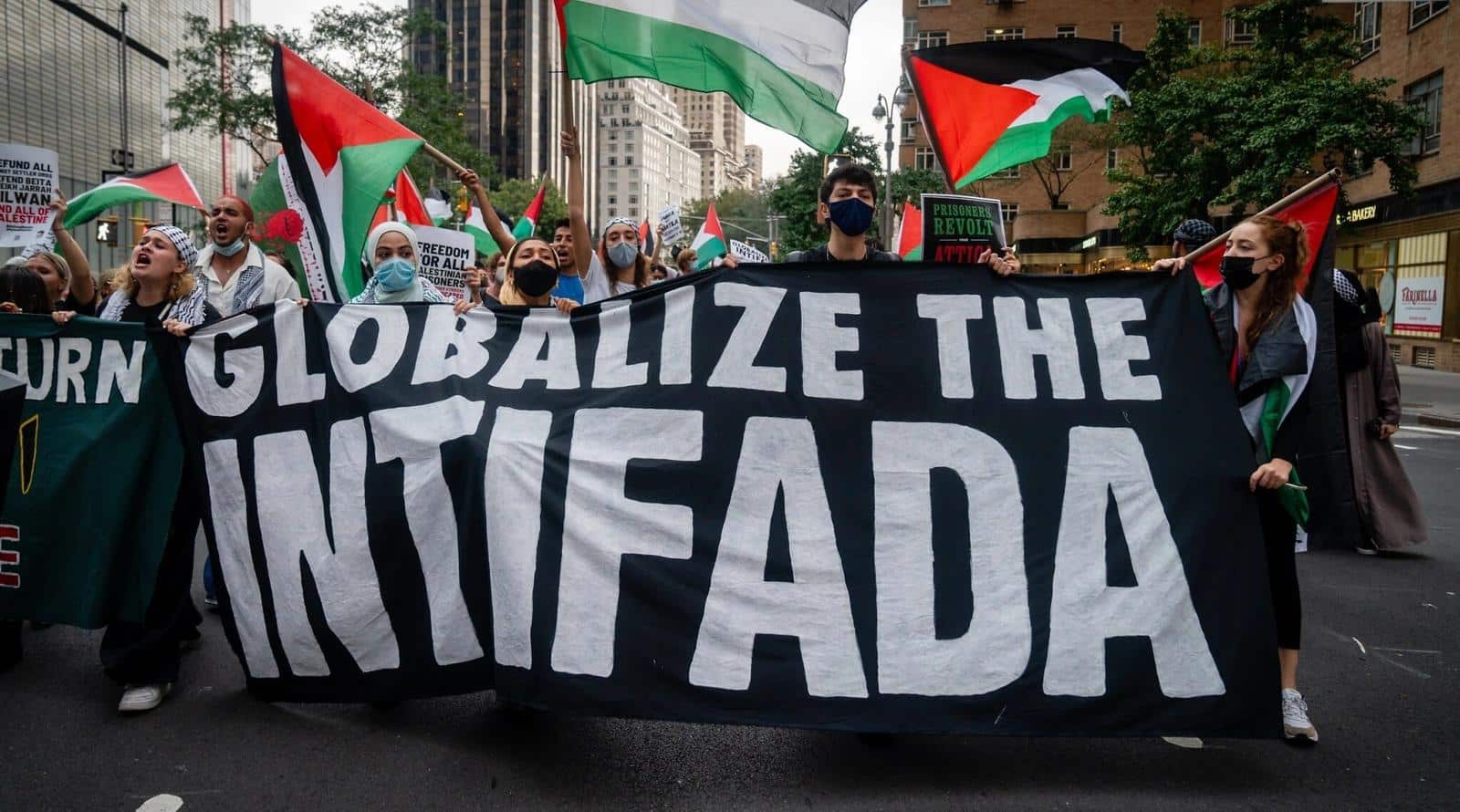
Few slogans so explicitly invoke organized violence against Jews as the call to “Globalize the Intifada.” The meaning of the slogan is inseparable from the history it invokes. The Arabic word intifada literally translates as “uprising” or “shaking off.” In contemporary political usage, it refers to two named campaigns of organized violence that deliberately targeted Israeli civilians through mass-casualty terror attacks. To demand the globalization of the intifada is therefore to call for the export of this model of violence — its tactics, its logic, and its targeting of Jews — beyond Israel and into Jewish life worldwide.
What Does “Globalize the Intifada” Mean?
“Globalize the Intifada” is a call to take the organized, deliberate violence of the Palestinian intifadas and replicate it against Jews everywhere. The intifadas were sustained campaigns of terror that killed approximately 1,200 Israelis across both campaigns and turned ordinary daily life into a source of constant fear.
Is “Globalize the Intifada” a Call for Violence?
Yes. Within Our Lifetime, the organization that launched the campaign, published a manifesto explicitly endorsing “liberation by any means necessary” to “break free from the genocidal grip of U.S. imperialism and Zionism.” The manifesto designated New York City a “theater of operations” and framed confrontation with Jewish and American institutions as ideological, intentional, and justified. It was designed and deployed as a call to replicate the violence that defined the second intifada specifically against Jewish communities worldwide.
What Were the First and Second Intifadas?
The First Intifada (1987–1993)
The First Intifada began in December 1987 as a widespread Palestinian uprising marked by riots, strikes, civil unrest, and escalating violence against Israeli civilians and security forces. The uprising escalated into shootings, stabbings, grenade assaults, Molotov cocktail attacks, and other acts of terror. Approximately 200 Israelis were killed during the violence. The uprising also helped propel Hamas from a newly founded Islamist movement into a central actor in Palestinian terrorism.
The Second Intifada (2000–2005)
The Second Intifada erupted in September 2000 and became one of the deadliest terror campaigns in Israeli history. Terrorist organizations carried out a sustained campaign of suicide bombings, shootings, and coordinated attacks targeting Israeli civilians in buses, restaurants, markets, hotels, and shopping districts. More than 1,000 Israeli civilians were murdered and thousands more were wounded. Ordinary errands could become fatal miscalculations. Boarding a bus, stopping for lunch, walking through a market, celebrating a holiday, or dropping children off at school required constant vigilance. No place felt reliably safe, and no routine could be trusted.
The Attacks That Defined the Second Intifada
The campaign included some of the most notorious terror attacks in modern Israeli history. In June 2001, a suicide bomber murdered 21 teenagers and injured over 130 others outside the Dolphinarium discotheque in Tel Aviv. Two months later, a suicide bomber killed 16 people, including seven children, at Jerusalem’s Sbarro pizzeria. During Passover in 2002, a suicide bombing at the Park Hotel in Netanya killed 30 people during a seder, while injuring 140 others.
“Globalize the Intifada” draws directly from this history of mass-casualty attacks against civilians. The groups that popularized it knew precisely what they were endorsing.
What Organizations are Behind “Globalize the Intifada”?
“Globalize the Intifada” emerged in the United States in 2021 through a coordinated activist campaign centered in New York-based networks.
Within Our Lifetime (WOL): The Group That Launched “Globalize the Intifada”
Within Our Lifetime (WOL) was the central organization behind the effort to transform “Globalize the Intifada” into a coordinated movement. Its founder, Nerdeen Kiswani, has stated that “abolishing Israel is the key to peace” and dismissed Israel as “a Zionist settler entity masquerading as a country.” At a campaign rally in July 2021, she told the crowd: “I hope that a ‘pop-pop’ is the last noise that some Zionists hear in their lifetime.”
Samidoun, the PFLP, and the Terror Network Behind “Globalize the Intifada”
Samidoun – the Palestinian Prisoner Solidarity Network promoted WOL’s inaugural rally and helped extend the slogan internationally. Multiple democratic governments have identified the organization as operating on behalf of the Popular Front for the Liberation of Palestine (PFLP). The United States, the European Union, Canada, and Israel all designate the PFLP as a terrorist organization. The United States and Canada designated Samidoun under their counterterrorism frameworks. Germany banned and dissolved the organization’s activities domestically. In October 2024, the U.S. Department of the Treasury designated Samidoun and Khaled Barakat under its global terrorism sanctions authorities. The designation described Samidoun as a “sham charity” serving as an international fundraiser for the PFLP. Treasury found that “Samidoun and Barakat play critical roles in external fundraising for the PFLP.”
From its earliest public rollout, the slogan was amplified through infrastructure linked to a designated terrorist organization.
How “Globalize the Intifada” Entered Mainstream Activism
A wider ecosystem of organizations helped amplify the message and mobilize supporters, pushing its messaging into campuses and protest circles across the country. This included Students for Justice in Palestine, Jewish Voice for Peace, CODEPINK, the Palestinian Youth Movement, The People’s Forum, Al-Awda, and the ANSWER Coalition.
Jewish Voice for Peace played a distinctive role within this landscape. By presenting itself as a Jewish organization, it helped normalize rhetoric widely recognized as antisemitic, granting the campaign a veneer of moral authority it could not have achieved on its own.
How “Globalize the Intifada” Became an Organized Campaign
One of the earliest documented public uses of the slogan in New York City appeared on June 11, 2021, during a demonstration outside the Museum of Modern Art (MoMA) in Manhattan. Protesters marched with banners reading “Globalize the Intifada” and chanted, “From New York to Gaza! Globalize the Intifada!” while framing MoMA as part of a broader anti-imperialist and “decolonization” struggle extending beyond Israel itself.
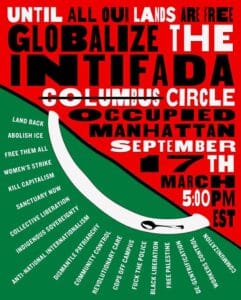
By September 2021, the rhetoric had become even more explicit and ideologically expansive. Protest materials distributed under the banner “Occupied Manhattan” crossed out “Columbus Circle” and reframed Manhattan itself as occupied territory. The imagery promoted “Globalize the Intifada” alongside slogans including “Abolish Zionism,” “From the River to the Sea,” “Land Back,” “Kill Capitalism,” “Collective Liberation,” and “Defund the Police,” embedding anti-Zionist activism within a broader revolutionary ideological framework.
The “Globalize the Intifada” Manifesto and the Global Expansion of the Campaign
WOL’s manifesto presented “Globalize the Intifada” as a transferable strategy directed at American institutions. It cast the United States as “the belly of the beast,” called for confrontation “at the heart of empire,” and described New York City as a “theater of operations,” reframing American cultural and civic spaces as occupied territory. The manifesto framed escalation and confrontation inside the United States as legitimate and necessary forms of political struggle.
WOL released a set of standardized chants designed to convert the slogan into a reproducible protest infrastructure. Accompanying materials instructed activists to conceal their identities and avoid contact with law enforcement.
Has “Globalize the Intifada” Led to Real-World Violence Against Jews?
Yes. The slogan moved from activist networks into campuses, synagogue doors, elected office, and ultimately a massacre at a Hanukkah celebration on Bondi Beach in Sydney, Australia.
From 2022 onward, the slogan spread from activist circles into mainstream civic spaces, campuses across four countries, and cultural platforms reaching millions. It became a standard instrument of campus intimidation, trapping Jewish students in locked buildings and forcing university presidents out of student assembly meetings.
Celebrating the October 7 Massacre in Times Square
Less than 24 hours after the deadliest massacre of Jews since the Holocaust, the atrocities of October 7 were not condemned, they were celebrated. The massacre was not treated as an atrocity to condemn, but as a model to defend, expand, and surpass. On the day of the massacre, WOL declared: “We must defend the Palestinian right to resist zionist settler violence and support Palestinian resistance in all its forms. By any means necessary. With no exceptions and no fine print.”
In the weeks that followed, WOL published maps identifying dozens of Jewish and pro-Israel organizations across New York City as targets with “blood on their hands,” urging supporters to “KNOW YOUR ENEMY.” A second map labeled Israeli and American companies, financial institutions, and transit hubs as “offices of an enemy,” expanding the campaign from rhetoric into organized confrontation against Jewish and civic institutions across New York.
Two years later, on the October 7, 2025 anniversary of the massacre, organizers returned to Times Square and declared, “We did not act enough,” urging supporters to “show up stronger than we did the first October 7th” and “louder than we did the first October 7th.”
A Pogrom in Amsterdam
In November 2024, Amsterdam experienced one of the most disturbing eruptions of antisemitic violence in post-war European history. Following a UEFA match between Ajax and Maccabi Tel Aviv, mobs poured into the streets, chased Israeli fans, assaulted them in alleyways, and carried out coordinated attacks across the city center. Attackers gave Nazi salutes, shouted antisemitic abuse, and boasted they were “looking for Jews.” Dutch officials condemned the events as a pogrom.
The “Globalize the Intifada” slogan was not chanted. It did not need to be. The ideology behind it had already taught people across continents to view Jews as legitimate targets.
Synagogues Surrounded in New York and London
In November 2025, approximately 200 protesters organized by Al-Awda, a group with documented ties to Samidoun, surrounded Park East Synagogue in Manhattan during a Nefesh B’Nefesh aliyah event. Demonstrators chanted “From New York to Gaza, globalize the intifada,” “Death, death to the IDF,” and “Resistance, you make us proud, take another settler out.” One protester repeatedly shouted “We need to make them scared!” The crowd took the call up in unison. Jewish attendees faced explicit antisemitic abuse at the entrance, including slurs, and anti-Jewish tropes that have for centuries fueled violence against Jewish communities.
That same weekend in London, protesters surrounded a synagogue during a separate aliyah event and blocked Jewish attendees from leaving. Demonstrators shouted that those inside “kill children.”
One week after Zohran Mamdani took office as mayor of New York City, the same network organized a protest near a Queens synagogue. Demonstrators chanted “We support Hamas here.” The protest forced the early closure of a daycare and two elementary schools in the surrounding neighborhood.
Al-Awda returned to Park East six months later. A Hezbollah flag was visible in the crowd. One protester beat her fist against an image of the Lubavitcher Rebbe affixed to a crossing signal outside the synagogue. An NYPD officer was hospitalized. That same week, protesters waving a Hezbollah flag and chanting “Globalize the intifada” and “Death to the IDF” marched outside the Young Israel of Midwood. An elderly man was shoved to the ground. Multiple protesters were arrested.
The Bondi Beach Hanukkah Massacre
Language that glorifies terror never stays rhetorical. It becomes violent. On the first night of Hanukkah in December 2025, attackers opened fire on “Hanukkah by the Sea,” a public celebration organized by Chabad on Sydney’s Bondi Beach. At least 15 people were killed and dozens more were wounded. Law enforcement classified the assault as terrorism and confirmed the attackers explicitly targeted the Jewish gathering.
The victims included a Chabad rabbi, a young child, and a Holocaust survivor.
The attackers did not target political activists or government officials. They targeted Jews gathered to celebrate on the first night of a holiday. Bondi Beach exposed the slogan’s final meaning in blood.
Does “Globalize the Intifada” Meet the IHRA Definition of Antisemitism?
Yes. “Globalize the Intifada” meets the International Holocaust Remembrance Alliance (IHRA) Working Definition of Antisemitism on multiple grounds. The IHRA definition is the standard used by democratic governments, security agencies, universities, and institutions worldwide to identify antisemitism.
First, it endorses violence against Jews. The IHRA definition holds that justifying or promoting harm against Jews constitutes antisemitism. This slogan invokes organized campaigns of mass-casualty attacks targeting Jewish civilians and demands their replication against Jews globally.
It also treats Jewish identity as grounds for collective targeting. The IHRA definition identifies holding Jews collectively responsible for the actions of Israel as antisemitic. “Globalize the Intifada” designates Jewish people everywhere as targets for violence regardless of nationality, political views, or religious practice. The rabbi, the child, and the Holocaust survivor at Bondi Beach were not targeted for their politics. They were targeted for being Jewish.
Finally, the slogan is not criticism of Israeli policy. The IHRA definition expressly protects criticism of Israeli government actions. “Globalize the Intifada” names no policy, proposes no reform, and requires no engagement with Israeli governance whatsoever.
Have Governments Treated “Globalize the Intifada” as Incitement?
A U.S. Congressional Resolution Identified “Globalize the Intifada” as Incitement
On July 17, 2025, a bipartisan group of U.S. lawmakers introduced H. Res. 588, the first congressional resolution explicitly addressing the chant “Globalize the Intifada.” Lead sponsors Representatives Rudy Yakym and Josh Gottheimer identified it as “a call to violence against Israeli and Jewish people across the world.” The resolution urges officials at every level of government to condemn the chant. It calls for treating its use as a threat indicator when assessing risks to Jewish institutions and public safety. Representative Gottheimer warned, “Words like these incite violence, fuel hate, and put Jewish families at risk.”
New South Wales Moves to Restrict “Globalize the Intifada” After Bondi Beach
Following the Bondi Beach massacre, New South Wales Premier Chris Minns announced proposed legislation restricting public use of “Globalize the Intifada.” Under the proposal, police could ban the chant alongside extremist symbols, shut down unauthorized demonstrations using it, and require protesters to remove face coverings. The proposed measures treated the slogan as extremist incitement, not protected speech. It was the most direct legislative response to the phrase by any government to date.
The New York City Mayor Who Refused to Condemn “Globalize the Intifada”
Zohran Mamdani took office as mayor of New York City on January 1, 2026, having refused throughout his campaign to condemn ‘Globalize the Intifada’ and having responded to the Park East synagogue targeting not by addressing the abuse of Jewish attendees, but by condemning the aliyah event inside as “a violation of international law.”
On his first day in office, Mamdani revoked New York City’s adoption of the IHRA Working Definition of Antisemitism, rescinded anti-BDS restrictions on city agencies, and eliminated safeguards limiting protest activity at or near synagogues and houses of worship. He removed every protection built to shield Jewish communities from the kind of intimidation witnessed at Park East within hours of taking office.
The mayor of the largest Jewish city outside Israel was legitimizing a slogan calling for violence against Jews worldwide.
What Are the Consequences of Normalizing “Globalize the Intifada”?
The intifadas were organized campaigns of mass murder targeting Jewish civilians. The organizations that carried them out celebrated every attack as they planned the next one. The slogan ‘Globalize the Intifada’ did not emerge despite this history. It emerged because of it.
For survivors of bus bombings and café attacks, for their families, for Jewish communities worldwide that watched on television, the call to ‘globalize the intifada’ is not a political slogan. It is an explicit threat to replicate the worst years of their lives to Jewish communities everywhere.
History has already shown what an intifada means. Allowing its globalization is complicity.
Go Deeper
Each article below explores one part of the “Globalize the Intifada” campaign in greater depth.
- The Intifadas: The Terror Campaigns Behind ‘Globalize the Intifada’
- The Organizations Behind ‘Globalize the Intifada’ and the Campaign to Target Israel and America
- The Terror Network Behind ‘Globalize the Intifada’
- ‘Globalize the Intifada’ on Campus: How the Slogan Became a Weapon Against Jewish Students
- Synagogues Under Siege: ‘Globalize the Intifada’ at Synagogue Doors
- Zohran Mamdani: When ‘Globalize the Intifada’ Reaches Elected Office
- The Bondi Beach Hanukkah Massacre: When ‘Globalize the Intifada’ Became Reality
- Cultural Incitement: How ‘Globalize the Intifada’ Entered Music, Fashion, and Art