|
Getting your Trinity Audio player ready...
|
In April 2026, Jewish institutions across thirteen countries and five continents were desecrated, shot at, firebombed, stormed, and threatened with guns and explosives. Synagogues, schools, cemeteries, Holocaust memorials, Jewish-owned businesses, and sites of mourning were all targeted within one month.
The Antisemitism Research Center (ARC) by CA documented at least 24 such attacks and acts of intimidation, evidence that antisemitic violence targeting Jewish institutions, the centers of Jewish communal life, is sustained, global, and accelerating.
The incidents spanned the United States, Canada, Australia, the United Kingdom, France, Germany, the Netherlands, North Macedonia, Romania, Greece, Estonia, Brazil, and Azerbaijan. The attacks ranged from swastikas spray-painted on synagogue walls to an Islamic Revolutionary Guard Corps (IRGC) plot to bomb a synagogue and assassinate a Jewish community leader. What connects them is not ideology, nationality, or method. It is the target.
Europe: The Echoes of Kristallnacht Are Growing Louder
United Kingdom
Against a backdrop of sustained antisemitic violence across Britain since October 7, 2023, April brought a sharp escalation. On March 23, four Hatzola ambulances had been set ablaze in Golders Green. By April, Jewish institutions themselves were burning.
On April 15, two masked individuals planted firebombs at Finchley Reform Synagogue. The devices failed to ignite. Counter-terrorism specialists joined the investigation. Two suspects were arrested.
A few days later, arsonists firebombed Kenton United Synagogue, a Modern Orthodox congregation in northwest London.
On April 19, a fire door at a Jewish-owned shop in Watford, Hertfordshire was set on fire and antisemitic graffiti was left on the building. Police classified it as religiously aggravated and were seeking a group of young men seen in the area at the time.
On April 29, two Jews were stabbed in a terror attack in Golders Green, one of London’s most prominent Jewish neighborhoods. One victim was reported in critical condition. The terrorist was arrested at the scene.
France
On April 4, in a suburb of Paris, a man hammered on the door of a Jewish family’s apartment at 3:30 in the morning, threatening to “repeat October 7” and to “exterminate” the family. French authorities opened an investigation for repeated death threats due to religion.
North Macedonia and the Netherlands
On April 12, two individuals set fire to the door of a synagogue and Jewish community building in Skopje, North Macedonia, before fleeing.
🇲🇰 Skopje, North Macedonia, April 12, 2026: According to local reports, an arson attack targeted the entrance of a synagogue and Jewish community building early this morning.
Two individuals set fire to the door before fleeing. pic.twitter.com/DJBVSa7ax3
— Combat Antisemitism Movement (@CombatASemitism) April 12, 2026
On April 16, demonstrators stood outside the synagogue in Groningen, Netherlands and chanted calls for “intifada,” a violent uprising against Jews.
Germany
On Friday, April 25, an antisemitic inscription was found on the Cottbus synagogue. Three days later, before dawn on Monday April 28, the same synagogue was defaced with a painted swastika, the second attack in four days. Police could not remove the marking even with fire department assistance. Both incidents were transferred to state security. On Sunday April 27, in Berlin’s Pankow district, apartment buildings were found covered in graffiti reading “Kill all Jews,” alongside a swastika and the words “Only a dead Jew is a good Jew.”
Canada: Four Attacks, One City, One Month
Toronto recorded four antisemitic attacks on Jewish institutions in April, making it among the most heavily targeted Jewish communities documented during the period.
On the second night of Passover, a Jewish-owned restaurant was struck by 14 bullets in what police investigated as a hate-motivated shooting. It was the second attack on the same restaurant chain in consecutive months. No arrests were made.
On April 13, a hooded individual captured on surveillance footage knocked down the menorah outside the Yorkville Jewish Center. The center published the footage and responded: “They knocked it down. We’re going to build it bigger.”
On April 25, a male suspect attempted to force entry into the Sephardic Kehila Centre in Thornhill during Shabbat morning services. He told security he was Middle Eastern and was not there to attend services. Security turned him away. He then encountered a congregant walking to the synagogue with his son, blocked their path, and punched the man in the face from behind. York Regional Police’s Hate Crime Unit opened an investigation.
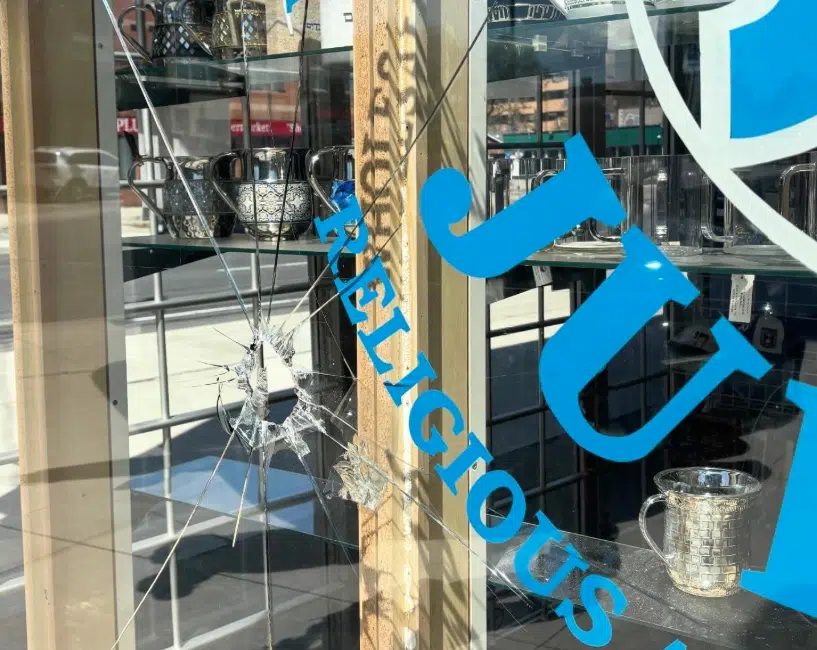
On April 26, attackers hurled a rock through the front window of Aleph Bet Judaica on Bathurst Street. It was the third targeting of the same store.
United States: From Threats to Closures
On April 9 in Colorado Springs, an unknown caller threatened to arrive at Temple Shalom with an AR-15 and a pipe bomb and “shoot and blow the place up.” Rabbi Jay Sherwood’s response captured the state of Jewish institutional life in America with precision. “What goes through my mind is that this is strangely normal,” he said. “When a threat comes in like this, unfortunately, it’s not shocking to me. It’s scary. It’s horrible. It’s terrible. But it’s not a shock anymore.”
On April 17 in Minneapolis, chalk graffiti appeared outside the University of Minnesota’s Chabad Jewish Student Center following a demonstration against an Israeli soldier’s speaking event.
On April 22 in Houston, Congregation Beth Israel, the oldest Jewish congregation in Texas, home to 1,500 families, closed alongside the adjacent Shlenker School, a preschool and elementary school. Both shut after receiving threats communicated through the Houston Police Department. The FBI joined the investigation. Law enforcement increased patrols at Jewish institutions across the city.
That same morning in Oak Park, Michigan, staff at Congregation Beth Shalom arrived to find a swastika spray-painted on the building. Rabbi Robert Gamer said the congregation was disgusted. “It’s not a matter of if it’s going to happen,” he said. “It’s when.”
In Hot Springs, Arkansas, antisemitic graffiti reading “No peace as long as Israel exists” was discovered on Congregation House of Israel.
On April 23, in Austin, Texas, Congregation Beth Israel was vandalized with a swastika and antisemitic graffiti, including “Death to Israel.”
Australia: A Community Still Grieving, Targeted Twice
Fifteen were murdered at a Hanukkah celebration on Bondi Beach in Sydney in December 2025. In April 2026, their community was targeted again. Twice.
On April 11, vandals defaced the memorial site at Bondi Beach near a plaque for the massacre victims, scrawling “F*** Israel” steps from where flowers were still being laid.
On April 29, the “Concert for Hope and Unity,” a benefit concert in Sydney, Australia, for victims of the Bondi Beach Hanukkah massacre was canceled after a Greek choir refused to perform alongside a Jewish ensemble. Some members said they did not feel safe sharing a stage with Jews.
Azerbaijan: Iran’s State Terror Reached a Synagogue Door
Iran’s Islamic Revolutionary Guard Corps (IRGC) planned simultaneous attacks against Jewish and Israeli targets in Azerbaijan, including the Israeli embassy, a synagogue, and Jewish community leaders. The plot also targeted the Baku-Tbilisi-Ceyhan oil pipeline, which carries around a third of Israel’s oil imports. Authorities seized nearly eight kilograms of C-4 explosives and detained at least seven Azerbaijani nationals. The cell was identified as part of a broader global Iranian network targeting Jewish and Israeli sites worldwide.
Brazil: A Jewish Cemetery Desecrated with Pig Heads
In Porto Alegre, pig heads were thrown in front of a Jewish cemetery, an act of deliberate desecration that Brazil’s Racism Law classifies as a criminal offense carrying a prison sentence.
To Dishonor the Dead Is to Threaten the Living
Vandals desecrated a Jewish cemetery in Reghin, Romania, just ahead of Yom HaShoah, Israel’s national Holocaust remembrance day, toppling 14 gravestones. Israeli Knesset Member and former Defense Minister Benny Gantz, whose great grandfather is buried at the cemetery, said he had been informed of the incident by Romanian Ambassador to Israel Radu Ioanid. “Antisemitism knows no bounds nor has faded with time,” Gantz wrote.
On Yom HaShoah itself, the Jewish cemetery in Volos, Greece was defaced with hateful and threatening messages.
A few days later, in Ereda, Ida-Viru County, Estonia, vandals extensively damaged the Holocaust memorial at the site of the Ereda concentration camp, where thousands of Jews were murdered by German occupying forces between 1941 and 1944. Parts of the monument were broken, dented, and physically dismantled.
To target Jewish memorial sites on the day the world mourns the six million Jews who were slaughtered by Nazis is not only to dishonor the dead. It is to threaten the living.